
The moment that separates a good bespoke engagement ring from a disappointing one happens before any metal is cut, before any stone is set, and before most buyers even realise a decision is being made. It happens at the wax approval stage, when the jeweller produces a resin or carving wax model of the ring and asks the buyer to slip it onto the intended finger. That five-second moment reveals proportions, scale, weight distribution, and how the setting actually sits against the knuckle — none of which a CAD render shows accurately and none of which the buyer can assess from photographs. Hatton Garden is one of the few jewellery quarters in the UK where the full brief-to-handover commission sequence still runs through a single workshop, and the wax approval stage is the moment when that integrated process proves its value over any alternative.
The quarter in EC1N occupies a few hundred metres between Chancery Lane on the Central line and Farringdon on the Elizabeth line, with over 300 jewellery businesses trading in that compressed area. Workshop spaces cluster on the upper floors of buildings along Hatton Garden itself, Greville Street, and Leather Lane, and the density means that a bespoke commission rarely needs to travel more than a short walk between the designer’s bench, the caster’s workshop, the setter, and the polisher. For a buyer commissioning a bespoke engagement ring, the physical proximity of every stage of the making is the structural reason the quarter produces the pieces it does.
What Bespoke Actually Means In A Hatton Garden Workshop
The word bespoke gets used loosely in the jewellery trade and means different things at different price points. At the entry level, a workshop might offer personalisation of a standard design, with the buyer choosing metal, centre stone, and setting style from a defined menu. That is semi-bespoke or customisation, and it is a perfectly reasonable service, but it is not what a Hatton Garden commission workshop means when they use the word.
Genuine bespoke work begins with an original brief, proceeds through sketched design concepts, moves to CAD modelling for proportion review, produces a wax or resin model for physical approval, casts the ring in precious metal using lost-wax casting, hand-finishes the cast piece at bench level, sets the stones in a specific sequence dictated by the design, and finishes with polishing and hallmarking. The piece exists nowhere until it is made for this buyer. Every decision, from the thickness of the shank in millimetres to the angle of the claws, is specified rather than selected from a catalogue.
The lead time for a genuine bespoke engagement ring in Hatton Garden typically runs from 6 to 10 weeks from design approval to collection, depending on complexity, stone sourcing, and workshop load. Commissions that involve sourcing a specific coloured stone from Ceylon or a Colombian emerald can extend meaningfully beyond that range. Buyers approaching the quarter for a Christmas or Valentine’s Day proposal should allow a clear 3-month buffer from first consultation to presentation.
The Consultation And Brief Stage
A bespoke commission begins with a consultation that typically runs 60 to 90 minutes. The designer needs to understand three distinct things: what the buyer wants, what the wearer wants, and what the piece needs to do in practice. These are often different.
The buyer usually arrives with reference images — pieces seen online, rings admired on a friend’s hand, a particular aesthetic lifted from a magazine. The designer works through those references to understand which elements are essential and which are incidental. A buyer who shows a halo setting with a cushion-cut centre stone might actually be drawn to the halo effect rather than the cushion cut, or might be drawn to the specific proportions of that particular ring rather than either element on its own. Teasing that apart is the first skill the designer brings.
The wearer’s practical considerations come next. Ring finger size, which is harder to measure accurately than many buyers expect, shifts seasonally and with temperature. The dominant hand — a right-handed wearer will knock an engagement ring against more surfaces than a left-handed one. Profession and lifestyle, because a wearer who types at a keyboard all day, plays a musical instrument, or works with their hands in ways that risk impact, will need to make choices that protect the centre stone. Allergies to specific metals, particularly nickel in lower-grade white golds. All of these shape the design decisions that follow.
The budget conversation happens in the same meeting and should be genuine. Hatton Garden bespoke commissions sit on a wide price range depending on the centre stone, metal, and complexity. An honest workshop will tell a buyer immediately if the desired design cannot be delivered within the stated budget, and will offer alternatives before the design stage commits both parties to an unrealistic trajectory.
The Design And CAD Stage
Hand-sketching remains the first design step in most Hatton Garden workshops. A designer produces two or three concept sketches based on the consultation brief, with the buyer selecting the direction that resonates most strongly. The selected concept then moves to CAD modelling, where the ring is built as a precise 3D model in software such as Matrix or RhinoGold.
The CAD render shows the buyer what the ring will look like from every angle in a way that sketches cannot. It confirms proportions, checks that the setting will hold the centre stone securely, and allows for precise adjustments at zero additional cost before any material is committed. A CAD render is a technical document as much as a visual one, because it generates the STL file that will drive the 3D printing of the resin or wax model that follows.
What the CAD render does not show is weight, scale in the hand, light performance on the centre stone, or how the finished piece will actually wear. A CAD render of a 2mm-wide shank looks identical to a 2.2mm-wide shank on screen, but the physical difference on a finger is immediately apparent. A CAD render shows a halo as a perfect ring of diamonds; the physical piece will reveal whether those accent stones are set at the exact same height, which is a setter’s skill rather than a CAD question. Buyers who approve a design at the CAD stage without seeing a physical model are relying on the workshop to catch issues that the software cannot reveal.
The Wax Model Stage
A good Hatton Garden workshop produces a physical model of the ring before casting in precious metal. The model is typically 3D-printed in castable resin or carved from jeweller’s wax, and it represents the final geometry of the ring at actual size and weight approximation. The buyer is invited back to the workshop to see it.
This is the moment that catches the buyer’s decisions that they would otherwise regret. The shank looks lighter on the finger than expected and needs thickening. The setting sits higher than the CAD render suggested and needs to be lowered. The centre stone looks smaller in the actual mount than in isolation and may need a visual weight adjustment through a wider shank or accent stones. None of these adjustments is unusual, and a good workshop expects them. The wax approval stage exists to surface those conversations before the piece commits to metal.
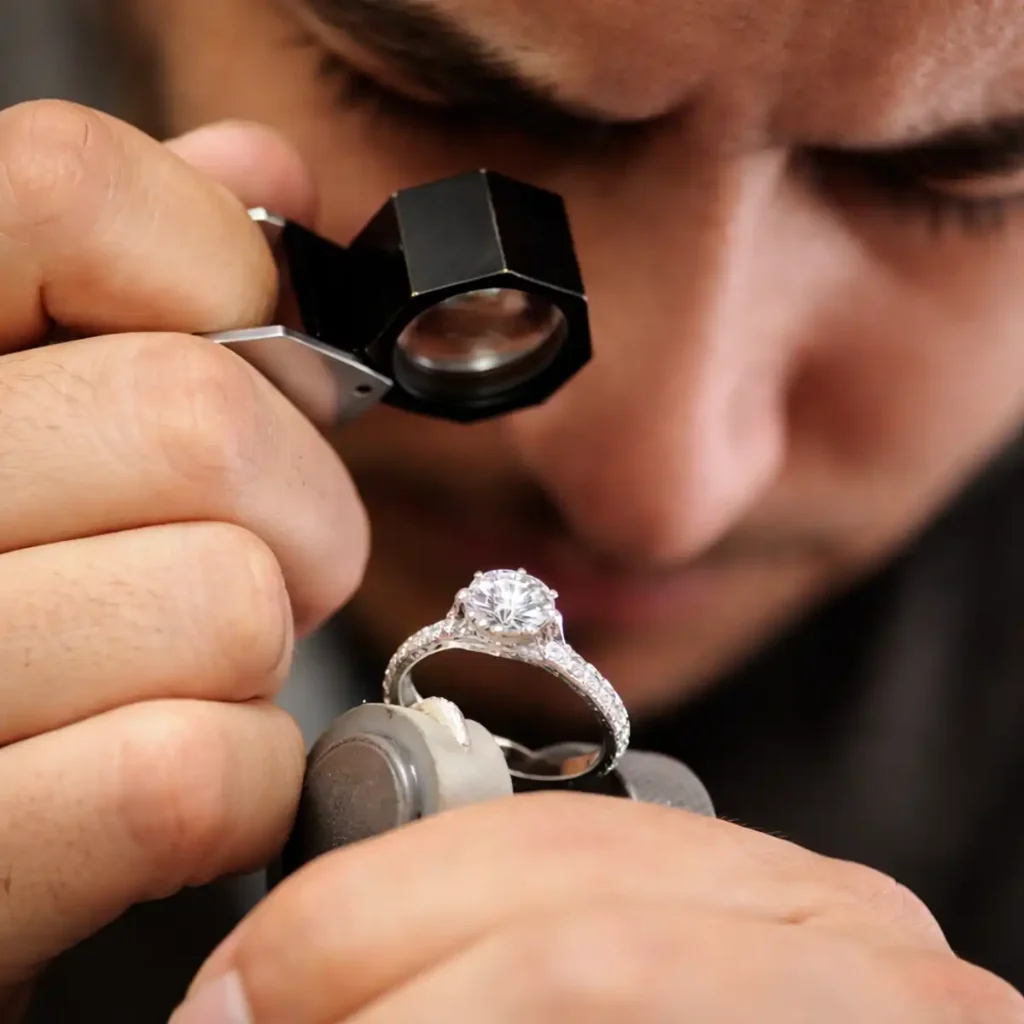
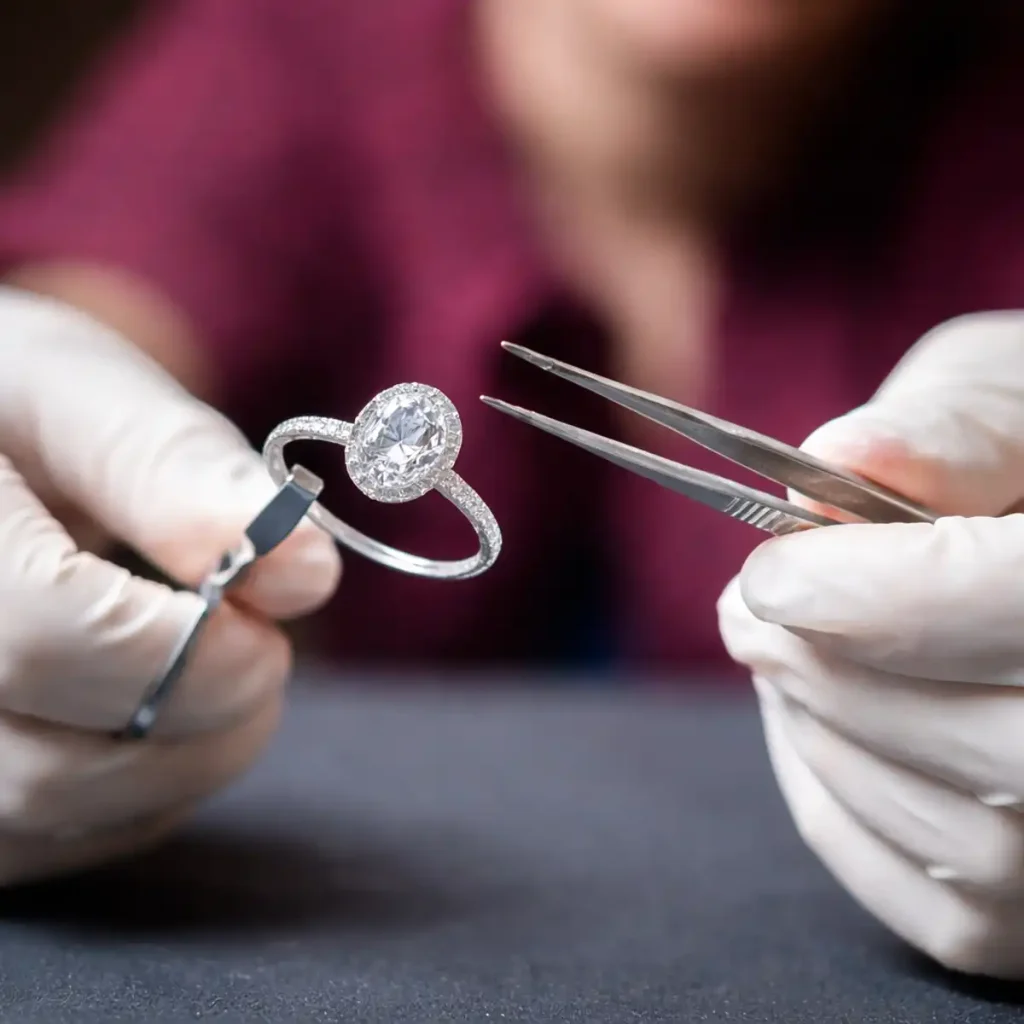
Fun fact: Lost-wax casting, the technique Hatton Garden workshops use to cast most bespoke engagement rings, dates to the third millennium BC and was used by Mesopotamian, Egyptian, and Indus Valley jewellers to produce cast gold pieces that survive in museum collections today, which means the casting process a buyer commissions in 2025 is recognisably the same technique practised over 4,000 years ago.
The Casting And Fabrication Stage
Once the wax model is approved, the piece moves to casting. The wax is invested in a plaster mould, burned out to leave a cavity, and filled with molten precious metal — typically 18ct yellow, white, or rose gold, or 950 platinum for engagement rings at the higher price points. The choice of metal affects more than colour. Platinum is denser and harder to work with than gold, which means it holds stone settings more securely over decades of wear but requires a setter with specific platinum experience. 18ct white gold is rhodium-plated to achieve its bright white appearance, which wears off over time and requires re-plating every 18 to 24 months, depending on wear patterns. 18ct yellow gold and 18ct rose gold require no plating and develop their patina naturally.
Palladium appears occasionally as an alternative to platinum, with a similar white colour but lower density and lower cost. Its working properties are different, and setters who work with palladium regularly tend to specialise in it rather than treating it as interchangeable with platinum.
The cast piece arrives at the bench as a rough form that bears the general shape of the final ring but requires significant hand-finishing before it can accept stones. Casting produces minor surface irregularities that must be filed, sanded, and polished away, and the internal shank surface must be finished smooth for comfort. Hand-finishing at this stage is what separates a workshop that casts and outsources finishing from one that works the piece through to completion in-house.
The Stone Setting Stage
Stone setting is the most specialised craft in the commission sequence, and the sequence of setting matters. A typical diamond engagement ring with a centre stone and a halo of accent stones is set with the centre stone first if the setting is a claw or prong, or with the accent stones first if the centre sits in a bezel that must clear the halo. Claw, bezel, pavé, channel, gypsy, tension, and collet settings each require different tools, different bench movements, and different levels of specialisation.
A claw setting on a round brilliant is the most common setting in Hatton Garden commissions and requires the setter to cut four or six precise seats into the claws, position the stone, and bend the claws over the crown with enough pressure to hold the stone permanently without cracking the girdle. The pressure required is measured in ounces, not pounds, and the setter’s judgement is the only instrument that reads it.
Bezel settings wrap a continuous collar of metal around the stone and protect it from impact more effectively than claws, at the cost of hiding more of the stone. Pavé settings set rows of small accent stones with beads of metal raised from the shank surface, and the setter’s skill shows in the evenness of the bead work and the invisibility of the individual settings. Tension settings hold the stone between two ends of the shank under compression, with no visible claws, and require precise engineering of the shank to deliver consistent pressure. Each setting type has a setter or setters who specialise in it, and a workshop that commissions across setting types maintains relationships with several specialists rather than expecting one person to set everything.
The Finishing And Hallmarking Stage
Once the stones are set, the piece returns to the bench for final polishing. Hand-polishing produces a finish that machine-polishing cannot match at the detail level, and Hatton Garden commission workshops typically polish by hand or with hand-guided rotary tools rather than automated systems. The final step before handover is hallmarking at the London Assay Office at Goldsmiths’ Hall, a short walk from the quarter. A British-made bespoke engagement ring above the hallmarking exemption weight must carry a sponsor’s mark, a fineness mark, and the London leopard’s head before it can be legally described as the metal it claims to be.
The ring returns to the workshop, hallmarked and polished, ready for collection. A final fitting confirms the size is correct, and the workshop provides the buyer with an insurance valuation, the centre stone certification, and the commission documentation, including CAD renders and
What To Ask A Hatton Garden Workshop Before Committing
The single most useful question to ask a Hatton Garden bespoke workshop during a first consultation is this. Which stages of my commission will be done in this workshop, and which will be sent elsewhere? A genuine in-house workshop will confirm that design, CAD, wax approval, finishing, setting, and polishing all happen at the address the buyer is standing in, with casting sometimes sent to a specialist foundry in the quarter but returning for all subsequent stages. A workshop that outsources multiple stages is not necessarily producing inferior work, but the buyer deserves to know where the piece is being made before agreeing on a price.
Beyond that, ask to see wax models of previous commissions and the finished pieces that resulted. Ask about the setter’s specialisation, particularly if the design involves platinum, tension settings, or micro-pavé work. Confirm lead times in writing, with specific milestones for CAD approval, wax approval, and final collection. A 6 to 10-week timeline should include 2 to 3 weeks of design and CAD, 1 to 2 weeks for the wax model, 1 week for casting, and 2 to 3 weeks for setting and finishing. Workshops that cannot provide that level of detail up front are workshops that may struggle to deliver it on schedule.