
The final stage of every British-made engagement ring is not the polish, the setting, or the final quality check. It is a short journey from a Hatton Garden workshop to Goldsmiths’ Hall on Foster Lane, where the piece is submitted to the London Assay Office, tested for metal fineness, and struck with a set of marks that are legally required before the ring can be sold as the metal it claims to be. The marks a buyer sees inside the shank of their engagement ring are the output of a statutory consumer protection system that has operated in London continuously since 1478, and understanding what those marks guarantee is the single most useful piece of technical knowledge a fine jewellery buyer can acquire.
Hatton Garden sits in EC1N between Chancery Lane on the Central line and Farringdon on the Elizabeth line, and the London Assay Office at Goldsmiths’ Hall is a 15-minute walk south through the City. That physical proximity is the reason British hallmarking is so deeply embedded in Hatton Garden workshop practice. A bespoke ring cast and finished on Greville Street or the northern end of Hatton Garden in the morning can be at the Assay Office by early afternoon, hallmarked within a working day or two, and returned to the workshop for final polishing and collection. No other jewellery quarter in the UK maintains this kind of working relationship with its Assay Office, and it shapes how Hatton Garden workshops think about UK hallmarking as a daily operational fact rather than a regulatory afterthought.
What A UK Hallmark Actually Guarantees
A UK hallmark is a legal guarantee of metal fineness, nothing more and nothing less. It confirms that the metal in the piece has been independently tested by an Assay Office and found to meet a declared purity standard. It does not grade workmanship, does not verify stone quality, and does not attest to the value of the finished piece. What it does is prevent a jeweller from selling 9ct gold as 18ct, base metal plated with gold as solid gold, or palladium as platinum. The protection is narrow but absolute, and it is the oldest continuously operating form of UK consumer protection.
The Hallmarking Act 1973 is the current governing legislation, and it makes it a criminal offence to describe, supply, or offer to supply any article of gold, silver, platinum, or palladium above the statutory exemption weight unless it carries an approved UK hallmark. The exemption weights are small: 1 gram for gold, 7.78 grams for silver, 0.5 grams for platinum, and 1 gram for palladium. Almost every engagement ring exceeds these weights and must be hallmarked before legal sale.
Four UK Assay Offices currently operate: London at Goldsmiths’ Hall, Birmingham, Sheffield, and Edinburgh. Each has its own town mark that appears on every piece tested at that office, and each maintains its own date letter cycle. The London mark is the leopard’s head, which has identified London assay since the 14th century and remains in use in modernised form today. Birmingham’s mark is the anchor, Sheffield’s is a rose (changed from a crown in 1975), and Edinburgh’s is a castle.
The Four Compulsory Marks Explained
Every UK hallmark consists of three compulsory marks plus the traditional date letter and an optional fineness symbol. The sequence and meaning matter, and a Hatton Garden bench jeweller reading a hallmark under the loupe works through them in order.
The sponsor’s mark is struck first and identifies the jeweller or workshop that submitted the piece for assay. The sponsor’s mark is a registered identifier, typically the initials of the maker or business enclosed in a distinctive cartouche shape. Every Hatton Garden bespoke workshop holds a registered sponsor’s mark at one or more of the four Assay Offices, and the mark is struck on every piece the workshop produces before the piece is submitted for testing. For a buyer examining an antique or vintage piece, the sponsor’s mark can identify the workshop of origin where historical records exist, and the London Assay Office maintains extensive archives of sponsors’ marks dating back centuries.
The fineness mark states the precious metal content of the piece in parts per thousand. For gold, the current UK fineness standards are 375 (9ct), 585 (14ct), 750 (18ct), and 916 (22ct). For silver, the standards are 800, 925 (sterling), 958 (Britannia), and 999 (fine silver). For platinum, the standards are 850, 900, 950, and 999. For palladium, the standards are 500, 950, and 999. The fineness mark is usually a three-digit number enclosed in a shape that also identifies the metal type: a rectangle with clipped corners for gold, an oval for silver, and a specific polygon for platinum and palladium.
The Assay Office mark identifies which office tested the piece. The London leopard’s head, Birmingham anchor, Sheffield rose, or Edinburgh castle appears on every hallmarked piece tested at that office. The mark is a guarantee of the testing process itself, because each Assay Office operates under identical statutory standards but maintains independent staff and equipment, and the visible office mark allows the chain of responsibility to be traced if a compliance question ever arises.
Fun fact: The London leopard’s head hallmark has identified assay at Goldsmiths’ Hall since 1300, which makes it the oldest continuously used consumer protection mark in the English-speaking world, predating the Magna Carta’s clauses on standardised weights and measures by 15 years and remaining in effectively continuous use across more than 700 years of London trading.
The Date Letter And Why It Matters For Antique Pieces
The date letter is a traditional fourth mark that identifies the year of assay. Each Assay Office operates an independent date letter cycle using the letters of the alphabet in sequence, with each cycle running for roughly 25 years before the letters begin again in a new font style and cartouche shape. The combination of letter, font, and cartouche uniquely identifies the year of hallmarking, which means a trained eye can determine the exact year a piece was assayed by reference to Assay Office records.
Date letters became optional in 1999 under revisions to the Hallmarking Act, but most British workshops continue to request them because buyers value the provenance information they provide. For antique and vintage pieces, the date letter is often the most useful mark because it fixes the age of the piece with precision that no other evidence can match. A Victorian ring hallmarked in London with a specific date letter can be dated to the year, and the date letter is frequently the primary evidence an antique dealer uses when authenticating a period piece.
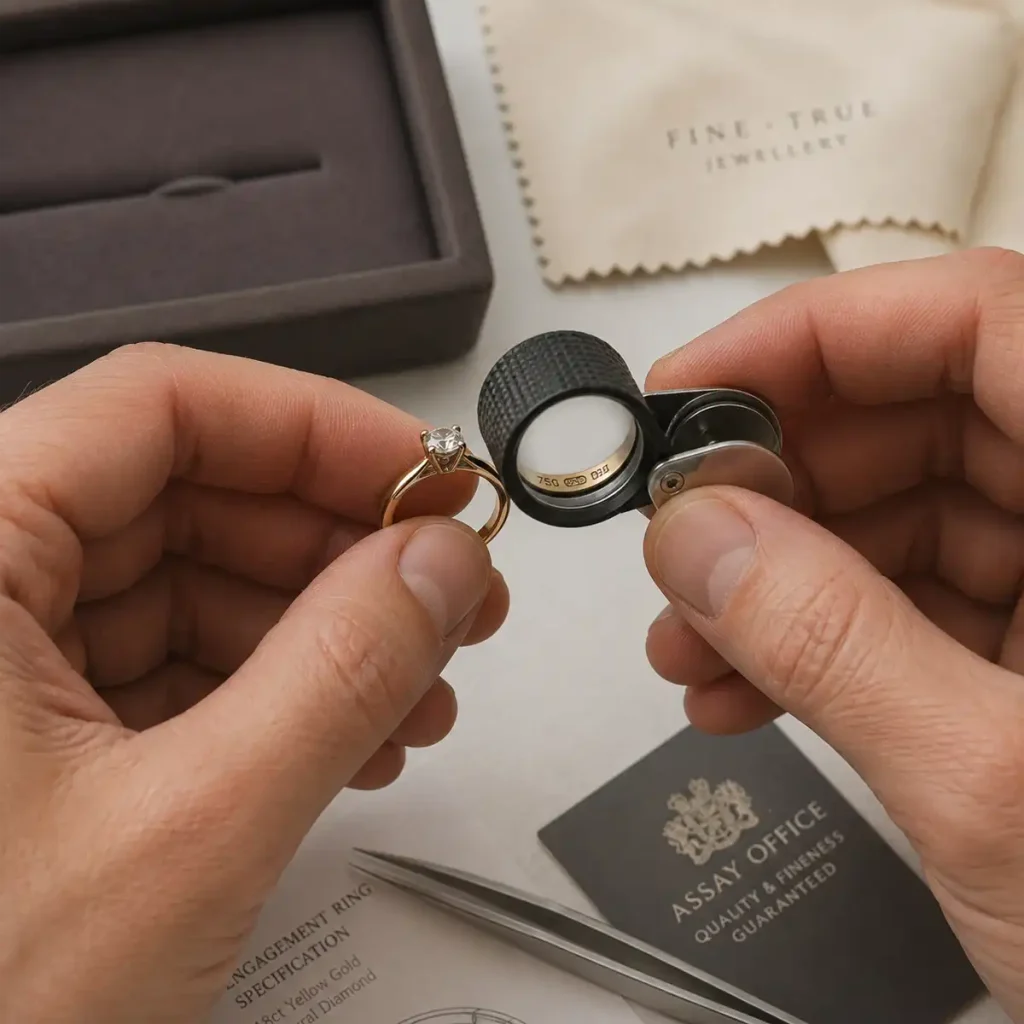

For buyers commissioning a new bespoke piece in Hatton Garden in 2026, asking the workshop to request a date letter is a small step that adds no meaningful cost and documents the year of manufacture permanently on the piece itself. Some buyers treat this as a sentimental consideration for an engagement ring; others see it as a future provenance document for a piece that may be inherited or eventually sold. Either position is reasonable, and the date letter is a useful mark regardless of which motivation the buyer brings.
Commemorative And Optional Marks
Alongside the compulsory and traditional marks, Assay Offices occasionally strike commemorative marks to mark specific events. The 2022 Platinum Jubilee marked the late Queen’s 70-year reign and was available on request during a defined window. The 2023 Coronation mark commemorates the coronation of King Charles III and operates on a similar basis. These marks appear only on pieces for which they were specifically requested during the commemorative period, and they add historical specificity to pieces made during those windows.
The Common Control Mark is a separate optional mark that indicates the piece has been assayed under the Hallmarking Convention, an international agreement that allows hallmarks from member countries to be mutually recognised. A piece carrying the Common Control Mark has been tested to standards that every signatory country will accept, which simplifies international sale and valuation. Not every Hatton Garden piece carries this mark, but it is available on request for buyers who anticipate significant international travel or eventual relocation.
How To Read A Hallmark In Practice
A Hatton Garden bench jeweller reads a hallmark in a specific sequence under a 10x loupe. The inside of the shank is the standard location on an engagement ring, though the marks may also appear on the outside of a wedding band or on less conspicuous surfaces on more complex pieces. The first step is to orient the marks, which are typically struck in a line running along the shank rather than around it.
The second step is to identify the sponsor’s mark, which appears first in the sequence and is typically the most decorative of the marks due to its cartouche shape. Recognising a specific sponsor’s mark requires familiarity with the workshop conventions used, and Hatton Garden jewellers who have traded for decades will often recognise the sponsor’s marks of neighbouring workshops without reference materials.
The third step is to read the fineness mark, confirming the metal content matches what the invoice describes. A buyer who has purchased an 18ct white gold ring and finds a 750-fineness mark in a clipped-corner rectangle has received confirmation that the metal meets the described standard. A buyer who finds a 375 mark on a piece sold as 18ct has discovered a significant discrepancy that should be raised with the jeweller immediately.
The fourth step is to identify the Assay Office mark, confirming where the piece was tested. For a bespoke commission from a Hatton Garden workshop, the London leopard’s head is the expected mark, though pieces made by London workshops occasionally submit to Birmingham or another office for operational reasons. Any of the four UK Assay Office marks represents a valid UK hallmark; none is intrinsically superior to another.
The fifth step, if present, is to read the date letter and confirm the year of assay. For new pieces, the date letter should correspond to the year of commissioning. For antique and second-hand pieces, the date letter is the primary age-dating evidence.
What To Ask The Workshop About Hallmarking
The single most useful question to ask a Hatton Garden workshop during a bespoke commission consultation is this. Will this piece be hallmarked at the London Assay Office, and when in the commission sequence does the hallmarking happen? The answer should confirm London as the Assay Office of choice for London-made pieces, and should place hallmarking after casting and fabrication but before final polishing and stone setting. Some setting work is done after hallmarking to avoid the risk of damage to small set stones during the striking process, while the main metalwork, including the shank and gallery structure, is hallmarked before setting.
For buyers commissioning a bespoke piece, requesting the date letter is worth mentioning explicitly during the consultation. For buyers purchasing a ready-to-wear piece, asking to see the hallmark under magnification before agreeing to the purchase is reasonable, and any legitimate Hatton Garden retailer will welcome the request. The marks are small, typically 1mm to 2mm in height on an engagement ring shank, and identifying them under a loupe requires steady hands and a moment of concentration. That moment, repeated across every piece of fine jewellery the buyer ever owns, becomes the foundation of a technical literacy that distinguishes an informed buyer from a trusting one.