
The protection question every engagement ring buyer eventually asks is this. The receipt from the jeweller says £8,000. The insurance policy needs a replacement value. Are those the same number, and if not, which one matters? The answer is that they are almost never the same number, and the one that matters is the independent valuation rather than the receipt. Hatton Garden has more practising registered valuers concentrated in a single postcode than anywhere else in the UK, and understanding the distinction between a purchase price and an insurance replacement value is the most commercially useful piece of knowledge a buyer can take away from the quarter.
Hatton Garden sits in EC1N between Chancery Lane on the Central line and Farringdon on the Elizabeth line. Independent valuation practices operate alongside the retail jewellers, typically on upper floors and by appointment, in the same streets that house the retail trade. Prestige Valuations has its head office in the quarter. Almaz Jewellery Valuations operates from 100 Hatton Garden within the London Diamond Bourse building. TH March, the chartered insurance broker specialising in jewellery since 1887, works closely with Hatton Garden valuers on the insurance broking side. The density of independent expertise is not incidental; it is the structural advantage the quarter offers at the post-purchase stage as much as at the purchase stage itself.
Why A Purchase Receipt Is Not A Valuation
The receipt from the jeweller records what the buyer paid. That is a useful document, but it is not an insurance document. An insurance policy needs to know what it will cost to replace the ring if it is lost, stolen, or damaged beyond repair, and the replacement value is almost always higher than the purchase price for three reasons that every insurer applies.
The first reason is retail margin. When an insurer replaces a ring, they typically source it through a jeweller who applies a standard retail margin to the cost of production. A ring that cost £8,000 to buy from a Hatton Garden independent with compressed margins may cost £10,000 or £12,000 to replace through a mainstream retailer the insurer has to work with. The insurance replacement value reflects that reality.
The second reason is the metal and stone price movement. Gold and platinum prices fluctuate substantially over the life of an insurance policy, and stone prices shift with market conditions. An insurance valuation prepared in 2023 may understate the 2025 replacement cost significantly. Valuations should be updated every 3 to 5 years to reflect current market prices, and many insurers require this explicitly in the policy terms.
The third reason is specification completeness. A retailer’s receipt typically describes the ring in general terms: metal, carat weight, and centre stone specification. An insurance valuation describes the ring in forensic detail sufficient to commission a faithful replacement, including the sponsor’s mark on the hallmark, the exact proportions of the centre stone, the setting technique, and photographic documentation from multiple angles. If the ring is ever lost, the valuation is the document that makes a replacement possible; the receipt alone often is not.
What An Independent Valuation Should Contain
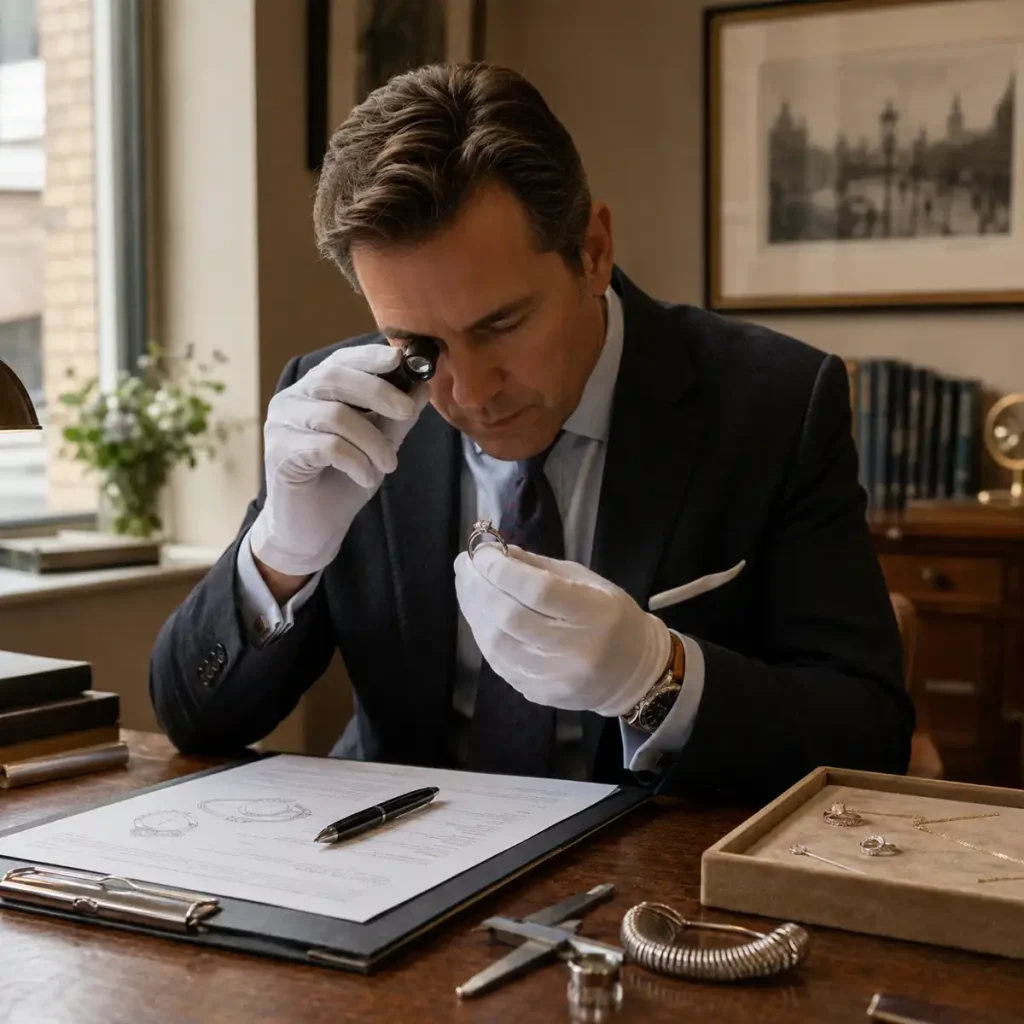
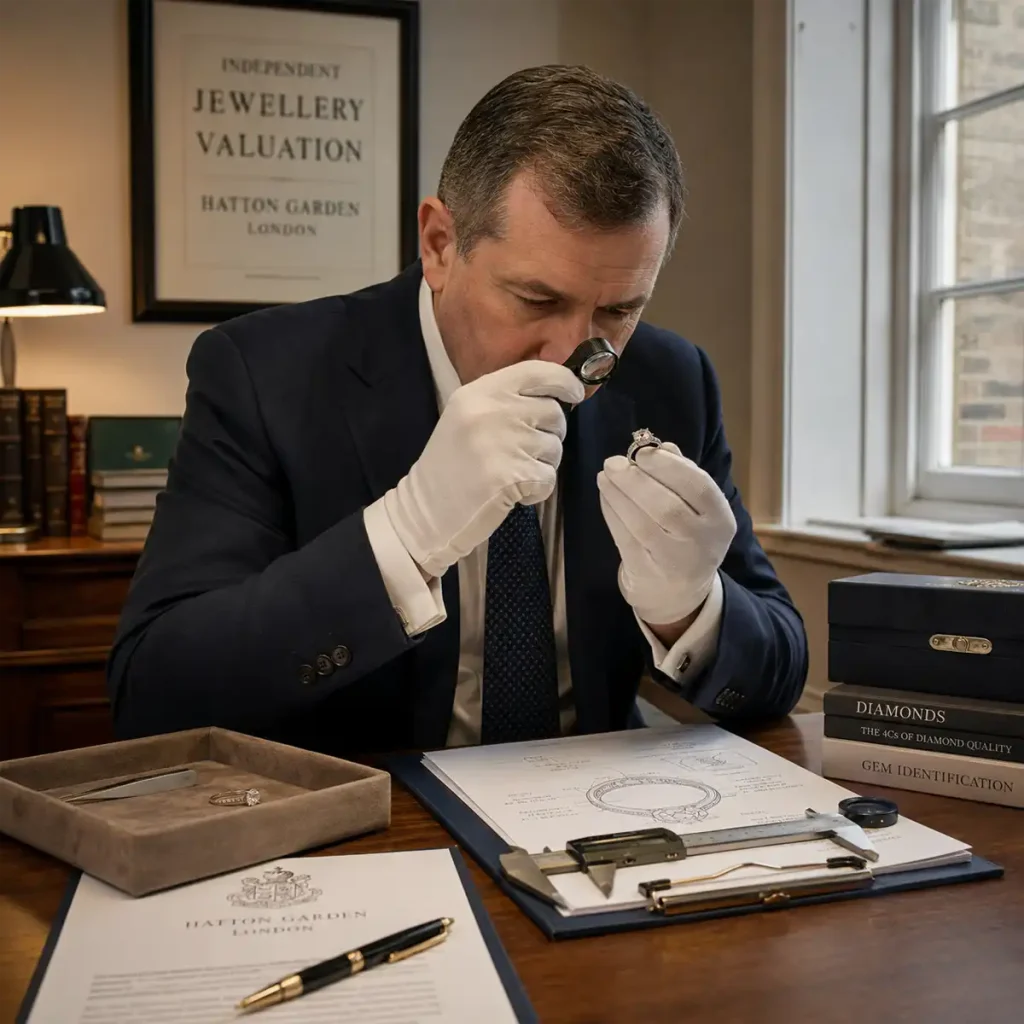
A Hatton Garden valuation from a registered valuer is a specific document with a defined structure. The term registered valuer matters because the UK jewellery valuation trade is self-regulated through professional bodies, principally the Institute of Registered Valuers under the National Association of Jewellers. An IRV-registered valuer has passed gemmological and valuation qualifications, carries professional indemnity insurance, and produces valuations that insurers accept without challenge. The designation FGA after a valuer’s name indicates a Fellow of the Gemmological Association and confirms the gemmological training underpinning the valuation.
An insurance valuation should contain a detailed description of the piece, including metal type and fineness, total carat weight and breakdown by individual stone, full 4Cs specification for diamonds, origin and treatment notes for coloured stones, setting and construction details, hallmark description including Assay Office and date letter where present, and precise measurements. Photographic documentation should include multiple angles showing the face, profile, and gallery of the piece. The replacement value should be stated in current market terms with the valuation date clearly marked. The valuer’s qualifications and registration details should appear on the document, along with their signature and stamp.
Fun fact: The National Association of Jewellers traces its origins to 1887 through predecessor bodies, the same year that TH March was founded as a specialist jewellery insurance broker in London, which means the professional valuation infrastructure a Hatton Garden buyer uses today has been developing continuously for over 130 years.
The Difference Between Insurance Valuation And Other Valuation Types
Not all valuations serve the same purpose, and asking for the right type matters. An insurance replacement valuation calculates what it would cost to buy an equivalent piece new from a retailer, which is the highest of the valuation figures. A probate valuation calculates the open market value for inheritance tax purposes, which is typically lower because it reflects what the piece would realise at sale. A matrimonial or division of assets valuation produces a figure appropriate to the specific legal context. A sale valuation produces a figure reflecting realistic trade resale, which is typically the lowest of the four.
The insurer will specify which valuation type the policy requires. For standard home contents insurance with a jewellery schedule, or for a specialist jewellery policy, the requirement is almost always an insurance replacement valuation. Buyers who present a probate or sale valuation for an insurance policy may find the piece is underinsured at the point of claim, which defeats the purpose of the insurance entirely.
What Jewellery Insurance Should Actually Cover
A jewellery insurance policy is not a single product; it is a category with meaningful variation between providers. The buyer should check four specific elements before accepting a policy.
The first element is worldwide coverage. Many standard home contents policies cover jewellery only when worn at the insured address, with limited cover away from home. An engagement ring worn daily needs worldwide coverage as a baseline. Specialist jewellery insurers and high net worth household policies typically provide this as standard; mainstream contents insurance often does not.
The second element is accidental damage. A centre stone that cracks after an impact on a door frame, or a setting that deforms after being caught on a coat sleeve, requires repair or replacement. Policies that cover theft and loss but exclude accidental damage leave a gap that is commonly triggered in the first five years of daily wear.
The third element is mysterious disappearance. If a ring is removed from a swimming pool and cannot be found, or slips off a finger in cold weather without the wearer noticing, the loss is not theft and not accidental damage in the conventional sense. Some policies cover mysterious disappearance explicitly; others exclude it. The distinction matters.
The fourth element is the replacement provider. Some policies settle in cash at the valuation figure; others require replacement through the insurer’s nominated jeweller. Cash settlement allows the insured to return to the original Hatton Garden maker and commission a faithful replacement. Nominated jeweller settlement may route the replacement through a retail partner whose inventory does not match the original piece’s specification. For bespoke or antique pieces, particularly, cash settlement is the substantially more useful structure.
UK Consumer Protection For The Original Purchase
Before the insurance question arises, the UK consumer protection framework applies to the original purchase and creates protections that every buyer should understand. The Consumer Rights Act 2015 governs in-person purchases and requires that goods be of satisfactory quality, fit for purpose, and as described. A ring that fails within a reasonable period due to a manufacturing defect falls within this protection, and the buyer has rights against the jeweller regardless of any warranty the jeweller offers privately.
The Consumer Contracts Regulations 2013 govern distance purchases, including online sales, and provide a 14-day cooling-off period during which the buyer can return the ring for a refund without reason, subject to limited exceptions for goods made bespoke to the buyer’s specification. Online Hatton Garden purchases fall under these regulations; in-person purchases at a Hatton Garden showroom do not, which is a distinction worth understanding before committing.
The Hallmarking Act 1973 governs metal fineness claims and requires that any British-made ring above the exemption weight carry a UK hallmark before it can be legally described as the metal it claims to be. A ring described as 18ct gold that lacks the required hallmark has been misdescribed as a matter of criminal law, and the buyer has rights of recourse accordingly. Hatton Garden bespoke workshops hallmark at the London Assay Office at Goldsmiths’ Hall as standard practice, and the hallmark is the buyer’s confirmation that the metal is what the invoice says.
What A Hatton Garden Buyer Should Actually Do
The single most protective step a buyer can take after purchasing an engagement ring is to commission an independent insurance valuation from a registered valuer within 3 months of collection. The valuation should not come from the jeweller who sold the ring, because a valuation from the seller is not independent and some insurers will not accept it for that reason. Book the valuation with a separate IRV-registered valuer, whose role is to document the piece for insurance purposes without any commercial stake in the sale.
Expect to pay between £75 and £250 for a single-ring insurance valuation from a Hatton Garden registered valuer, depending on the complexity of the piece and whether the valuer works from their own premises or conducts a home visit. The valuation should include photographic documentation, the written report, and a stamped and signed certificate that insurers accept as standard documentation. Update the valuation every 3 to 5 years, or immediately after any significant repair or alteration that changes the piece.
Present the valuation to the insurer at the point of policy inception rather than waiting until a claim, and confirm in writing that the insurer accepts the valuation as the basis for the sum insured. Store a copy of the valuation separately from the ring itself, ideally in a different physical location, along with photographs that would allow a jeweller to reconstruct the piece from scratch if the original is ever lost entirely. Those three steps, taken in the first months after purchase, are the difference between a ring that is genuinely protected and a ring that carries a policy number but inadequate cover in practice.


