
This guide sets out how a bespoke engagement ring commission typically runs in the UK, from the first consultation through to a finished, hallmarked ring. It describes trade practice used across independent workshops rather than the procedure of any single maker, since engagement-rings.net operates as a directory connecting buyers to bespoke jewellers rather than as a workshop itself. The stages covered here, brief and budget, stone selection, CAD design, a wax or resin model for approval, lost-wax casting, stone setting, and UK hallmarking with finishing, follow a broadly consistent order across the trade, though individual workshops vary in timing and in how much input a buyer has at each point. The purpose is to set out a realistic view of what a bespoke engagement ring commission involves, what to ask at each stage, and where independent checks, such as a hallmark or a gem grading report, actually apply.
The Stages Of Commissioning A Bespoke Engagement Ring
A bespoke engagement ring commission generally runs through seven stages: an initial brief and budget conversation, stone selection, CAD design, a wax or resin model for approval, casting, stone setting, and hallmarking with finishing. A straightforward commission typically takes 6 to 12 weeks from brief to collection, though complex settings or reworked designs extend that.
The first stage of any bespoke engagement ring commission is the brief and budget conversation. A workshop or bench jeweller usually asks about the wearer's existing jewellery, hand size, lifestyle (manual work, sport, an active job) and any stones already owned, such as an inherited diamond. Budget is agreed in principle at this point, since it determines carat weight, metal choice and the complexity of the setting that follow.
Stone selection comes next. For a bespoke engagement ring using a diamond or coloured stone bought new, an independently grading report from a named laboratory such as GIA, IGI or HRD allows a buyer to compare like with like rather than relying on a workshop's own description. Colour and clarity grading only carries weight when the issuing laboratory is named on the report.
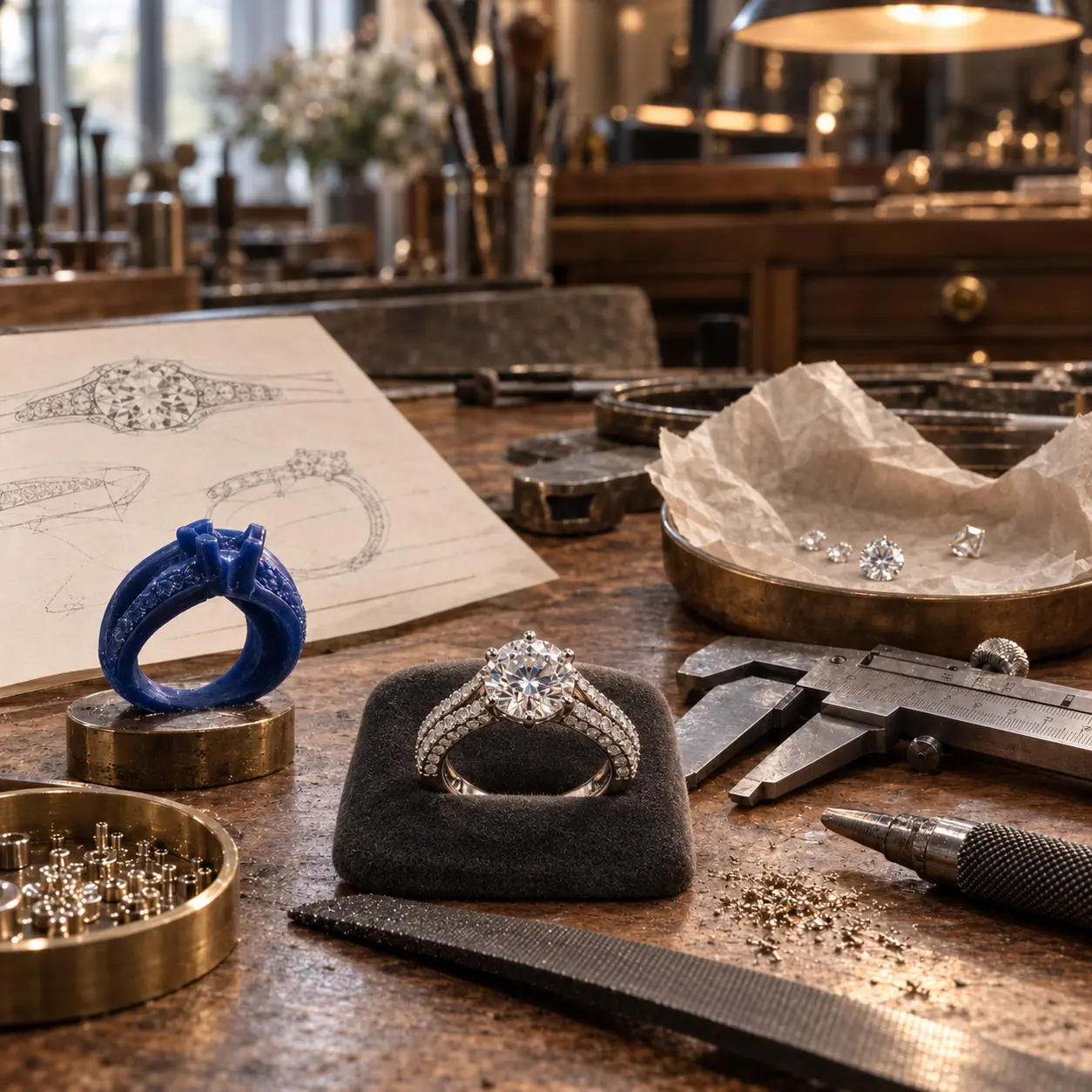
Once a stone is chosen, the workshop produces a CAD design. Computer-aided design lets a bench jeweller show a buyer the ring from multiple angles, adjust claw height, band profile and setting style, and calculate metal weight before any metal is cut. Most workshops allow two or three rounds of CAD revision within the quoted price for a bespoke engagement ring; further changes beyond that are usually charged separately.
The CAD file is then used to produce a wax or resin model, sometimes 3D printed, for physical approval. This stage exists because a screen render and a ring on the hand read differently, and it is the last point at which a buyer can request structural changes cheaply. Once the model is approved, it is used to create a mould, and the casting stage begins.
Lost-wax casting is the traditional method used to turn the approved model into a metal ring. The wax or resin pattern is placed in a flask and surrounded with a plaster mixture, burned out to leave a cavity, and molten metal, typically 9ct or 18ct gold, platinum or palladium, is poured through a sprue channel into the mould. Once cooled, the sprue is cut away and the rough casting is cleaned up before setting.
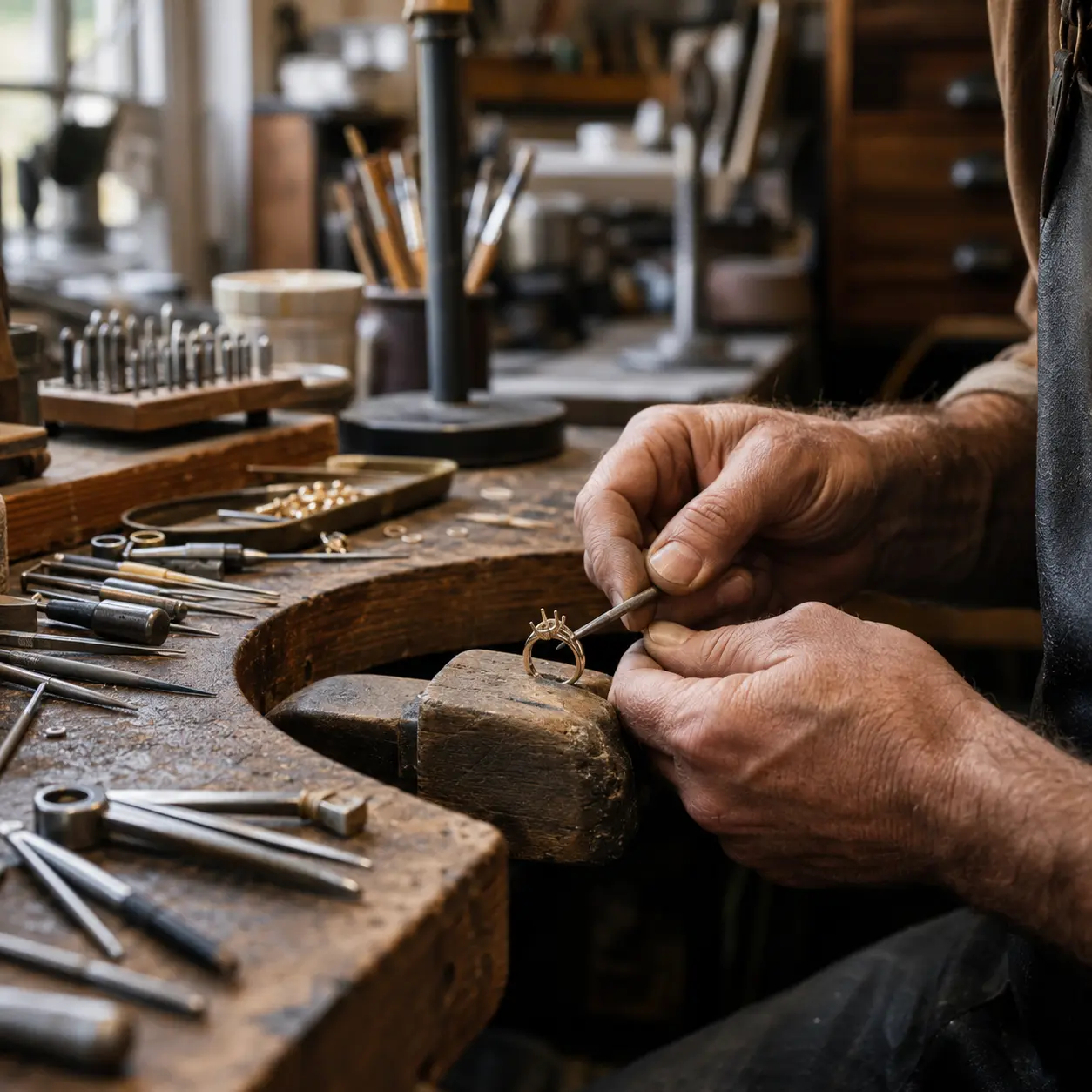
Stone setting follows casting. The three most common approaches are claw setting, which lifts a stone and lets more light reach it; bezel setting, which encloses the stone in a metal rim for extra protection; and pavé setting, where small stones are set closely together across a band. The choice affects both the look of the finished bespoke engagement ring and how it wears day to day.
Finishing covers polishing, rhodium plating on white gold (to give an even white colour and some wear resistance), and UK hallmarking of the finished piece before it is released to the buyer as a completed bespoke engagement ring.
Bespoke Commissioning Compared With Buying A Ready-Made Ring
Buying a ready-made engagement ring from stock and commissioning a bespoke engagement ring differ in what a buyer controls and how long the process takes. A ready-made ring is available to try on and take away, or to order in a standard size within days. A bespoke engagement ring commission generally takes weeks rather than days, because CAD design, a model approval stage and casting each need time, and a workshop is producing one ring rather than picking from existing stock.
The trade-off is control. A ready-made ring fixes the carat weight, metal and setting style at the point of manufacture; a buyer chooses among what already exists. A bespoke engagement ring commission allows the stone, setting style and band profile to be specified individually, and it suits a buyer who wants to reuse an inherited stone or match a specific hand shape or lifestyle. It does not, on its own, make a ring rarer or more valuable; a hallmark and a stone's grading report describe what the piece is made of, not what it might be worth to a future buyer.
Cost structures also differ. Stock rings are priced against a fixed design already made in volume, while a bespoke engagement ring commission is quoted against the specific stone, metal weight and setting chosen, so quotes vary between workshops for what looks like a similar brief. [EDITOR: dated figure with market] is the right way to reference any typical price range for either route, rather than a single figure presented as current.
Common Misunderstandings About CAD Models And Casting
A few points about the bespoke engagement ring process are often assumed rather than checked.
A CAD render is not a guarantee of final colour or exact proportions. Screen renders use lighting and material settings chosen to look attractive, and a wax or resin model, not the CAD image, is the stage to check actual proportions and comfort on the hand.
Casting is not a single, uniform process across the trade. Lost-wax casting can be done in small batches by hand or on more automated equipment, and workshops differ in how they finish a rough casting before it is set, so two rings from the same CAD file can arrive slightly different in weight and finish.
A hallmark does not certify a stone. It relates only to the precious metal content of the piece, which is a separate check from any diamond or gemstone grading report.
Approving a wax or resin model is not a formality. It is the point in a bespoke engagement ring commission where a buyer can still request a different claw height, band width or setting style without remaking a finished casting.
Questions To Ask At Each Stage Of A Commission
Before commissioning a bespoke engagement ring, a buyer should confirm four things in writing: the total price and what triggers extra charges, the number of CAD and model revisions included, the expected timeline with a realistic allowance for delays, and which UK Assay Office will hallmark the finished piece.
At the brief stage: what is included in the quoted price, and what counts as a change request that costs extra.
At stone selection: which laboratory graded the stone, and whether the report is included with the finished ring or held separately.
At CAD design: how many revision rounds are included, and whether the file itself is provided to the buyer.
At the wax or resin model stage: whether the buyer sees and can adjust the physical model in person, not only on screen.
At casting and setting: which metal and carat (9ct, 18ct, platinum or palladium) will be used, and how that was agreed against the budget set earlier.
At collection: which UK Assay Office hallmark is stamped on the piece, and whether an independent valuation for insurance is available separately.
What A UK Hallmark Actually Certifies
A UK hallmark is a set of stamps applied by one of the UK's Assay Offices (Birmingham, Edinburgh, London or Sheffield) once the finished piece has been tested and found to match its stated fineness. By law, precious metal items above the exemption weights, 1g for gold and palladium, 7.78g for silver and 0.5g for platinum, must carry a hallmark before sale in the UK.
The hallmark confirms the precious metal content of the ring: the metal, its fineness (such as 375, 585 or 750 for 9ct, 14ct and 18ct gold), the Assay Office that tested it, and a date letter or maker's mark depending on the scheme used. It does not confirm the quality, origin or grading of any stone set in the ring, the number of hours of work involved, or the retail value of the finished ring. A hallmark and a stone's grading report, taken together, describe what a bespoke engagement ring is made of, not what it might be worth later, and buyers checking both are looking at two separate certifications issued by two different kinds of body.
Before commissioning a bespoke engagement ring, it is worth having the brief, budget and revision allowance confirmed in writing, checking that any stone carries a grading report from a named laboratory such as GIA, IGI or HRD, and confirming which UK Assay Office will hallmark the finished piece. Asking to see the wax or resin model in person, rather than approving from a CAD render alone, remains the most reliable way to catch proportion or comfort issues before casting. A realistic timeline, generally 6 to 12 weeks for a straightforward commission, and clarity on what triggers extra cost, both reduce the chance of disagreement between a buyer and a workshop later in the process.