
The two months' salary rule is the most successful marketing campaign in jewellery history, and almost no UK buyer who repeats it knows where it came from. The rule did not exist before 1947, did not exist anywhere outside De Beers' marketing department until decades after that, and has no basis in tradition, finance, or relationship logic. It is a number a Madison Avenue copywriter wrote into a print advertisement to anchor what consumers should consider an acceptable spend. Three generations of buyers later, a substantial portion of UK couples still cite the rule when discussing their budget, which is a measure of marketing effectiveness that should give any thoughtful buyer pause. The two months' salary rule for engagement rings UK is the single most consequential financial myth in the bridal market, and the UK reality of what couples actually spend looks nothing like the rule prescribes.
Where the rule actually came from
In 1938, the De Beers Consolidated Mines diamond cartel hired the New York advertising agency N.W. Ayer to address a commercial problem. Diamond engagement rings were not yet a universal Western tradition. American buyers in particular were spending less on diamond engagement rings than the cartel needed them to spend, and many couples were not buying diamond rings at all.
N.W. Ayer's response was a sustained campaign through the 1940s and 1950s that established the diamond engagement ring as the universal marker of betrothal, gave the world the slogan "A Diamond Is Forever" in 1947, and introduced the concept that the appropriate ring spend should be one month's salary. The one-month figure later expanded to two months in subsequent campaigns, and the three months figure that some sources still cite was a US-market expansion that never gained the same traction in the UK.
The historical record is well-documented in trade and advertising archives. The campaign was so effective that within 30 years a number invented in an advertising agency had become a perceived tradition, and within 60 years the perceived tradition had become a perceived obligation.
What UK couples actually spend
The honest UK number, as documented across multiple bridal market surveys through 2024 and 2025, sits well below the two-month rule for the median couple. The most-cited UK figure for average engagement ring spend across the market sits between £1,800 and £2,500, with significant variation by region, age, and household income.
A UK couple with a combined household income of £60,000 per year, where the partner buying the ring earns £35,000, would be told by the two months' rule to spend approximately £4,800 on the ring. The actual median spend at that income level in the UK in 2025 was closer to £2,200. The rule prescribes more than double the actual median behaviour, which is precisely the gap the original campaign was designed to engineer.
A snippet-ready summary for buyers questioning the figure: the two months' salary rule has no UK basis. UK couples typically spend between £1,500 and £3,500 on engagement rings, with the median around £2,000 to £2,500 across the market. The rule was invented by De Beers' advertising agency in the 1940s and serves the diamond industry's commercial interests, not the buyer's financial position.
The financial-priorities reframe
The honest framework for an engagement ring budget has nothing to do with salary multiples. It has to do with the couple's actual financial position, their other priorities, and what amount allows the purchase to be a celebration rather than a financial strain.
A couple saving for a UK property deposit faces a working calculation. The average UK first-time buyer deposit in 2025 sat at approximately £53,000 across the market and significantly higher in London. Every £1,000 added to engagement ring spend extends the property purchase timeline by a measurable amount, and the financial logic of taking £4,000 from a property deposit fund to meet a marketing-invented salary rule deserves direct interrogation.
A couple paying off student debt, supporting children from previous relationships, building a small business, or saving for a wedding has equivalent calculations to make. None of these calculations resolves to a salary multiple. All of them resolve to the question: what amount allows this purchase to be a happy moment rather than a financial regret?
The most useful way to frame the budget question is in terms of recovery time. If the engagement ring spend would take more than 6 months of dedicated saving to replace at the couple's current saving rate, the spend is probably too high relative to the couple's other priorities. If the spend can be absorbed within 1 to 3 months of normal saving, it is comfortably within the couple's financial position. This is a financial logic the salary rule cannot match because it ignores the couple's actual financial situation entirely.
What different UK budget bands actually deliver in 2026
A working understanding of what each budget band delivers makes the financial-priorities calculation easier, because it allows the buyer to see what compromise different price points actually represent.
At £1,000 to £1,500, the UK market in 2026 delivers strong value in lab-grown diamond engagement rings at 1.00 to 1.50 carats with good colour and clarity grades, set in 18ct white gold. A natural-diamond ring at this price band typically delivers 0.30 to 0.50 carats at the same colour and clarity, set in 9ct or 18ct white gold.
At £2,000 to £3,000, the natural diamond market opens up to 0.70 to 1.00 carat stones with good cut grades, in 18ct white gold or platinum solitaires. The lab-grown equivalent at this budget delivers 2.00 carats at high specifications.
At £4,000 to £6,000, the natural market reaches 1.00 to 1.30 carat stones with strong specifications in platinum settings, or 0.80 to 1.00 carat stones in halo or three-stone designs. Bespoke commission becomes feasible in this band at most UK ateliers.
At £8,000 to £15,000, the natural market enters the 1.50 to 2.00 carat range with premium specifications, or full bespoke commission with significant design complexity. This is the band where Hatton Garden independents compete most directly with high-street brand premium tiers.
These figures are indicative ranges drawn from UK retailer pricing visible across the market in 2025 and 2026; specific pricing varies by stone and retailer.
Fun fact: The De Beers slogan "A Diamond Is Forever" was named the most successful advertising slogan of the 20th century by Advertising Age in 1999, beating campaigns from Coca-Cola, Marlboro, and McDonald's; the slogan and the salary-rule campaigns it supported transformed diamond engagement rings from a niche purchase to a near-universal Western expectation within two decades.
What to do when external pressure pushes the budget up
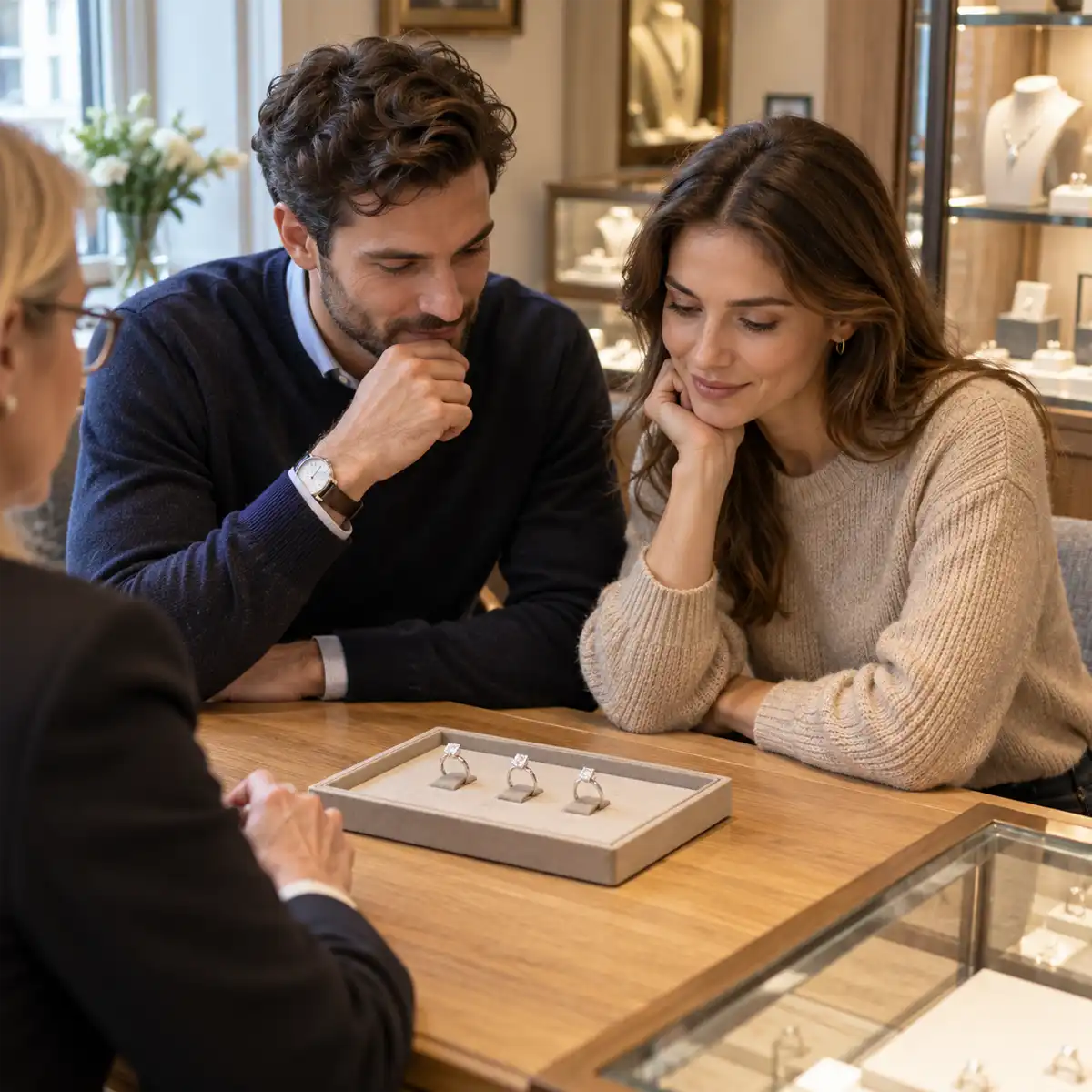
A practical reality of engagement ring buying is that pressure to spend more comes from sources beyond the buyer's own thinking. Family expectations, peer comparison, social media, and the showroom experience itself all push toward higher spend, and a buyer who has decided £2,500 is the right number can find themselves quoting £4,000 to a jeweller within the space of a 90-minute consultation.
The protective response is to set the budget number before walking into any showroom, treat it as a hard limit rather than a starting point, and have a candid conversation with the partner about what the ring represents. Most UK couples who have this conversation report that the partner buying the ring assumed a higher spend was expected, and the partner receiving the ring assumed a lower spend was preferred. The conversation reveals the gap and resolves it before the showroom does.
A jeweller who responds to a £2,500 budget by upselling toward £4,000 is a jeweller operating commercially. A jeweller who works within the £2,500 budget to find the best stone and setting available at that price is a jeweller worth committing to. UK ateliers vary significantly on which approach they default to, and the Hatton Garden independent sector tends toward the latter while the high-street brand sector tends toward the former.
What the rule's persistence tells us
The interesting question is not whether the salary rule is correct. It is why the rule persists three generations after the campaign that invented it ended. The answer is that the rule serves a specific purpose for the diamond industry, which is to anchor expectations at a spend level above what couples would otherwise default to. The persistence of the rule indicates the campaign succeeded; the absence of any equivalent rule for car purchases, holiday spending, or wedding ring spend indicates the campaign was specifically targeted and specifically effective.
A UK buyer in 2026 holding the rule as a guide is, in effect, taking financial advice from a 1940s American advertising agency on behalf of a diamond cartel. Anyone telling you otherwise has a commercial interest in your answer.
Closing thoughts for the buyer at this stage
The most useful action you can take when working out your engagement ring budget UK is to set the number based on your actual financial position, not on a salary multiple, and then visit two or three UK jewellers with that number stated clearly upfront. Watch how each jeweller responds. The jeweller who works within your number to find the best ring at that price is the jeweller who will serve you across the rest of the purchase. The jeweller who treats your number as a starting point for upselling is providing commercial information about how they will treat you on every subsequent decision.
Once the ring is purchased, the protection of that purchase becomes the next consideration, and UK ring insurance is an area where the same independent-versus-commercial framing applies.