
In March 2021 the Advertising Standards Authority ruled against a Goldsmiths advert that showed a pair of Mappin & Webb white gold and diamond hoop earrings cut from £7,500 to £3,375, and Black Friday engagement rings face the same test this November.
The higher retail figure had been genuine once, charged from November 2016 to December 2019. By the time the ad was seen on 30 September 2020, though, the £3,375 retail price had been running for about 10 months, and the ASA ruling held that a saving could no longer be claimed against a price the shop had stopped charging.
Black Friday falls on Friday 27 November 2026 and Cyber Monday on 30 November. The figure that decides a deal is the was price, not the percentage printed beside it. A solitaire also adds checks an earring rarely needs: whether the centre stone is natural or laboratory-grown, which laboratory graded it, whether the mount is hallmarked, and whether resizing before Christmas cancels the right to send it back. For judging the stone on its own merits, our piece on comparing two engagement ring quotes goes further.
When a Black Friday saving on an engagement ring is real
A saving on Black Friday engagement rings is real when the higher price was the ring's usual selling price, was the most recent price charged before the reduction, and ran longer than the sale price. A recommended retail price proves nothing by itself, and an up to 50% banner must hold for a significant share of the stock.
Those tests come from the ASA's own advice on promotional savings claims. Where prices rotate, it expects the higher one to have been charged for a significantly longer period. On up to claims the page is blunt, stating that less than 10% of sale items at the maximum saving is unlikely to count as a significant proportion.
Behind the advertising code sits the law. Since 6 April 2025 the unfair commercial practices rules have been in the Digital Markets, Competition and Consumers Act 2024, and the CMA's guidance on them, CMA207, lists "the existence of a specific price advantage" among the matters a trader must not mislead shoppers about.
Civil penalties reach £300,000 or 10% of worldwide turnover, whichever is higher. A fake deadline is banned outright: Schedule 20 to the Act prohibits falsely claiming an offer will only last a limited time.
No fixed formula settles a case. On 30 July 2026 Mr Justice Richards refused to impose the CMA's proposed ratio of full-price to discounted sales in CMA v Emma Matratzen, a mattress case decided under the older 2008 regulations. Few sales at the higher price were relevant without being decisive. What counted was whether the average shopper would see that price as realistic, and Emma accepted that a reference price should be held for at least as long as the discount runs.
Translated to a ring, that leaves one request worth putting in writing before paying: the dates on which this exact ring, with this exact centre stone, sold at the higher price. A jeweller with real pricing history can answer in a line.
What UK jewellers have published for Black Friday 2026
With 3 weeks to go, the larger UK jewellers have published dates and conditions for Black Friday engagement rings, but no ring-by-ring prices. Their own pages say this much.
Beaverbrooks confirms Black Friday on Friday 27 November 2026, online and in its stores, and tells Beaverbrooks Club members they will hear first. Its FAQ says unworn Black Friday purchases can be returned within 30 days with the original packaging and proof of purchase. No engagement ring reductions are listed yet.
Goldsmiths gives the same 2 key dates, promises up to 50% off selected engagement rings, and asks shoppers to sign up to be told when the offers go live.
Queensmith describes its sale as coming late 2026 and publishes no terms.
The Diamond Store titles its page Black Friday Sale 2026 and says engagement rings are included. Resizing after purchase, its FAQ adds, may be available depending on the design, and the shop does not offer a bespoke service.
C.W. Sellors already runs an engagement rings Black Friday collection under a sale now on banner, with extended Christmas returns until 8 January 2027.
A sale that opens in early November moves the question back in time. Its was price has to have been charged before the sale began, for longer than the sale will last. Goldsmiths' up to 50% is a ceiling, and the ASA's 10% line is the one to remember when most rings in a collection show far smaller cuts.
Why a laboratory-grown diamond can get cheaper without a sale
Natural and laboratory-grown diamonds sit in markets moving at different speeds, so a percentage off Black Friday engagement rings means something different on each.
Laboratory-grown diamond prices have been falling for years. Analyst Edahn Golan's wholesale index, reported by JCK on 10 August 2026, is down 96% since he began tracking it in 2018. The index fell 26% across 2025 and a further 13% year on year in the second quarter of 2026.
In the first quarter of 2026 a 3 carat, D colour, VVS round laboratory-grown diamond traded at $126 per carat wholesale, 30% below 2025. The same report cites analyst Paul Zimnisky's May 2026 finding that retailers still mark laboratory-grown stones up more than 80% over wholesale.
Set that against a ring priced last winter. A lab-grown diamond engagement ring cut by 15% against a 12-month-old ticket may simply have caught up with the trade, which is why the ASA's most-recent-price test matters most here.
Natural stones are not static either. Anglo American reported that De Beers' average realised rough price fell 32% to $105 per carat in the first half of 2026, mostly because cheaper goods made up more of its sales, alongside a 16% fall in its average rough price index, as JCK reported on 23 July 2026. Those are rough, mine-level figures, not shop prices, and they move a natural solitaire's retail price far more slowly than Golan's index moves a laboratory-grown one.
Disclosure is the other half of the comparison. On 13 May 2026 the ASA upheld a complaint from the Natural Diamond Council and the London Diamond Bourse against Novita Diamonds, whose social ads for ready-to-ship engagement rings called synthetic stones diamonds with no qualifier. Shoppers, the ASA found, read an unqualified diamond as a natural one. On a sale page, the words laboratory-grown, lab-grown or synthetic belong beside the word diamond in the product name itself, not only in a specification tab.
Fun fact: GIA says more than 95% of laboratory-grown diamonds entering the market fall into a very narrow range of colour and clarity, the reason it gave for dropping its natural-diamond grades for them.
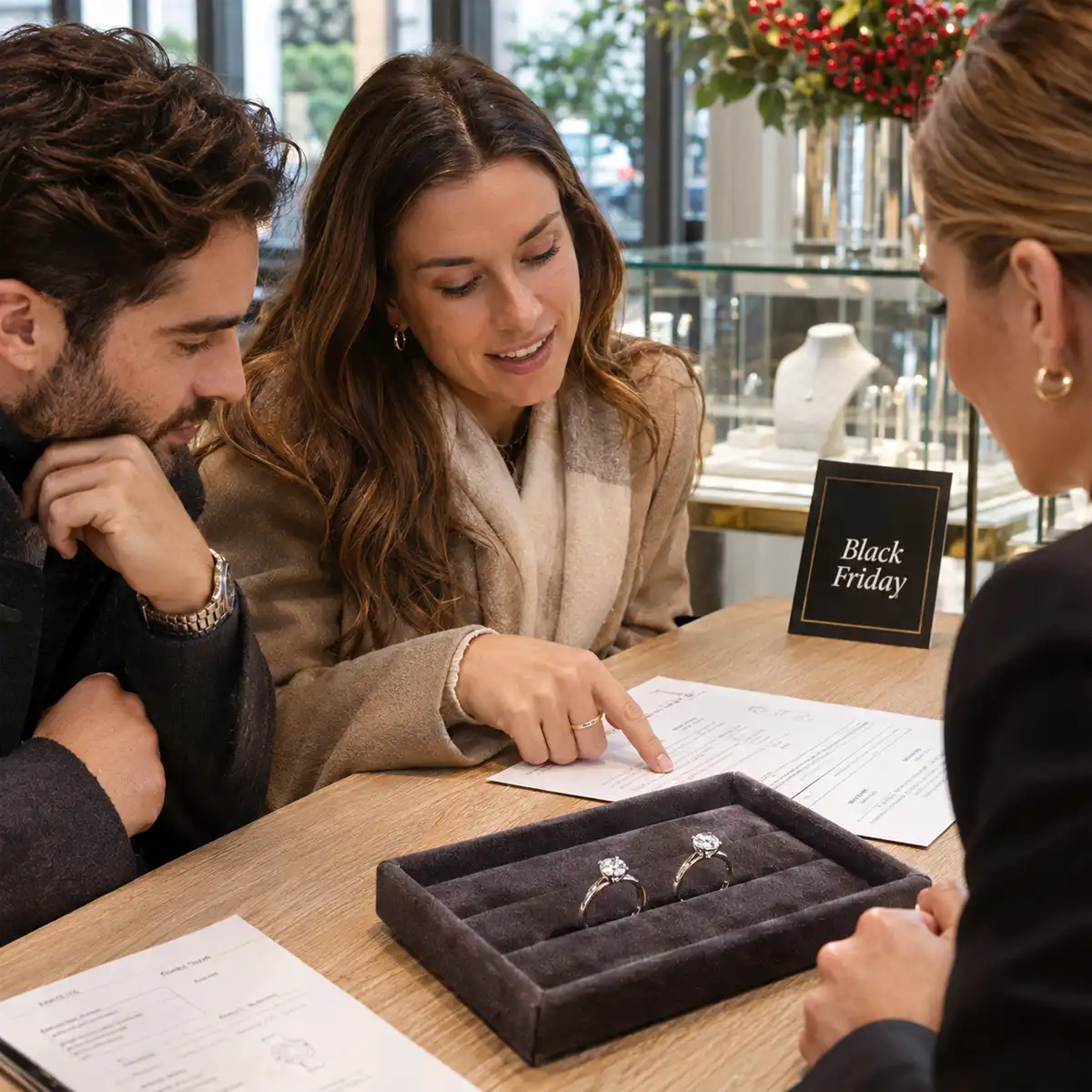
Matching the certificate and the hallmark to the ring in the box
Buy certified is the advice repeated on almost every engagement ring page. On its own, the advice is incomplete.
A grading report describes one loose stone on the day a laboratory examined it, and it protects a buyer only if that stone is demonstrably the one in the ring.
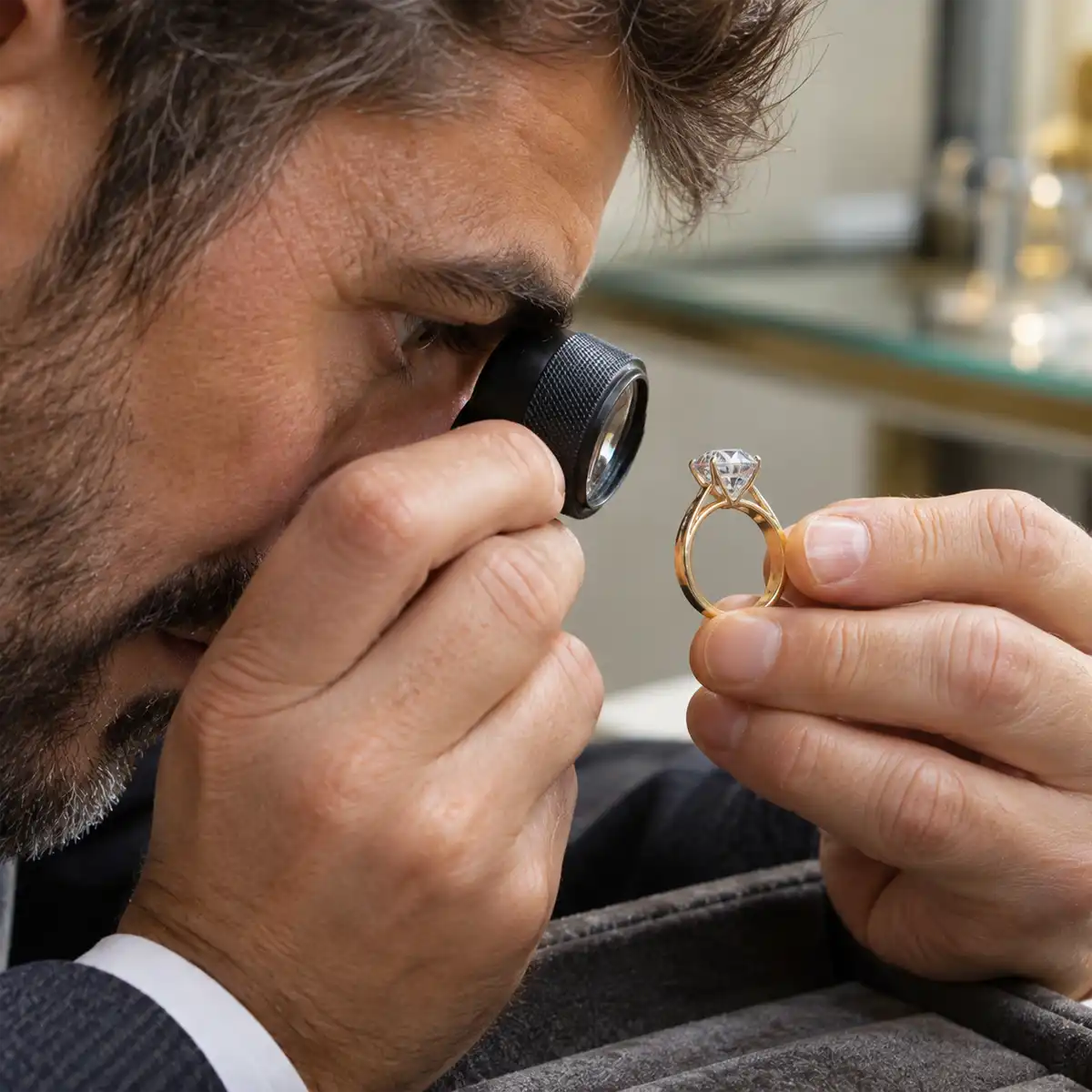
The match is physical. A report number can be laser-inscribed on the girdle, and a jeweller with a loupe can show inscription and report side by side before any money changes hands. Check the number on the laboratory's own online report service afterwards. A discount on Black Friday engagement rings that arrives with a report to follow is a discount on an unverified stone.
Grades no longer read the same across laboratories. Since 1 October 2025 a GIA report on a laboratory-grown diamond, now called a Laboratory-Grown Diamond Quality Assessment, places the stone as Premium or Standard instead of on GIA's natural colour and clarity scales. GIA's Premium needs D colour, VVS clarity or better and excellent polish and symmetry; its Standard floor is E to J colour and VS clarity. Every stone GIA assesses is inscribed Laboratory-Grown with the assessment number.
IGI went the other way, saying in July 2025, as IDEX reported, that it would keep applying the 4Cs to natural and laboratory-grown stones alike. A Black Friday listing that reads laboratory-grown, E colour, VS1 is therefore quoting an IGI grade, not a GIA one, and the house should be named beside it.
For natural diamonds GIA still grades colour on its D to Z scale, so the comparison between two natural stones holds as long as both reports come from the same house.
The metal has its own proof. Under the Hallmarking Act 1973, gold or palladium over 1 gram, platinum over 0.5 gram and silver over 7.78 grams cannot be described as precious metal unless hallmarked. The marks confirm the fineness and the assay office that tested the mount, and nothing about the diamond set in it. An unmarked band sold as 18 carat white gold or platinum above those weights is a reason to walk away whatever the reduction.
Returns, resizing and insurance before a Christmas proposal
Black Friday engagement rings bought online can be cancelled for any reason until 14 days after delivery, with the refund due within 14 days of the ring going back. Resizing first can end that right, because goods made to a buyer's specification are excluded, and some jewellers' policies treat an altered ring the same way.
The cancellation window comes from regulation 30 of the Consumer Contracts Regulations 2013 and the refund deadline from regulation 34. The exclusion for goods made to the consumer's specifications or clearly personalised sits in regulation 28. None of this applies to a ring bought over a counter, where a change of mind depends on the shop's own policy.
Fault is different. Under section 22 of the Consumer Rights Act 2015, a ring that is faulty, unfit or not as described can be rejected for a full refund within 30 days, in a shop or online, sale price or not. A stone that turns out to be laboratory-grown when the listing said natural is a not-as-described case.
Resizing is where timing bites. Goldsmiths' returns policy excludes items that have been customised, made to specification, engraved, personalised or altered, while leaving statutory rights for faulty goods untouched.
A ring delivered on 1 December therefore has a change-of-mind window to 15 December, and a resize before then can close it. For a Christmas proposal, the safer order is to confirm the size before buying, keep the ring unaltered until the decision is settled, then book the work. Our page on ring resizing and the rings that cannot be resized covers which designs resist it.
Insurance should start the day the ring arrives, not on 25 December. A Black Friday receipt records what was paid, which can sit well below the replacement value an insurer would face, so ask which figure sets the sum insured. Our breakdown of what engagement ring insurance covers and costs sets out the documents to have ready.
Before paying for any of the Black Friday engagement rings on offer on 27 November, ask the jeweller in writing for the dates the higher price was charged, and keep the reply. Read the product name for laboratory-grown or synthetic next to the word diamond, note which laboratory issued the report, and have the girdle inscription matched to it.
Look for the hallmark and the weight of the mount. Then put the delivery date and the end of the 14 days in a calendar, leave any resize until after that date, and arrange cover from the day of delivery. A Black Friday saving on an engagement ring is only as real as the date the higher price was last charged.