
This guide sets out how an engagement ring setting affects 3 separate things: how securely the stone is held, how the ring performs in daily wear, and how much of the price goes into metalwork rather than the stone. It uses standard UK trade terminology used by workshop jewellers and independent valuers, not marketing language from a single retailer. engagement-rings.net is a national directory rather than a Hatton Garden specialist, so the comparisons below are not tied to any one workshop or postcode; they apply to claw, bezel and pavé work carried out by any competent UK bench jeweller. 7 setting styles are covered here: claw (prong), bezel (rub-over), pavé, channel, three-stone, halo and solitaire. Each section explains what the setting physically does to the stone, where it is most likely to fail, and what to ask a jeweller before paying for it. Trade names are used throughout, since retailer marketing terms do not always match bench terminology. None of this should be read as guidance on resale value or future worth.
A setting decides how much of a stone's edge is protected and how much of its light escapes.
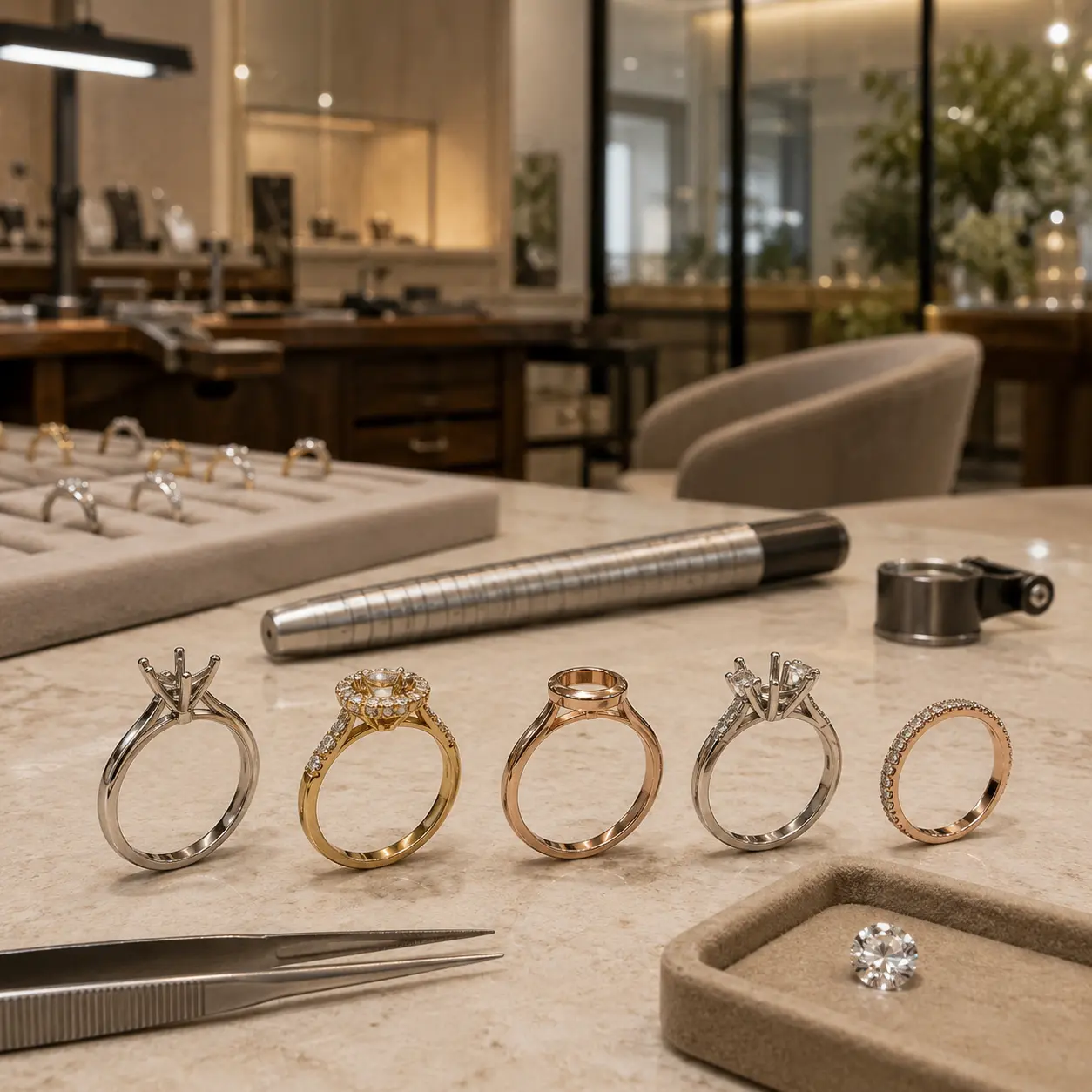
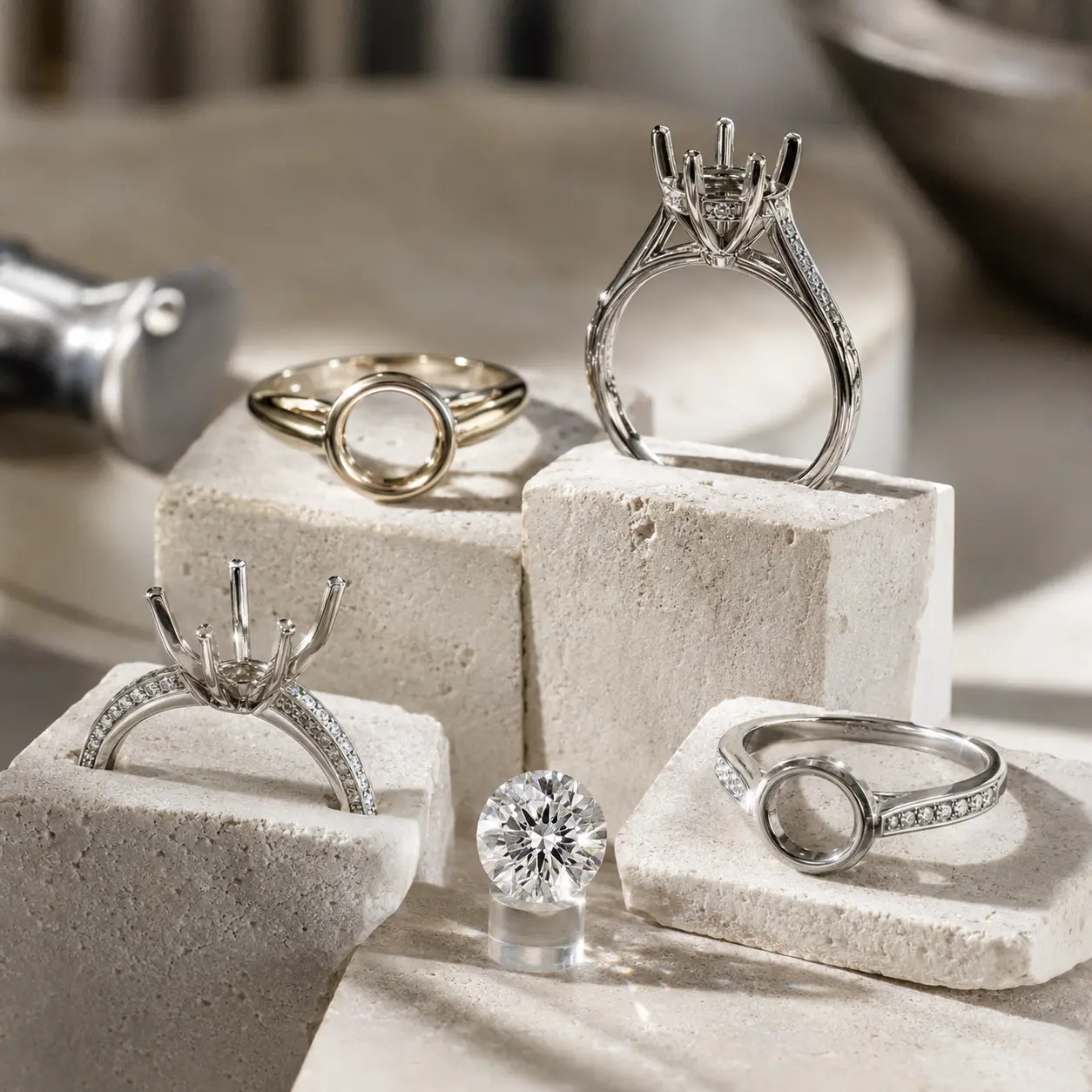
What an engagement ring setting actually controls
A setting is the metalwork holding a stone in place: the collet or head that grips it, the gallery beneath, and the shoulders connecting it to the shank. Its design decides how much metal covers the stone's edge, how exposed the girdle is to knocks, and how much dirt collects underneath the engagement ring setting over time.
The rub-over setting as a single piece of metalwork
A rub-over setting, also called a bezel setting, is a continuous rim of metal running around the entire girdle of the stone, pushed over the edge by hand or by machine until it grips on all sides. There is no gap between metal and stone edge because the whole girdle sits inside the rim. This construction removes the claw tips that usually catch on wool, hair and pockets, and it shields the girdle from chipping, which matters more with softer or heavily included stones. The trade-off is that a bezel covers more of the stone's outline, so a shallow or heavily included stone can look smaller in a rub-over than the same stone held in an open claw setting. A rub-over also suits cushion, oval and pear outlines particularly well, because the rim can be shaped by hand to follow an uneven girdle instead of gripping only at 4 or 6 fixed points. A jeweller can open the metal slightly at the shoulders to let in more light, but this is bench work carried out on request, not a standard feature, and it takes longer at the bench than fitting a pre-cast claw head. A rub-over can also be built high, leaving a gap beneath the stone for light to enter from underneath, or low, sitting flush against the finger for a smoother profile; the choice affects how much brilliance the stone shows without changing the security the rim provides.
Claw settings compared with bezel settings for daily wear
Claw and bezel settings solve the same problem, holding a stone against the shank, in different ways, and the choice changes how the ring behaves outside a jewellery box.
Light and visibility: a claw setting exposes most of the stone's girdle to light from the side, which most cutters rely on for full brilliance; a bezel setting covers the girdle and can mute the outer edge of a shallow cut.
Everyday snagging: claw tips catch on gloves, tights and hair; a bezel has no raised tips and sits flush against skin, which matters for anyone working with their hands.
Damage to the stone: a bezel protects the girdle from chips and is generally preferred for softer stones; a claw setting relies on 4 or 6 points of contact that can bend or wear thin over years of contact with worktops and fabric.
Cleaning: dirt collects behind claws and in the gallery; a rub-over has fewer crevices but is harder to clean underneath the rim itself without removing the stone.
Re-tipping and repair: claws wear down and need re-tipping every few years under normal wear; a bezel rim rarely needs this but is harder and more costly to open if the stone has to come out for cleaning or replacement.
Labour and metal use: a bezel rim uses more metal and more bench time to shape and polish than a cast claw head, which is one reason bezel work is often quoted as a separate labour charge rather than folded into a standard mount price.
For a sense of how these differences translate into actual workshop pricing on a given day, see [EDITOR: dated price observation].
A common misunderstanding about pavé and channel settings
Buyers often assume that pavé and channel settings are safer for small stones than claw settings because there are no protruding prongs to catch on clothing. This is only half right, and treating pavé and channel as carrying the same risk is the actual mistake.
In a pavé setting, each small stone sits in its own drilled seat and is held by tiny shared beads or claws raised from the surrounding metal. If 1 bead wears down, typically only the stone next to it can come loose, and a jeweller can usually re-raise a single bead without touching the rest of the row.
In a channel setting, there are no claws at all. The stones sit in a groove and are held purely by the pressure of the 2 channel walls squeezing the girdle. A single knock hard enough to spread that channel can loosen every stone along the row at once, because they all depend on the same 2 walls. Channel-set stones are also harder to inspect individually, since there is no gap between metal and stone to check under a loupe. Repairing a spread channel usually means the whole row is reset at once, which takes longer and costs more than re-raising one pavé bead. Which setting is safer for small stones depends on which failure a buyer is trying to avoid, not on which style looks like it has fewer visible metal points. Anyone comparing a pavé engagement ring setting against a channel one should ask which repair method applies, since the answer determines both cost and how long the ring will be away from its owner for the work.
How to check an engagement ring setting before paying
A short set of checks at the point of sale catches most problems before they become expensive to put right.
Ask the jeweller to name the setting type on the receipt or invoice, not just describe the ring's overall style.
Confirm which metal is used for the claws, rub-over rim or channel walls, since this can differ from the metal used in the shank.
Ask to see the stone under a loupe or microscope, checking for gaps between metal and girdle and for any claws that are already thin or uneven.
Request the stone's grading report from GIA, IGI or HRD, and check that the report number matches any laser inscription on the girdle.
Ask how often the setting should be checked and re-tipped, and get any free inspection offer confirmed in writing.
Check the hallmark on the shank matches the metal claimed on the receipt.
Ask how resizing will affect the setting, since stretching or shrinking a shank can distort a channel or loosen a bezel rim.
Arrange an independent valuation and inspection within the retailer's return period, not after it has closed.
Which setting suits a solitaire, three-stone or halo design
A solitaire holds one stone alone in a claw or bezel setting with nothing beside it. A three-stone setting flanks the centre stone with 2 side stones sharing the shoulders. A halo surrounds the centre stone with a ring of small pavé stones, adding perceived size and a layer of metal that can mask minor girdle damage.
Before paying for any ring, ask the jeweller to name the setting type in writing, confirm which metal is used for the claws or rub-over rim, and request the stone's certificate from GIA, IGI or HRD with the report number checked against any girdle inscription. Ask how the setting will be inspected and re-tipped over time, and get that commitment in writing if it forms part of the sale. Have the finished ring independently valued and examined under magnification within the return period, not afterwards. A setting is metalwork with an ongoing maintenance need, not a single decision made at the counter, and checking it properly protects both the stone and the money already spent on it. None of these checks take more than a few minutes, and any jeweller unwilling to answer them is worth questioning.