
The two ring silhouettes that dominate the UK engagement market account for roughly 70% of all bridal commissions, and the comparison between them is the comparison most UK couples actually face in the showroom. Halo and solitaire engagement rings sit at opposite ends of the visual spectrum: the halo built around maximised perceived size and surrounding sparkle, the solitaire built around the unambiguous focus of a single centre stone. The choice between them affects not only the engagement ring itself but how the wedding band will eventually sit beside it, which is a consideration most retailer comparisons overlook entirely.
This guide treats both choices on their structural and stylistic merits, with the matched-band implications addressed where they materially affect the decision.
What each silhouette actually is
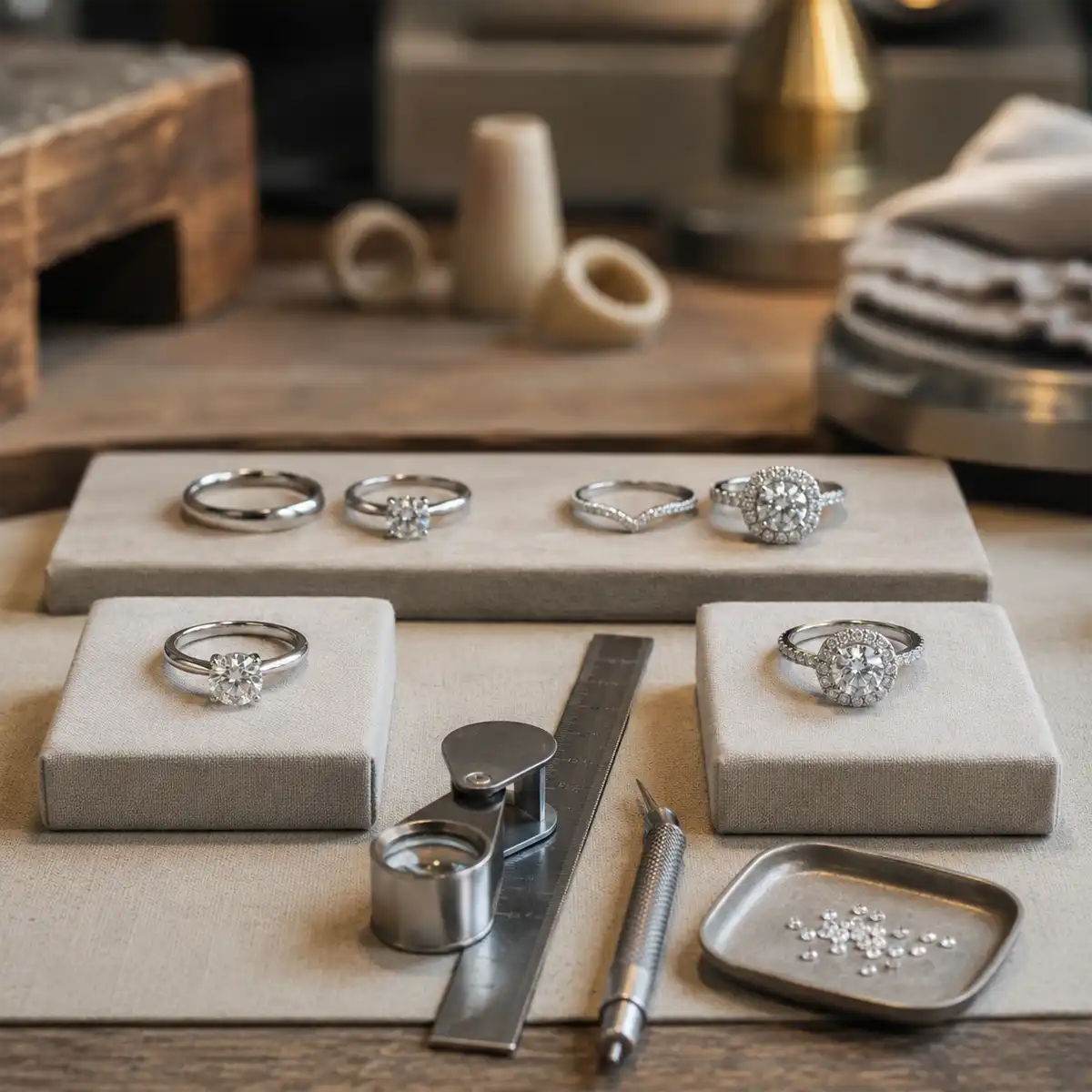
A solitaire engagement ring features a single centre stone held in a setting, typically a four-claw or six-claw configuration, on a plain or detailed band. The visual reading is centred entirely on the centre stone, with the metal of the setting acting as a frame rather than a competing visual element. The Tiffany Setting introduced in 1886 established the modern solitaire archetype, and its influence runs through the majority of UK solitaire designs in 2026.
A halo engagement ring features a centre stone surrounded by a continuous ring of smaller pavé-set diamonds, called the halo, which sits at the level of the centre stone or just below it. Variants include the hidden halo, where the surrounding pavé diamonds sit beneath the centre stone visible only from side angles, and the double halo, where two concentric rings of pavé diamonds surround the centre. Halo designs grew through the 2000s and 2010s on the back of celebrity bridal coverage and have settled into the second-most-requested silhouette across the UK market.
The perceived size question
The headline argument for the halo design is the perceived size advantage, and the numbers behind that argument matter for the comparison. A 1.00-carat round brilliant centre stone in a halo setting reads to the eye as approximately 1.30 to 1.50 carats, depending on the halo's diameter and the size of the surrounding pavé stones. The visual uplift of 30% to 50% comes from the continuous reflective ring around the centre stone, which the eye reads as part of the centre stone unless examined closely.
The financial implication is straightforward. A buyer paying £4,000 for a 1.00-carat solitaire produces a ring that reads as 1.00 carats. The same buyer paying £4,000 for a 0.75-carat centre stone in a halo setting produces a ring that reads as approximately 1.00 to 1.10 carats on the hand. For buyers who prioritise visible size at fixed budget, the halo route delivers more apparent stone for the money.
The trade-off, which retailer comparisons rarely state, is that the perceived size advantage is most pronounced at the 0.50 to 1.00-carat range. Above 1.50 carats, the halo's relative contribution diminishes as the centre stone becomes large enough to dominate the visual reading regardless of the surround.
The pavé stone-loss reality
The long-term consideration that most retailer comparisons skip is the maintenance reality of pavé-heavy designs across decades of daily wear. Halo settings hold their surrounding diamonds in micro-pavé configurations, with each small stone secured by tiny grains of metal pushed up from the surrounding setting. Across 10 to 20 years of wear, these grains can wear down, loosen, and occasionally release a stone.
UK ateliers report that halo engagement rings returned for maintenance after 10 years of continuous wear show pavé stone loss at rates of 1% to 5% of the original surrounding stones, depending on the wearer's lifestyle. The replacement cost for a single lost pavé diamond, including resetting, runs to £80 to £180 at most UK independent jewellers. Across a 20-year wear horizon, the cumulative maintenance cost on a halo design typically exceeds £400 to £800 in pavé maintenance alone.
A solitaire setting has no pavé stones to lose. The single centre stone is held by claws that may require retipping after 15 to 25 years, but the maintenance cost is concentrated on a single structural element rather than distributed across dozens of small stones.
A snippet-ready summary for buyers weighing long-term maintenance: halo engagement rings typically require pavé maintenance every 5 to 10 years, with cumulative costs of £400 to £800 across a 20-year wear horizon. Solitaire engagement rings concentrate maintenance on the centre stone setting, with claw retipping at 15 to 25-year intervals costing £80 to £150 per service. The maintenance burden is one of the genuine practical differences between the two styles.
Resizing tolerance and modification
A practical consideration that becomes significant when life circumstances change is how each silhouette handles resizing. A solitaire on a plain band resizes easily at most UK ateliers, with a standard resize costing £40 to £80 and taking 5 to 10 working days. A solitaire on a pavé-detailed band resizes within a smaller tolerance because the pavé stones along the band cannot be expanded without removing and resetting them.
A halo setting resizes within significant constraints. The halo itself cannot be modified, which means the resize must work entirely within the band's tolerance below the halo. Most halo designs accommodate one full size up or down without major modification. Beyond that range, the resize requires partial reconstruction of the band at significantly higher cost (£150 to £400) and longer turnaround.
For buyers who anticipate weight fluctuation, pregnancy, or other circumstances that affect ring size, the resizing tolerance is a genuine factor. A solitaire offers the broader tolerance; a halo accommodates change within a narrower range.
How each style pairs with the wedding band
The consideration most exclusive to the bridal-journey perspective is how each engagement ring style pairs with the wedding band that will eventually sit beside it. This is where the halo-versus-solitaire decision extends beyond the engagement ring into the full bridal set.
A solitaire engagement ring with a slightly elevated centre stone pairs naturally with a flat or court-profile wedding band sitting flush against the engagement ring with no gap. The matched set reads as architecturally clean, with the wedding band acting as a structural counterpart to the engagement ring rather than a visually competing element. UK ateliers typically design these pairs together at the engagement ring stage if the buyer wants the eventual pairing pre-considered.
A halo engagement ring presents a different pairing challenge. The halo's diameter typically exceeds the engagement ring's band width, which creates a gap between a straight wedding band and the engagement ring when worn together. The two solutions are a fitted band shaped to follow the contour of the halo, or a contoured band with a curve that wraps around the halo's lower edge. Both solutions work well, but both add cost and require the wedding band to be designed specifically for the engagement ring rather than chosen from a standard collection.
The fitted band route typically costs £400 to £800 in 18ct gold or £550 to £1,100 in platinum at UK ateliers in 2026, against £300 to £600 for a standard straight band that pairs with most solitaires. The differential is the pairing premium that halo engagement rings carry into the wedding band stage.
Fun fact: The hidden halo configuration, where pavé diamonds sit beneath the centre stone visible only from profile angles, was popularised in UK bridal commissions through 2018 to 2022 as a compromise between the surrounding-sparkle of a full halo and the cleaner top-down reading of a solitaire, and now accounts for a significant share of UK engagement ring requests.
How each style ages across decades
A consideration that matters for heirloom-intent buyers is how each style ages across stylistic cycles. The solitaire design has aged extremely well across 140 years since the Tiffany Setting introduction. A solitaire engagement ring made in 1890 reads as essentially the same archetype as a solitaire made in 2026, with detail variations in claw count and band width that are stylistic rather than period-tagging.
The halo design has a shorter and more variable history. Halo configurations existed in Edwardian and Art Deco jewellery, declined through the mid-20th century, and re-emerged through the 2000s in their current form. A halo engagement ring purchased in 2026 will read as period-tagged to the 2000s-2020s era within a 30-year horizon, in the same way that 1980s halo variants now read distinctly as 1980s pieces.
This is not an argument for solitaire over halo; it is an observation about how each style's visual identity ages. A buyer thinking in heirloom terms about how the ring will read in 2056 has different priorities than a buyer thinking about how the ring reads in 2026.
What UK price geometry looks like at each style
At equivalent centre stone specifications, the two silhouettes price differently because the halo includes significant additional pavé work. A 1.00-carat round brilliant solitaire at G colour, VS2 clarity, in 18ct white gold or platinum, prices at £4,500 to £6,500 at UK independent jewellers in 2026. The same centre stone in a halo setting prices at £5,500 to £8,000, reflecting the additional pavé stones (typically 0.20 to 0.40 carats of melée diamonds in the halo) and the additional setting labour.
For lab-grown equivalents, the relationship holds: the solitaire prices below the halo by a similar margin, though the absolute prices are 75% to 85% lower at both silhouettes.
Which style suits which buyer
Solitaire suits the buyer who prioritises long-term timelessness, lower maintenance burden, broader resizing tolerance, simpler wedding band pairing, and unambiguous visual focus on the centre stone. Halo suits the buyer who prioritises maximised perceived size at fixed budget, surrounding sparkle, and a more elaborate aesthetic. Both styles are entirely legitimate choices, and neither is structurally wrong.
The matched-band consideration tips the decision for buyers who want their wedding band selection to be straightforward; the perceived-size consideration tips the decision for buyers who want maximum visible stone at a fixed price. The lifestyle consideration of pavé maintenance tips toward solitaire for active wearers; the visual-impact consideration tips toward halo for buyers who want a more elaborate engagement ring statement.
Closing thoughts for the buyer at this stage
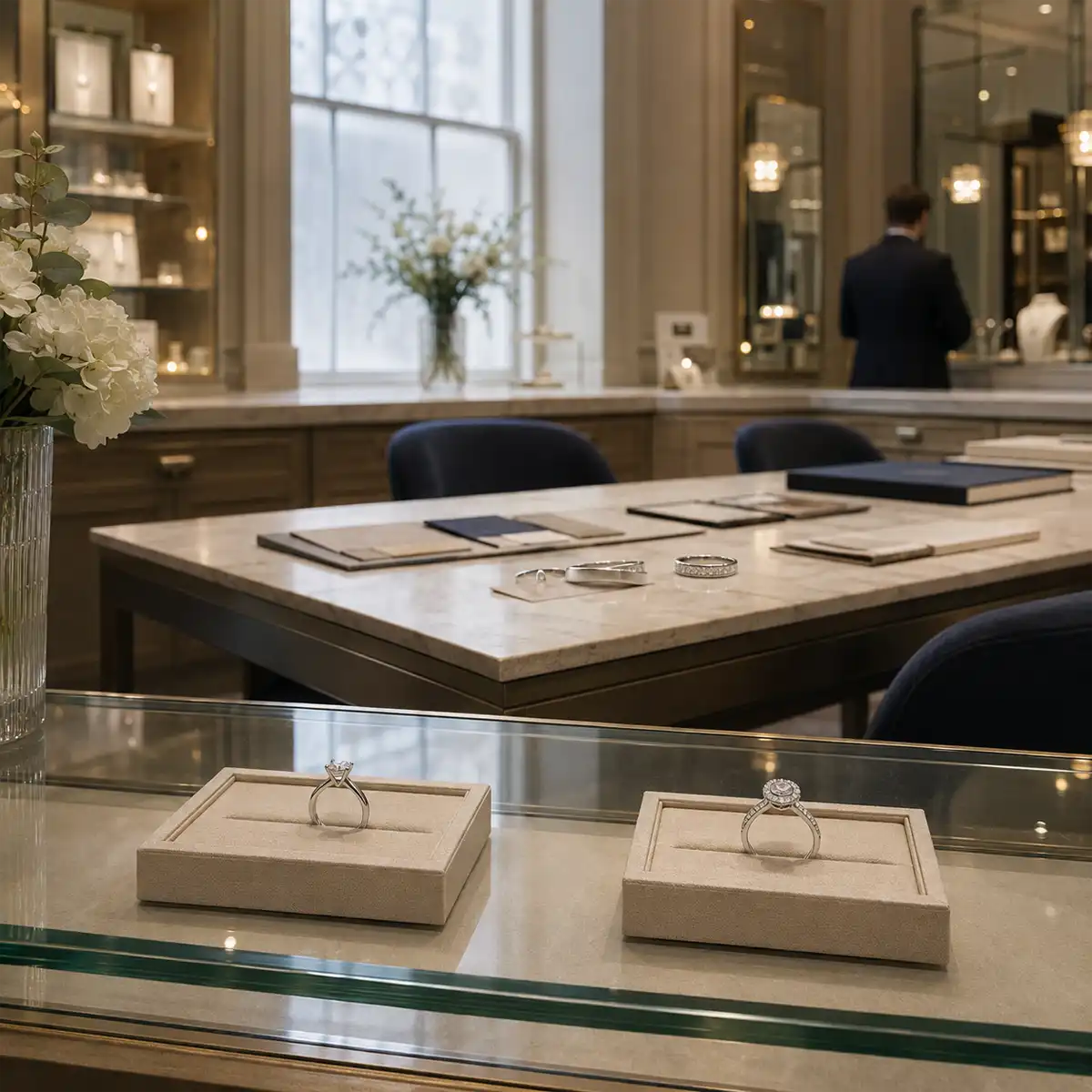
If you are weighing halo vs solitaire engagement rings, the most useful action is to view both styles side by side under daylight-balanced light, with a fitted wedding band beside each, so the eventual full bridal set is visible at the comparison stage rather than imagined. UK ateliers will arrange this comparison on request, particularly if the conversation is positioned as a long-term planning discussion rather than a same-day purchase. Seeing the full set at the engagement ring decision stage prevents the wedding band gap surprise that catches many buyers 12 to 18 months later.
Once the silhouette is settled, the question of how to commission the eventual set into a coherent design becomes the next consideration, and the bespoke commission route opens the broadest range of pairing possibilities.