
Lab-grown diamonds are the fastest-growing part of the UK jewellery trade, and confusion about how they compare with natural diamonds is common among buyers. This guide sets out the facts on a factual basis: gemmological composition, the grading reports issued by GIA, IGI, and HRD, the real price gap seen in UK retail, and what happens when either type is resold. It does not treat any diamond, lab-grown or natural, as a financial product. Diamonds are a purchase for personal use, and this guide is written on that basis throughout. Every claim about resale is presented as a range to check locally rather than a fixed figure, because resale prices vary by retailer, condition, and market conditions at the time of sale.
What Lab-Grown Diamonds Are
Lab-grown diamonds are diamonds grown in a controlled laboratory setting using CVD or HPHT processes, rather than formed underground over geological time. The crystal structure, carbon composition, and optical properties match natural diamonds exactly. The only meaningful difference is origin, which is why the term lab-grown diamonds must always appear next to the word diamond on any listing or receipt.
Gemmologically, a lab-grown diamond and a natural diamond are both crystallised carbon with the same hardness, refractive index, and fire. Standard handheld testers used in jewellery shops mostly check for diamond versus simulant, such as moissanite or cubic zirconia, and do not by themselves distinguish lab-grown diamonds from natural stones. That distinction requires specific screening equipment and a grading report from a recognised laboratory.
To the naked eye, and even under a jeweller's loupe in most cases, a lab-grown stone set into a ring looks no different from a natural one of the same grade. This is precisely why disclosure at the point of sale matters more than any visual check. A shopper cannot rely on appearance to know what they are buying, and no honest retailer expects them to; the paperwork carries the information the eye cannot.
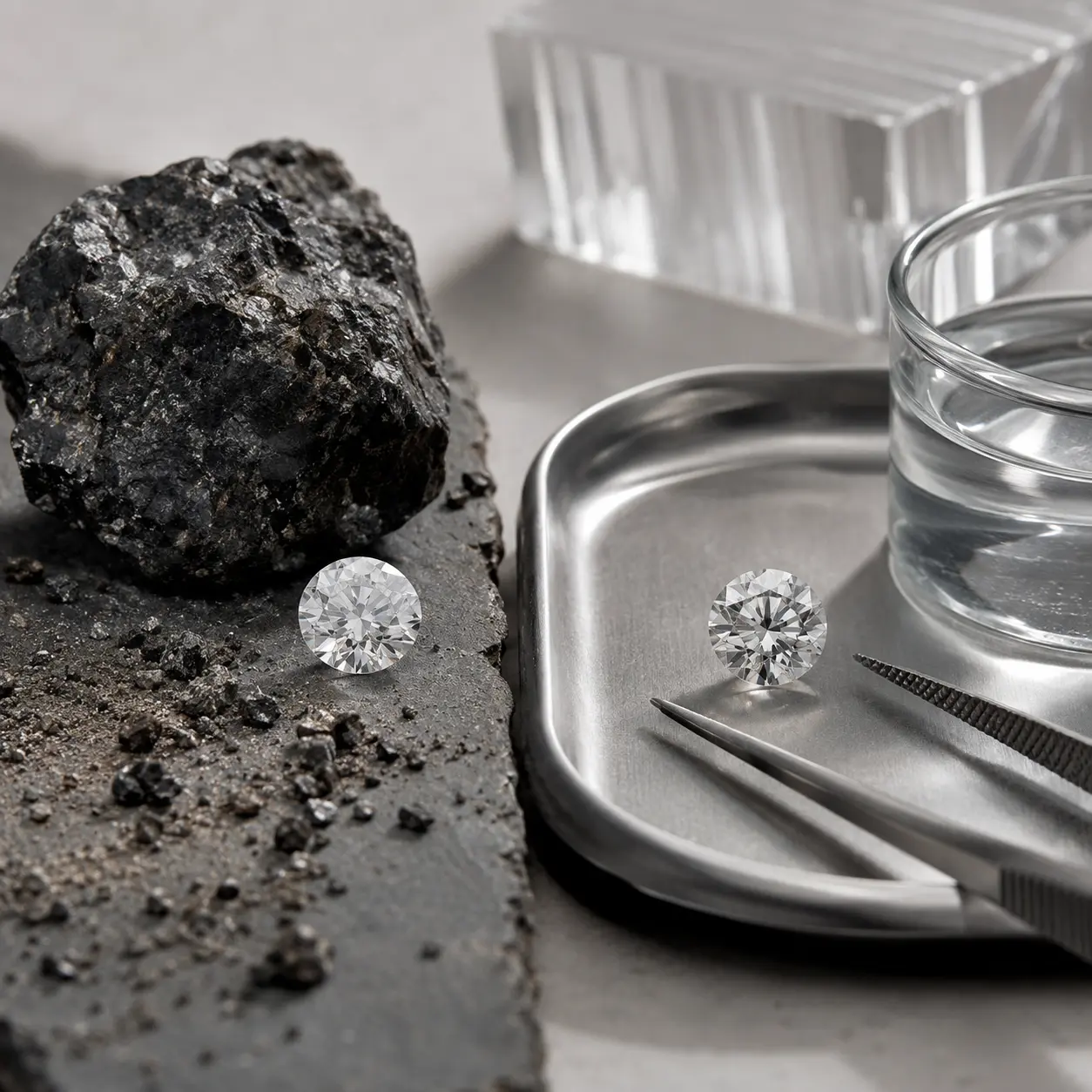
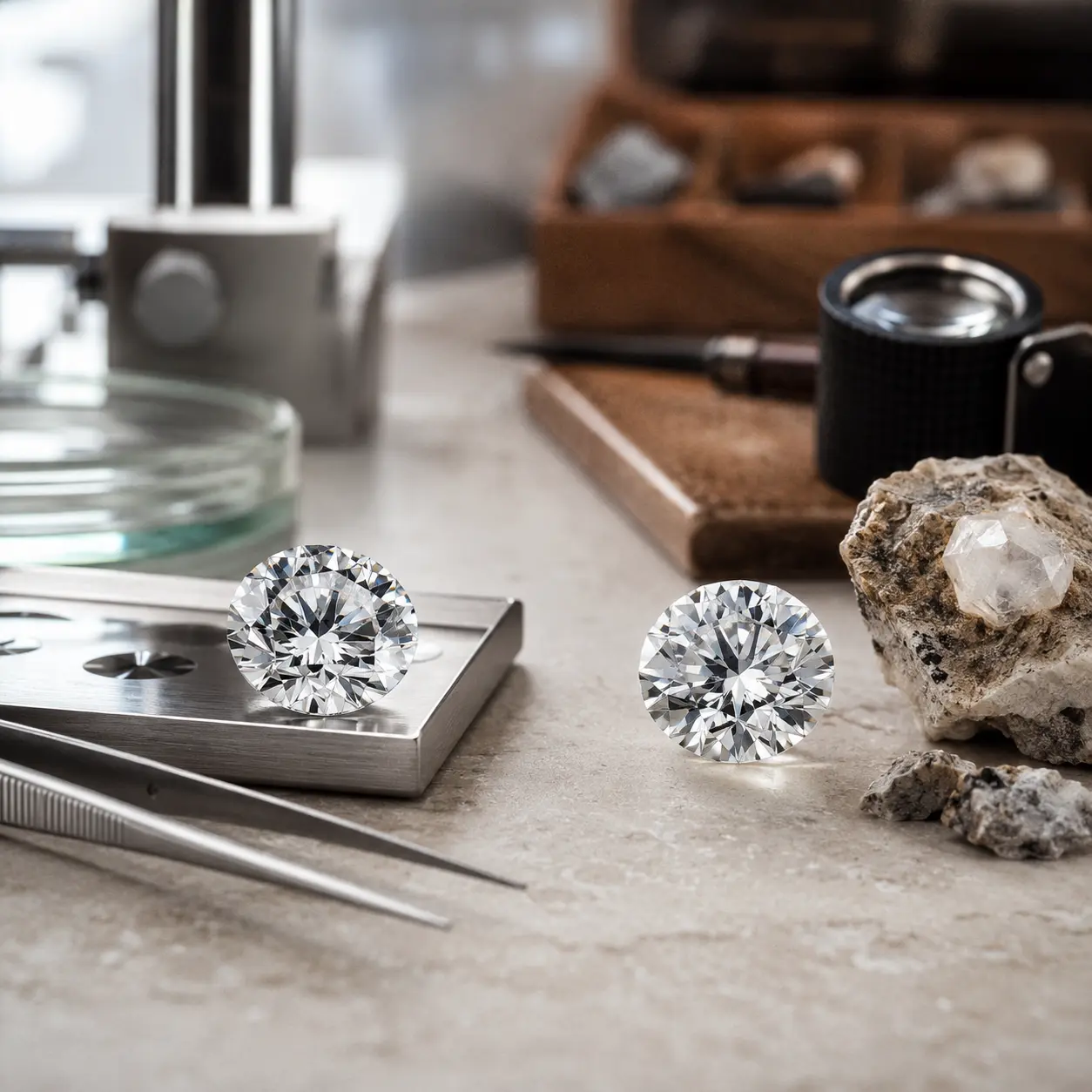
How Lab-Grown Diamonds Are Identified and Certified
Every lab-grown diamond sold through a reputable UK retailer should carry two things, a girdle laser inscription and a grading report. The girdle laser inscription is a microscopic marking cut into the edge of the stone, usually including the report number and, in most cases, the words lab-grown or laboratory-grown. It is readable only under 10x magnification and cannot be removed without altering the stone.
The grading report itself is issued by a laboratory such as GIA, IGI, or HRD. It records the same 4Cs used for natural diamonds, colour, clarity, cut, and carat weight, and states plainly that the stone is laboratory-grown. A report from GIA on a lab-grown diamond looks visually similar to a natural-diamond report but is printed on a different coloured border specifically so the two are not confused at a glance. Any listing that omits the words lab-grown or laboratory-grown next to the word diamond, whether in a shop, online, or on an invoice, falls short of what UK buyers should expect.
Behind the certificate, gemmological laboratories use equipment ordinary retailers do not have on the premises, including photoluminescence spectroscopy and specialist imaging systems, to confirm growth method beyond doubt. These tools detect trace signatures left by the growth process itself, quite separate from colour, clarity, cut, or carat. A jeweller who cannot produce a laboratory report, and instead offers only a verbal assurance about origin, is not meeting the standard this guide sets out for either lab-grown or natural stock.
Lab-Grown Diamonds Compared With Natural Diamonds on Price and Rarity
Physically, lab-grown diamonds and natural diamonds are close to indistinguishable without laboratory equipment. Commercially, they diverge sharply.
Formation: natural diamonds form over roughly 1 to 3 billion years under extreme heat and pressure underground; lab-grown diamonds are produced in a matter of weeks using CVD or HPHT methods.
Price: lab-grown diamonds typically retail at 30% to 85% less than a natural diamond of equivalent size and grade, with the gap widening as carat weight increases.
Rarity: natural diamonds are a finite, geologically limited resource; lab-grown diamonds can be produced to match demand, which is the main driver of the price gap.
Type: most lab-grown diamonds sold for jewellery are type IIa, a chemically purer classification that also occurs, more rarely, in nature.
Certification: both should carry a report from GIA, IGI, or HRD naming the stone's origin explicitly.
Neither category should be described using the word synthetic on its own, since that term has been used loosely and inconsistently across the trade. The accepted description is lab-grown diamond or laboratory-grown diamond, used consistently and never swapped with the word natural on the same item.
Internally, the two also carry different growth signatures that a laboratory can read. HPHT stones sometimes show metallic flux inclusions left over from the growth process, while CVD stones can show fine graining patterns running through the crystal. Natural diamonds tend to show mineral inclusions formed underground, such as tiny crystals of other minerals trapped during formation. None of these features are visible without magnification, and none affect how the finished stone performs once cut, polished, and set.
How CVD and HPHT Production Works
Lab-grown diamonds are produced using one of two methods.
Chemical vapour deposition, CVD, places a thin diamond seed plate in a sealed chamber filled with carbon-rich gas. The gas is heated until carbon atoms detach and settle on the seed plate layer by layer, building a diamond crystal over several weeks.
High pressure high temperature, HPHT, recreates the conditions found deep underground. A carbon source and a diamond seed are placed under extreme pressure and heat inside a press, causing carbon to crystallise onto the seed over a period of days to weeks.
After growth, the rough stone is cut and polished using the same equipment and skills used for natural diamonds. It is then sent for independent grading, where the laboratory records the 4Cs and confirms the growth method on the report. Because the finished stone is chemically identical to a natural diamond, the production method has no bearing on durability, hardness, or day-to-day wear.
Some CVD stones are given a further HPHT annealing step after growth to improve colour before they reach a grading laboratory. This is a recognised part of production, not a defect, and a properly issued grading report will note any post-growth treatment applied. The finished quality control standard, whether the stone began as CVD or HPHT, is the same independent report used for natural diamonds, checked against the same 4Cs criteria by the same laboratories.
Do Lab-Grown Diamonds Hold Their Value
Neither lab-grown diamonds nor natural diamonds should be bought as a way of growing money. Both typically resell for well below their original retail price, since retail prices include cutting, certification, and retailer margin that private resale does not recover. Lab-grown diamonds often lose a larger share of that value than natural diamonds.
Resale figures are volatile and vary by retailer, region, and the specific stone, so any percentage quoted here would age quickly. [EDITOR: dated resale figure with market] is the placeholder this guide uses rather than inventing a number that might mislead a reader months from now.
What stays consistent is the underlying reason for the gap. A diamond's retail price reflects the full supply chain, cutting, polishing, certification, marketing, and the retailer's margin. A resale buyer, whether a private individual or a dealer, is only paying for the raw stone's grade and current market appetite, not any of the costs that built the retail price. Lab-grown diamonds and natural diamonds both typically resell for well below their retail price, and no reputable jeweller should present either as an appreciating item.
Insurance valuations add a further point of confusion worth separating out. An insurer's replacement valuation reflects the cost of buying an equivalent stone new, at retail, which is why it sits far above what a private resale or a dealer buy-back would offer. A buyer who sees a high insurance figure on a valuation certificate should understand it as a replacement cost, not as evidence of what the stone would fetch if sold on, whether it is a lab-grown diamond or a natural diamond.
Questions to Ask Before Buying
A few checks apply regardless of whether the stone under consideration is a lab-grown diamond or a natural diamond.
Does the listing state clearly, next to the word diamond, whether the stone is lab-grown or natural?
Is there a grading report from GIA, IGI, or HRD, and does it name the growth method?
Can the girdle laser inscription be shown under magnification in person or via a clear photograph?
Has the retailer given a written breakdown of carat, colour, clarity, and cut, each tied to the report rather than a verbal estimate?
Has resale been discussed honestly, as a loss against retail price, rather than framed as a value-holding purchase?
Is any insurance valuation offered clearly labelled as a replacement cost rather than a resale estimate?
Does the retailer confirm that cleaning, resizing, and day-to-day care are identical for both stone types?
A retailer who answers all seven without hesitation, and who is willing to put the answers in writing, is dealing in lab-grown diamonds and natural diamonds on the same honest terms this guide has set out.
Buyers comparing lab-grown diamonds against natural diamonds are best served by working from the grading report rather than the sales pitch. Ask which laboratory issued it, GIA, IGI, or HRD, and confirm the report states the growth method in writing next to the word diamond. Ask for the girdle laser inscription to be shown, not just described. Ask what the retailer would expect the stone to resell for today, in writing, rather than in general terms. None of this changes how a lab-grown diamond or a natural diamond looks or wears once set. It does determine whether the price paid was fair, disclosed correctly, and understood as a personal purchase rather than a financial one.