
This guide sets out what the 4Cs framework, carat, colour, clarity and cut, actually records on a diamond grading certificate, and where the 4Cs stop matching what a buyer sees with the naked eye. The information follows the published grading scales used by the three laboratories that dominate certification in the UK trade, GIA, IGI and HRD, together with the technical relationship between cut proportions and light return that graders themselves rely on when assessing a stone beyond its paper grade. engagement-rings.net is an independent UK directory of jewellers; we hold no stake in any single retailer, laboratory or stone, and no listing here is paid to appear more favourably than another. The aim is not to recommend a specific diamond, but to separate which parts of the 4Cs change appearance, which mainly change price, and which questions a buyer should put to a jeweller before paying for a graded stone.
What the 4Cs framework records on a grading certificate
A grading certificate from GIA, IGI or HRD records four measurements, carat weight, colour grade, clarity grade and, for round brilliants, a cut grade, plus a plot of inclusions and a set of proportions. It does not score how a stone looks face-up or how it reads under different light.
Carat measures weight, not size. Two stones of identical carat weight can show a different diameter face-up depending on how deep or shallow the cut runs. Colour is graded on GIA's D to Z scale, from colourless through to noticeably tinted, and most buyers cannot separate adjacent grades once a stone is mounted, particularly from H downward. Clarity runs on a scale from Flawless through Included 3, plotting the position, size and type of inclusions rather than simply counting them. Cut grade is issued only by GIA, and only for standard round brilliants; fancy shapes such as cushion or emerald cuts are described by proportions instead, without a single overall cut score. Of the 4Cs, cut is the one most consistently tied to how bright a stone looks face-up, reading the 4Cs correctly means treating each grade as a measurement, not a verdict on appearance.
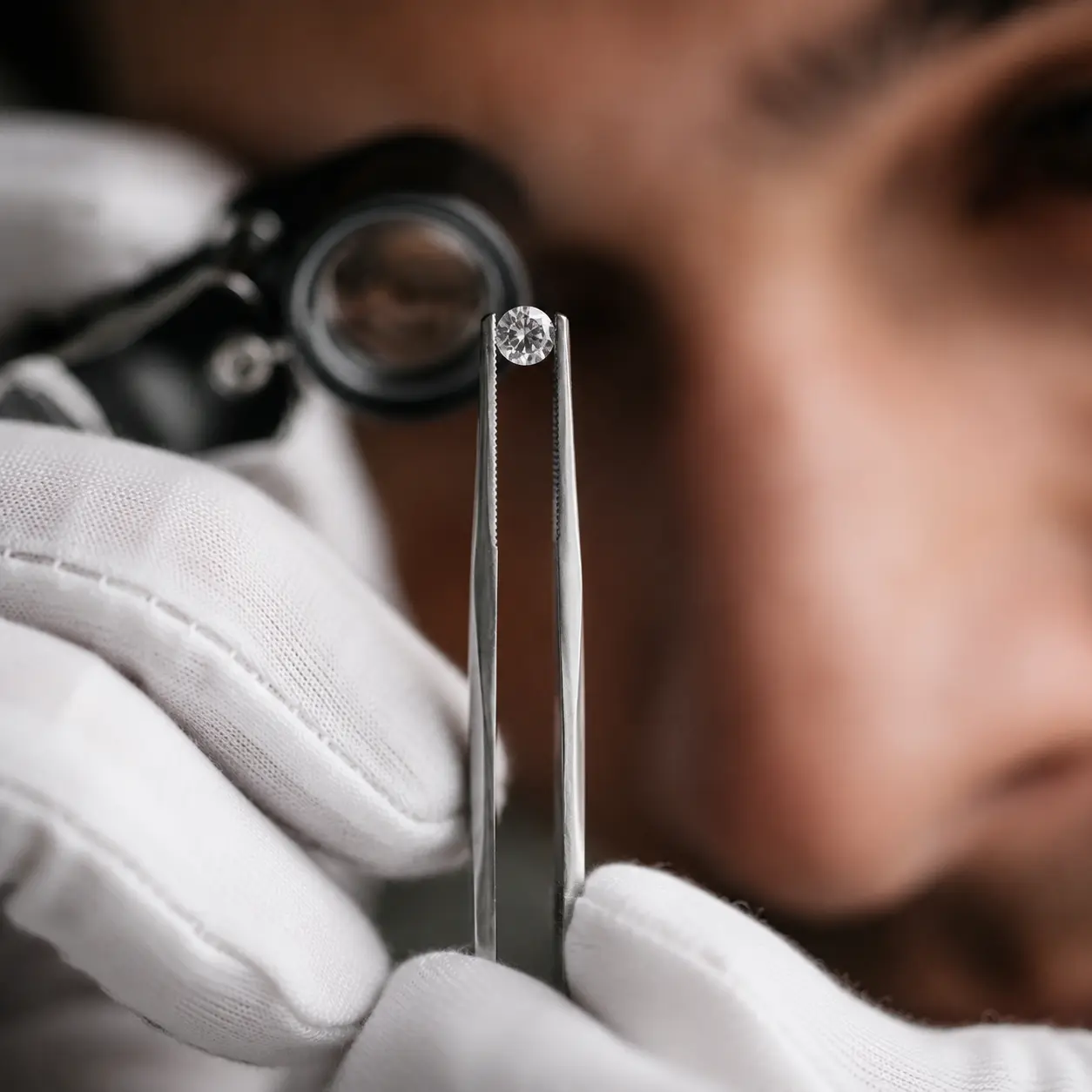

The advice to buy the highest grade you can afford does not hold up
The common advice given to first-time buyers is to buy the highest colour and clarity grade the budget allows, treating the 4Cs as though every grade step buys an equal amount of visible difference. Tested against how these stones actually look once mounted, that reading of the 4Cs does not hold up past a certain point.
A GIA G colour diamond and a GIA D colour diamond, both mounted and viewed face-up under ordinary indoor light, are not reliably separated by an untrained eye. The difference between adjacent colour grades is legible mainly to a trained grader working with loose stones, master comparison stones and controlled daylight-equivalent light, not to a buyer looking at a ring on a hand. The same applies to clarity, an IGI VS2 stone and an IGI VVS1 stone of the same shape and cut will look identical face-up if neither carries an eye-visible inclusion, and GIA's own clarity definitions note that many SI1 and some SI2 stones are eye-clean depending on the type and position of the inclusion rather than the grade name alone. [EDITOR: dated price observation] on the difference in price between a GIA G colour stone and a GIA D colour stone of equivalent size illustrates how much of that premium buys a difference only a grader can see.
Of the 4Cs, colour and clarity matter most below an eye-clean threshold, after that point cut and stone size do more visible work than a further step up either scale.
An Excellent cut against a Good cut of the same carat weight
This is the clearest case in the 4Cs where two stones can match on paper and still look different in the hand. Take two round brilliants of the same carat weight, the same colour grade and the same clarity grade, one graded GIA Excellent for cut and the other graded GIA Good. On paper, three of the four grades match exactly.
The Excellent-cut stone will typically carry a table percentage in the high 50s, a depth percentage around 60 to 62.5%, and crown and pavilion angles calculated to return light back through the top of the stone rather than leaking it out the sides or base. The Good-cut stone, cut to a shallower or deeper depth percentage to preserve carat weight from the rough, returns less light and shows duller brightness with less fire and scintillation, even though its colour and clarity grades read identically on the certificate. Girdle thickness affects the comparison too, a girdle cut too thin chips more easily in daily wear, while one cut too thick hides weight the buyer is paying for without adding visible size.
Between the two, the Excellent-cut stone wins on appearance and on durability at the girdle, despite matching, or even slightly losing, on carat weight once cut to better proportions.
What the 4Cs certificate leaves out
A certificate reporting the 4Cs does not disclose how fluorescence will look in that specific stone, does not translate polish and symmetry into plain language, and does not describe how a stone will appear under LED shop lighting compared with daylight. Two diamonds with identical 4Cs on paper can still look different once out of the display case.
Fluorescence is graded none, faint, medium, strong or very strong, describing how a stone reacts under ultraviolet light. Strong blue fluorescence can make a lower colour grade stone appear whiter in daylight, but in a small number of stones it also produces a slight haziness or oily look that the grade alone will not predict. Polish and symmetry are graded separately from cut, on a scale from Excellent to Poor, and both affect how cleanly light exits the stone, a stone with an otherwise strong cut grade but weak symmetry can still underperform its own certificate. None of this shows up by reading the 4Cs in isolation, it shows up by asking to view the stone loose, under more than one light source, before it is mounted or paid for.
A GIA report for a 1.01-carat round brilliant, read line by line
A GIA report for a 1.01-carat round brilliant might read as follows, colour G, clarity VS2, cut Excellent, polish Excellent, symmetry Very Good, fluorescence None, depth 61.5%, table 57%, girdle thin to slightly thick and faceted, culet none. Read in isolation, the grade line, GIA G colour, VS2 clarity, tells a buyer almost nothing about how that stone will look on a hand.
Reading the full report in order matters more than reading the grade line covering the 4Cs alone. The header carries the report number, shape and measurements, and that report number is what a buyer checks against the laboratory's own database to confirm the certificate matches the stone in front of them. Below the header sit the grading results, colour, clarity, cut, polish, symmetry and fluorescence, followed by a proportions diagram showing table percentage, depth percentage, crown and pavilion angles. Underneath that sits the plot, a diagram marking the position of each inclusion the clarity grade is based on. The comments field, often the smallest section on the page, is where a laboratory notes anything a single grade cannot capture, additional clouds, a treatment, or an unusual optical effect, and it is the section most buyers skip past.
Questions to ask before paying for a graded diamond
Before agreeing a price on a graded stone, a buyer working through the 4Cs should ask:
Which laboratory issued the report, GIA, IGI or HRD, and can the report number be checked against that laboratory's own database?
What is the exact cut grade, and for a fancy shape without an overall cut score, what do the proportions show instead?
Is any fluorescence recorded, and can the stone be compared against a non-fluorescent stone of the same colour grade under the same light?
Has the stone been treated, clarity-enhanced, laser-drilled or HPHT-processed, and is that noted in the comments field of the report?
What is the girdle thickness, and has it been faceted or left bruted?
Can the stone be viewed loose, out of the setting, under daylight-equivalent light as well as the shop's usual lighting?
Before paying for a graded stone, check the certificate number against the issuing laboratory's own database, GIA, IGI and HRD each publish one, and read the comments field for anything a single grade does not capture. Ask to see the stone in more than one light rather than relying on the grade names alone. A GIA G colour, VS2 clarity stone with an excellent cut and no fluorescence complications will typically look better on a hand than a higher graded stone let down by poor proportions. The 4Cs framework describes what a laboratory measured under controlled conditions, it does not describe how a stone will look in a shop, on a hand, or after years of wear, and it should sit alongside an inspection of the stone itself, not in place of one.