An 8 carat lab-grown diamond became a news story on 16 November 2026, when the Daily Mail reported a row between Adam Sullivan, a Gold Coast fitness entrepreneur, and the jeweller that made his fiancée's ring. Sullivan proposed to Avalon Nadfalusi on Hamilton Island. The jeweller, The Prestwick Place, then posted the ring on Instagram with a price of $37,000.
The report describes the stone as an 8 carat oval-cut lab-grown diamond. Sullivan objected that the price was published "without our permission". The jeweller told the paper the ring was one of its signature catalogue pieces and that it had not named or tagged the couple.
The dispute is about privacy. What readers will remember is the number. It raises a plain question for a UK buyer: what does a stone that size cost here, and what does the price actually measure. This piece answers from the retailers' own pages, read on 16 November 2026. Our explainer on lab-grown diamond prices, grading and resale covers the wider market.
How much does an 8 carat lab-grown diamond ring cost in the UK
On 16 November 2026, 2 London jewellers' own pages put an 8 carat lab-grown diamond ring between £6,950 and about £16,300 at retail. KJJ listed a finished 8.01 carat oval ring for £6,950. Revé Diamonds gave around £16,300 as the starting price for a round stone in a plain solitaire.
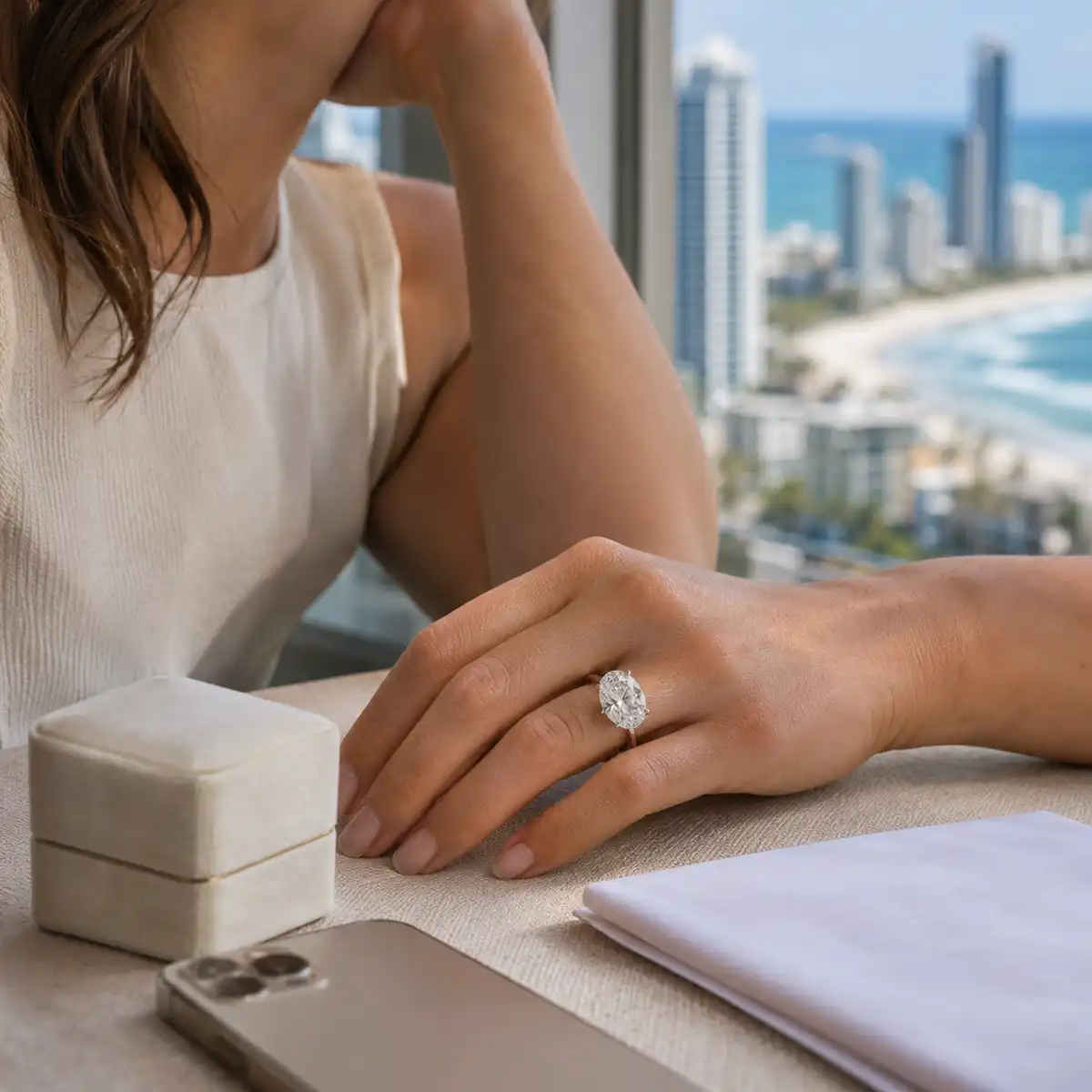
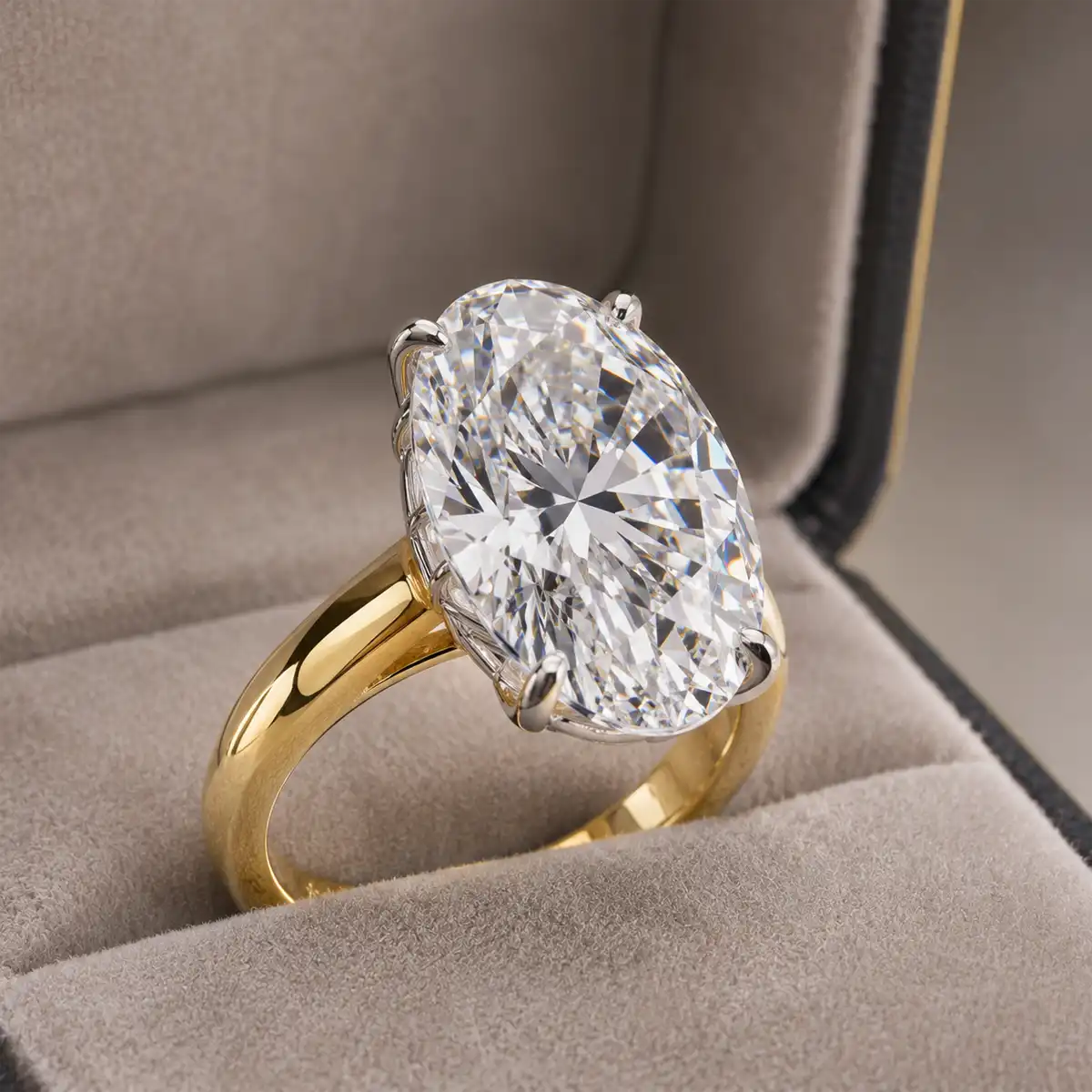
The cheaper figure is a single finished ring. KJJ's product page describes an 8.01 carat oval-cut lab-grown diamond with an IGI report grading it F colour and VS1 clarity, set east to west in 18ct yellow gold and platinum. The firm calls it a one-off and says the ring was made in Hatton Garden. No reference price or discount is shown, so £6,950 is the asking price, not a sale figure.
The higher figure is a starting point rather than a product. Revé Diamonds' 8 carat ring page states that an 8 carat lab-grown diamond ring "starts from around £16,300 for a round D-VS1 in a plain solitaire setting". The page does not say which laboratory graded that stone. Revé lists its showroom at 14 Hanover Square, Mayfair, and says its workshop is in Hatton Garden; our Revé Diamonds listing has the firm's details.
The 2 prices are not like for like. One is an oval and one a round. One names IGI grades, the other gives grades without naming the laboratory. KJJ's price includes a heavy two-metal mount, Revé's a plain solitaire. Even so, the pair shows something real. One weight of lab-grown diamond can cost more than twice as much at one London jeweller as at another. Both prices were read on the same day.
That gap matters more than any single figure.
Why the $37,000 figure says little about UK prices
The figure travelling with this story is $37,000, and the obvious move is to turn it into pounds and compare. The report does not support that.
In the Daily Mail's report the price is "$37,000", with no currency named. Turning it into pounds would mean guessing which dollar was meant, and the article does not say. Nor does it give a colour grade, a clarity grade, a grading laboratory or the metal, which are the facts that decide what an 8 carat lab-grown diamond ring should cost. A carat weight and a shape are not a specification.
The jeweller's own defence points the same way. According to the report, The Prestwick Place said the ring was an established signature design, publicly available in its catalogue before the purchase. A catalogue price for a branded design includes the design, the mount, the making and the retailer's margin, with the stone as one part of it.
The UK pages read for this piece make the point with real figures. KJJ's finished 8.01 carat ring, mount included, is priced below Revé's starting figure for a stone of the same weight in a plain setting. Neither price can be read as "the price of 8 carats". Each is the price one retailer asks for one stone, one specification and one piece of metalwork.
Weight sets the headline. Specification sets the price.
That is the sceptical reading of the Gold Coast story. A headline price for a lab-grown stone tells a buyer what one jeweller charged one customer. It says nothing about what the same weight costs elsewhere, and less still about what it would fetch if sold on, which no source in this story addresses.
What a grading report says about an 8 carat lab-grown diamond
A grading report for an 8 carat lab-grown diamond now reads differently depending on the laboratory. Since 1 October 2025, GIA has stopped giving lab-grown diamonds the colour and clarity grades it uses for natural stones and labels them Premium or Standard instead. IGI reports, like the one on KJJ's stone, still state grades.
GIA set out the criteria on its announcement of the revised service. Premium requires D colour, clarity of Very, Very Slightly Included or higher, and Excellent polish and symmetry, with an Excellent cut grade for round brilliants. Standard accepts colour from E to J, clarity of Very Slightly Included, and Very Good polish and symmetry. Any stone that misses the Standard minimums "will not receive a GIA assessment".
Fun fact: GIA explained the change by saying it would no longer use "the nomenclature created for natural diamonds to describe what is a manufactured product".
The practical effect shows up in the 2 London prices. A D colour stone of VS1 clarity, the specification Revé quotes, falls short of GIA's Premium tier, which needs VVS clarity or better. Under GIA's current service such a stone would be described as Standard. Under IGI it keeps its letters, as KJJ's F colour, VS1 clarity stone does.
Neither label is a verdict on how the stone looks. A buyer comparing 2 large lab-grown diamonds should first establish which laboratory issued each report, then compare like with like. Grades from 2 different laboratories, or a grade against a GIA tier, cannot be lined up as if they were the same scale. Ask for the report itself.
An 8 carat lab-grown diamond against a natural one, per carat
Dividing each price by its weight gives a rough measure of what a carat costs in each case. The figures below are our own arithmetic from prices read on 16 November 2026, all retail, all London.
Item and source | Retail price, 16 November 2026 | Per carat, approximate |
|---|---|---|
KJJ, finished ring, 8.01 carat oval lab-grown diamond, IGI F colour, VS1 clarity | £6,950 | £868 |
Revé Diamonds, starting price, 8 carat round lab-grown diamond, D-VS1, plain solitaire | about £16,300 | about £2,038 |
Revé Diamonds, starting price, 8 carat round natural diamond, G-SI1 | about £97,000 | about £12,125 |
On Revé's own figures, an 8 carat natural diamond starts at roughly 6 times the price of an 8 carat lab-grown diamond, even though the natural stone it quotes is lower in both colour and clarity. Against KJJ's finished ring, the natural starting price is about 14 times higher. The gap is wide.
The per carat figures flatter the finished ring, because KJJ's £6,950 also pays for 18ct gold and platinum, and Revé's £16,300 includes a plain setting. Neither retailer prices its stone and mount separately on these pages, so the stone's own share cannot be separated out. The table measures asking prices, not what the stones cost to make or what they would resell for.
For the wider case on choosing between the 2, our comparison of lab-grown and natural diamonds in the UK sets out the arguments on both sides.
Questions to settle before paying for a large lab-grown stone
Which laboratory issued the report, and what does it say. Ask for the report number and check it on the laboratory's own report check service before paying.
Is the stone described as lab-grown on the report, the product page and the invoice. All 3 should say so plainly.
Is the mount hallmarked. The London Assay Office states that platinum over 0.5g and gold over 1g must carry a UK recognised hallmark to be sold as precious metal, and that selling unhallmarked metal so described can bring a fine of up to £5,000 per article.
What exactly the price covers. Stone, mount, making, engraving and VAT should be itemised or confirmed in writing.
Will the jeweller photograph or publish the ring. The Gold Coast dispute turned on a post with a price in it. A buyer who wants privacy can ask for that in writing at the order.
Before committing to an 8 carat lab-grown diamond, put 2 or 3 written quotes side by side on the same terms: laboratory, report number, shape, colour, clarity, metal and whether the price includes VAT. Where one quote uses a GIA tier and another uses IGI grades, ask each jeweller for the full report and compare the measurements and polish rather than the headline grade.
Check the hallmark on any mount sold as gold or platinum. Ask how the retailer handles resizing on a ring with a stone of this weight, and get the answer in writing. A price that cannot be broken down into stone and mount is a price that cannot be compared.