
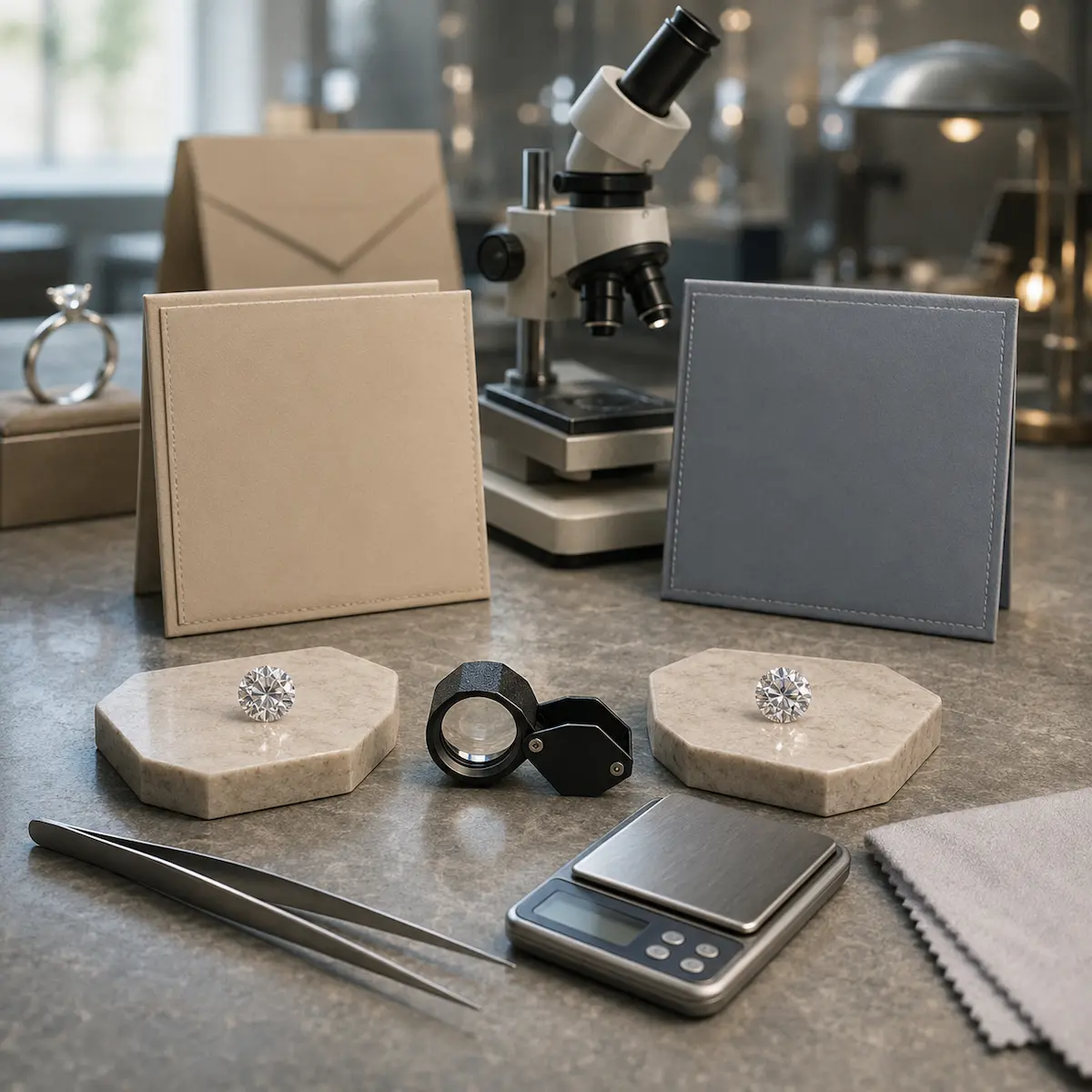
The most important fact about the lab-grown versus natural diamond decision in 2026 is the one most UK retailers do not state plainly: a lab-grown diamond and a natural diamond of equivalent specification are gemmologically indistinguishable to the wearer, to the jeweller, and to the gemmologist using standard 10x loupe inspection. The two stones share identical chemical composition, identical crystal structure, identical hardness, and identical optical properties. A laboratory-grade Type IIa CVD diamond and a natural Type IIa diamond from a Botswana mine will both pass every diamond-versus-simulant test, both register as diamond on every standard testing instrument, and both appear identical to the human eye at any magnification short of advanced spectroscopic analysis. This is the starting point that every honest discussion of lab-grown vs natural diamonds UK 2026 must work from, and it is the point most retail-led content avoids stating directly.
What separates the two products is therefore not the diamond itself. It is the origin, the price, the secondary market, and the certification landscape. Each of these factors deserves examination on its own terms, without advocacy in either direction.
What a lab-grown diamond actually is
Lab-grown diamonds are produced by two principal methods. Chemical Vapour Deposition uses a small natural-diamond seed and deposits carbon atoms onto it from a heated gas plasma, building the stone layer by layer over several weeks. High Pressure High Temperature replicates the geological conditions under which natural diamonds form, applying extreme pressure and heat to a carbon source for a similar duration. Both methods produce diamond crystals that are then cut, polished, and graded using the same processes applied to natural rough.
The technology has improved dramatically since the first commercially viable lab-grown engagement-ring-quality stones reached the UK market around 2017. By 2026, lab-grown diamonds at sizes up to 5 carats and beyond are routinely produced at colour and clarity grades that match the upper bands of the natural market. UK retailers including 77 Diamonds, Diamonds Factory, and most Hatton Garden independents now offer lab-grown alongside natural in dedicated lines.
The UK price differential and how it has shifted
The price differential between lab-grown and natural diamonds is the single most consequential factor in the decision and the area where the market has shifted most rapidly. In 2018, a lab-grown 1.00-carat round brilliant of equivalent specification to a natural stone sold at roughly 30% to 40% below the natural price. By 2022, the differential had widened to 60%. By 2026, lab-grown 1.00-carat round brilliants at G colour, VS2 clarity sit at approximately 75% to 85% below the equivalent natural stone at UK retailers.
The current UK market positions a 1.00-carat lab-grown round brilliant at G colour, VS2 clarity, in a simple platinum solitaire setting at approximately £1,400 to £2,200, depending on retailer. The equivalent natural stone in the same setting prices between £6,500 and £9,000. At 2.00 carats, the gap widens further: lab-grown sits at £3,500 to £5,500 while natural moves to £20,000 to £30,000 at the same specification.
This price geometry matters because it changes the value proposition entirely. For the same UK budget that purchases a 0.75-carat natural diamond, a lab-grown stone delivers 2.00 carats at higher colour and clarity grades. The buyer who prioritises stone size has a clear answer; the buyer who prioritises something else has a different calculation to perform.
The secondary market reality
The honest discussion of lab-grown versus natural diamonds requires direct treatment of the secondary market, and this is the area where retail-led content most consistently fails the buyer.
Natural diamonds carry a documented secondary market through specialist dealers, auction houses, and pawnbrokers across the UK, with resale values typically running between 25% and 50% of the original retail purchase price depending on the stone, the certification, and the time between purchase and resale. The natural diamond market has functioned this way for decades and is unlikely to change materially within the lifetime of a 2026 engagement ring purchase.
Lab-grown diamonds, as of 2026, do not have an established secondary market with comparable price stability. A lab-grown stone purchased at £2,000 in 2026 will be very difficult to resell at any meaningful percentage of that price, because the wholesale cost of producing equivalent new stones continues to fall. Most UK pawnbrokers and second-hand specialists will value a lab-grown diamond at a small fraction of its original purchase price, if they accept it at all.
This is a market reality, not a steer. It does not mean lab-grown is a worse choice; it means lab-grown is a different product with a different financial profile. A buyer purchasing a lab-grown diamond should treat the purchase as one would treat the purchase of any other beautiful object, with no expectation of meaningful financial recovery on resale. A buyer purchasing a natural diamond should hold no illusion about realising original purchase price on resale either, but the secondary market exists at meaningful percentages.
The certification landscape
Certification practice differs materially between lab-grown and natural diamonds in 2026.
The Gemological Institute of America, GIA, certifies both lab-grown and natural diamonds, though the lab-grown reports use a slightly different format and explicitly identify the laboratory origin. The International Gemological Institute, IGI, has emerged as the dominant lab-grown certification body and certifies the majority of lab-grown stones sold through UK retailers. HRD Antwerp also certifies lab-grown diamonds and is the European trade standard.
For natural diamonds, GIA remains the certification benchmark in the UK market. The grading consistency between GIA and IGI on natural stones differs slightly, with GIA generally regarded as the stricter laboratory on clarity and cut grades, which means a stone graded VS2 by IGI might be graded SI1 by GIA in close cases. For lab-grown, IGI dominates volume and operates the most established lab-grown grading framework.
A UK buyer comparing two lab-grown stones graded by different laboratories should expect modest grading differences. A UK buyer comparing a GIA-certified natural and an IGI-certified lab-grown is comparing two different products on two different grading scales, and direct cross-comparison should be made cautiously.
Environmental and ethical considerations honestly stated
Lab-grown diamond marketing frequently positions the product as the environmentally and ethically superior choice. The honest position is more complex. Lab-grown diamond production is energy-intensive, with the energy mix of the producing country materially affecting the environmental profile. Stones produced in countries with coal-heavy electricity generation carry a significantly higher carbon footprint than stones produced under renewable energy. Stones produced under verified renewable energy carry a lower footprint than mined natural diamonds.
The natural diamond industry has improved significantly on traceability through 2024 and 2025, with major suppliers including De Beers and Alrosa providing blockchain-tracked provenance for an increasing percentage of rough. The Kimberley Process Certification Scheme remains the international framework for conflict-free certification, though its limitations on issues beyond rough-stone origin are well documented and the scheme should not be treated as a comprehensive ethical guarantee.
Both products can be sourced ethically, and both products can be sourced less ethically. A buyer prioritising environmental and ethical considerations should investigate the specific producer of the specific stone rather than relying on the general lab-grown-versus-natural framing.
Fun fact: The first gem-quality lab-grown diamonds large enough for engagement rings were produced commercially by General Electric in 1971, but the cost per carat at that time exceeded the natural diamond market by such a margin that no commercial market emerged until production economics shifted in the 2010s.
Which decision suits which buyer
The honest summary of the decision works as follows. A buyer prioritising stone size at a fixed budget, with no expectation of resale value, who values the technical equivalence of the product, will be well-served by lab-grown. A buyer prioritising long-term value retention, established secondary market liquidity, and the historical premium associated with natural origin will be well-served by natural. A buyer prioritising environmental impact must investigate the specific stone's production conditions regardless of which category they choose.
A snippet-ready summary for buyers at the comparison stage: lab-grown diamonds and natural diamonds are gemmologically identical, but lab-grown stones are 75% to 85% cheaper at equivalent UK 2026 specifications, lack an established secondary market, and are predominantly certified by IGI rather than GIA. Natural diamonds carry a higher purchase price, an established UK secondary market, and the GIA certification standard most familiar to UK buyers and insurers.
What to verify before paying a deposit
Three verifications matter regardless of which category you choose. First, the certificate must be genuine, verified through the issuing laboratory's online verification tool against the report number. Second, the stone must match the certificate, which a competent UK jeweller will demonstrate by inspecting the laser inscription against the report number under magnification. Third, the seller must disclose in writing whether the stone is lab-grown or natural, with no ambiguity in the sale documentation.
A jeweller refusing to put the lab-grown or natural classification in writing is a jeweller worth walking away from, regardless of which category the stone falls into.
Closing thoughts for the buyer at this stage
The most useful question to ask yourself when comparing lab-grown vs natural diamonds UK 2026 is not which is better. It is which is better for your specific priorities, given your specific budget, your specific feelings about secondary market value, and your specific position on the environmental and ethical questions. Both products are real diamonds. Both products will look identical on the hand. The decision is about what surrounds the diamond, not about the diamond itself.
Once that decision is made, the question of how much to spend on the ring overall becomes a separate consideration entirely, and the cultural pressure around that question deserves its own analysis.