
The bespoke route is the most rewarding way to acquire an engagement ring, and the route most UK buyers approach with the least preparation. A bespoke commission is a 6 to 14-week design and manufacturing process involving conversations, drawings, digital renders, wax models, casting, hand-finishing, and final stone setting, and the buyer who walks into the first consultation knowing what each stage delivers will make better decisions than the buyer who treats the process as an extended showroom visit. Bespoke engagement rings UK sits at the intersection of design collaboration and skilled hand manufacture, and this guide covers what each stage actually involves, what to ask before paying any money, and how to verify the atelier you are committing to.
This is a pillar guide, intended as the working reference for buyers across the full commission journey from initial brief to delivery. The depth reflects the financial and emotional weight of the decision.
What bespoke actually means in UK practice
The word "bespoke" carries different meanings across the UK jewellery market, and the buyer's first task is to verify which meaning the atelier is using.
True bespoke means a ring designed entirely from the buyer's brief, with no pre-existing template or model, manufactured as a single piece for a single commission. The design is original to the buyer, the manufacturing process is hand-led from start to finish, and the resulting ring is not part of a production run of any kind. This is what the term traditionally means in the UK jewellery trade, and it sits at the highest end of the bespoke spectrum.
Semi-bespoke means a ring based on an existing house design, modified to the buyer's specifications, with the buyer choosing stones, metal, and certain design variations within a template the atelier has already developed. The result is a unique combination but not an original design. Most UK retail "bespoke" services offered by larger jewellers fall into this category.
Customisable means a ring chosen from an existing collection with options for centre stone, metal, and limited setting variations, with no significant design modification. This is closer to a configurator-driven retail purchase than a true bespoke commission.
The price differential between these three categories is significant. True bespoke at a Hatton Garden independent typically prices 30% to 60% above the retail equivalent for comparable stone and metal specifications, reflecting the design and manufacturing labour. Semi-bespoke prices 10% to 25% above retail. Customisable prices essentially at retail with options. A buyer paying true-bespoke prices for a semi-bespoke service is not getting what they are paying for, and this verification is the buyer's first protection.
The brief stage and what to bring
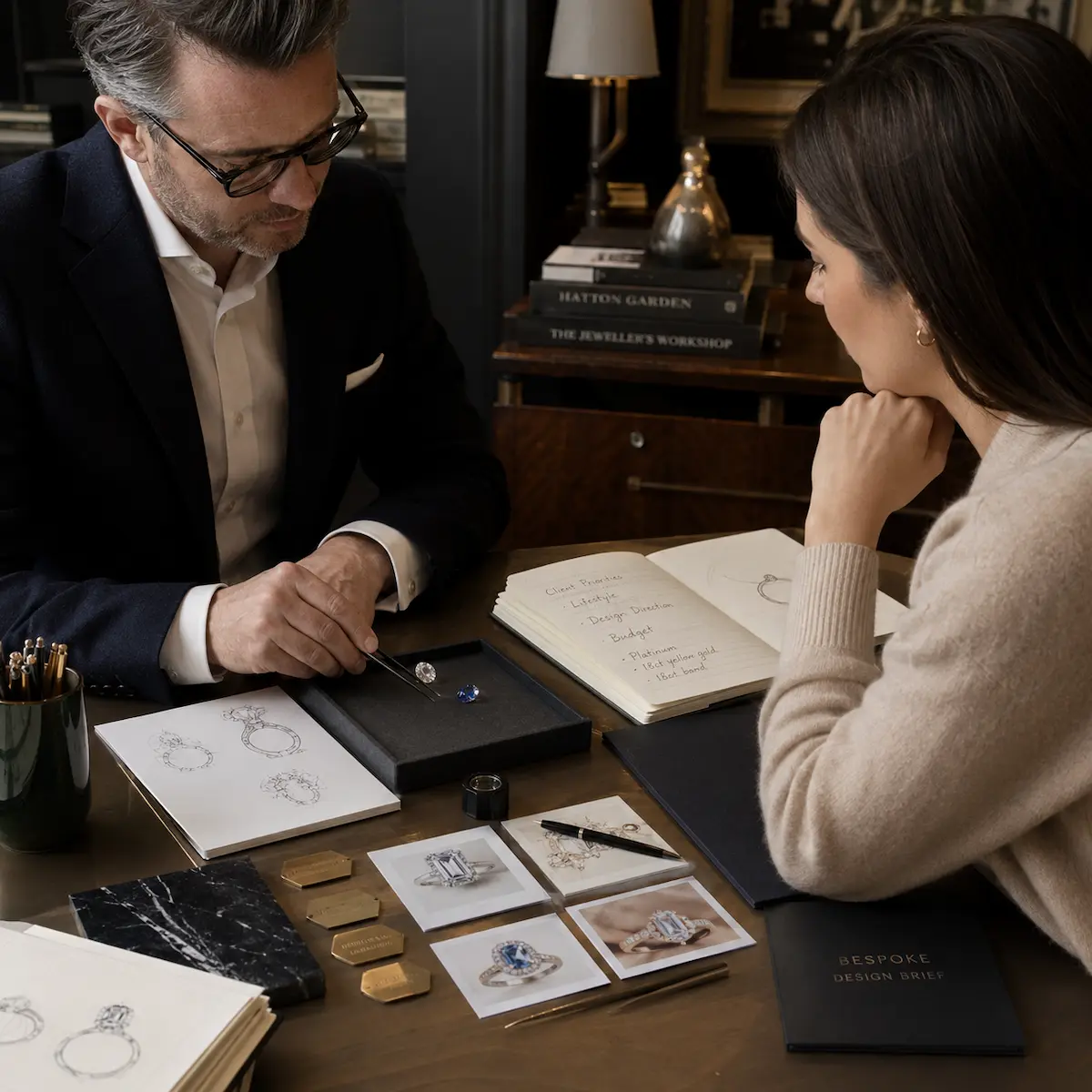
The first consultation, typically 60 to 90 minutes at a UK independent atelier, establishes the brief. The buyer's preparation for this conversation determines the quality of the resulting design.
A useful brief covers four areas. First, the wearer's existing jewellery preferences (metal tone, finish, ring size, hand shape, stylistic register). Second, lifestyle considerations (work environment, sports or hobbies that affect daily wear, frequency of removal). Third, design references (photographs of rings the wearer has admired, with annotations on what specifically appeals about each). Fourth, the budget envelope is stated as a working range rather than a fixed maximum, with clarity on whether the centre stone is included in the figure or sourced separately.
The atelier's role at the brief stage is to translate the buyer's preferences into design parameters, raise practical considerations the buyer may not have considered, and propose options that fit the budget envelope. A skilled bespoke designer will push back on impractical combinations (a delicate pavé band on a wearer who does daily hand-intensive work, for example) and propose alternatives the buyer may not have known were available.
The brief stage is the moment to ask about the design fee structure. Some UK ateliers absorb design fees into the eventual commission cost; others charge a separate design fee of £200 to £600 that is creditable against the eventual commission or refundable if the buyer chooses not to proceed. The structure should be stated in writing before any design work begins.
CAD design and what the digital render shows
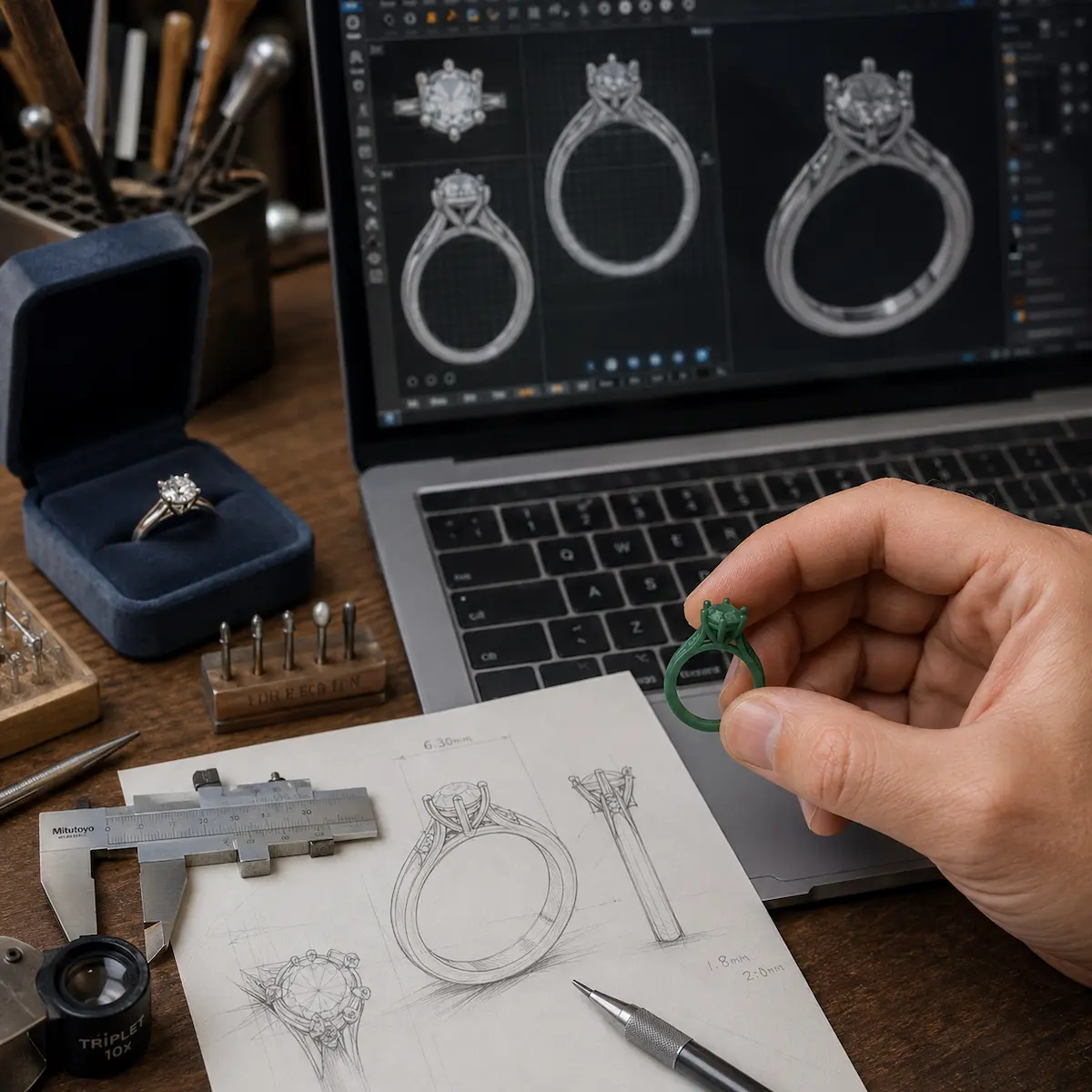
The next stage is computer-aided design, where the brief becomes a three-dimensional digital model of the ring. CAD work typically takes 5 to 15 working days at most UK ateliers, and the buyer reviews the resulting renders before approval.
The honest position on CAD is that the digital render shows form, proportion, and structural arrangement, but it cannot simulate certain critical aspects of the finished ring. Light performance through the centre stone cannot be accurately rendered. The exact weight on the wrist cannot be felt. The way the ring will read in natural daylight versus indoor light is approximated rather than reproduced. Surface finish (high polish, matte, brushed) renders cleanly, but the reality on metal is always slightly different.
A buyer reviewing CAD renders should focus on what the render does show: the stone proportions, the claw configuration, the band profile, the gallery construction, the relationship between the centre stone and any side stones or pavé work. This is the stage to request changes, because CAD modifications cost nothing in materials but become expensive once the wax model has been carved or 3D-printed.
Most UK ateliers offer 2 to 4 rounds of CAD revisions as standard within the agreed commission. Beyond that range, additional revisions may incur fees. The buyer should ask explicitly about the revision policy at the brief stage.
The wax stage that CAD cannot replace
The most underappreciated stage in the bespoke process is the wax model approval. After CAD design is finalised, the design is either carved by hand from wax or 3D-printed in a wax-equivalent resin. The buyer reviews this physical model before casting, and what the wax reveals is what the CAD cannot.
The wax shows the actual proportion at a hand-held scale. The exact weight distribution becomes apparent. The claw arrangement around the centre stone position can be inspected from every angle. The band profile in cross-section can be felt against the finger. Critical adjustments (a claw set 1mm too tight, a gallery wall slightly off-axis, a band thickness that reads heavier in physical form than it did on screen) are caught at the wax stage and corrected before casting.
UK ateliers operating to the highest standards will require buyer approval of the wax model in writing before proceeding to casting. This is not bureaucracy; it is the structural protection of the commission. Once casting begins, the design is committed to metal, and changes from that point onward involve significantly higher costs and longer timelines.
A snippet-ready summary for buyers approaching the bespoke process: the wax model approval stage is the most important checkpoint in any bespoke engagement ring commission, because it shows the design at hand-held scale in a way CAD renders cannot simulate. UK ateliers operating to professional standards require written wax approval before casting begins. The buyer who skips careful wax review forfeits the most important opportunity to catch design issues before they become expensive.
Casting, finishing, and stone setting
Once the wax is approved, the lost-wax casting process produces the metal ring. The wax model is invested in a refractory mould, the wax is melted out (the "lost-wax" terminology), and molten metal is poured into the resulting cavity. The casting itself takes 1 to 2 days, but the cooling, devesting, and initial cleanup take another 2 to 3 days.
The cast ring then enters the hand-finishing stage. The casting surface is rough by design, and skilled bench jewellers file, sand, and polish the metal to its final finish. This stage typically takes 5 to 10 working days for a complex commission, and the quality of the finishing work distinguishes a competent atelier from an exceptional one. Filed-and-polished rings show clean, sharp internal angles, no casting porosity, no tool marks, and a uniform polish across surfaces.
Stone setting is the final manufacturing stage. The centre stone is set first, with claws bent and burnished into the final position to hold the stone securely. Pavé and side stones are set after the centre stone, in sequence determined by the design. A complex halo or pavé-heavy commission can require 2 to 5 working days for stone setting alone, and this is the stage where a skilled setter is the difference between a long-lasting ring and one that loses stones within years.
The completed ring is then submitted to the relevant UK assay office for hallmarking, which adds 5 to 10 working days to the timeline. Compulsory hallmarks (sponsor's mark, fineness mark, assay office mark, date letter) are stamped or laser-marked at this stage. The hallmark is the buyer's legal guarantee of metal content under the Hallmarking Act 1973.
UK lead times in practice
The full commission timeline at a UK atelier in 2026 typically runs as follows: brief and consultation 1 to 2 weeks; CAD design and revisions 2 to 4 weeks; wax model approval 1 to 2 weeks; casting and finishing 2 to 3 weeks; stone setting 1 to 2 weeks; hallmarking and final delivery 1 to 2 weeks. The total ranges from 8 to 14 weeks, with 10 to 12 weeks being typical for a moderately complex commission.
UK lead times extend at peak season, which runs from October through February (covering Christmas and Valentine's proposals) and from May through July (covering summer engagements). Buyers commissioning for a specific date should add 2 to 4 weeks to the typical timeline as a working buffer, and any commission targeting a specific proposal date should begin at least 14 to 16 weeks before that date for safety.
The deposit structure that UK ateliers use
Most UK independent ateliers operate a three-stage payment structure for bespoke commissions. The first deposit, typically 30% to 50% of the total commission, secures the design work and triggers the start of CAD. The second payment, typically 30% to 50%, is due at wax approval and triggers casting. The final balance, usually 20% to 40%, is due on delivery before the buyer takes possession of the ring.
This structure protects both parties: the atelier covers material and labour costs at each stage, and the buyer retains commercial leverage at each approval point. Variations exist (some ateliers operate a 50/50 split at brief and delivery, others require full payment at wax approval), and the buyer should confirm the structure in writing before paying any deposit.
A buyer asked to pay 100% of the commission upfront should treat that request with caution unless the atelier has a substantial documented track record and the buyer is fully comfortable with the structure. UK consumer law provides certain protections under the Consumer Rights Act 2015 for goods that are not as described, but bespoke commissions are explicitly excluded from the Consumer Contracts Regulations 2013 cooling-off period. The buyer who has paid 100% upfront has limited financial recourse if the design or execution disappoints.
Fun fact: The lost-wax casting process used in modern bespoke jewellery commissions traces its roots to ancient Egypt and Mesopotamia, with documented examples of cast metal jewellery using the technique dating back over 5,000 years; the process has been refined but not fundamentally replaced in five millennia of use.
What to ask before paying any deposit
Eight questions reveal whether a UK atelier is operating to bespoke commission standards. First, is this true bespoke, semi-bespoke, or customisable, and how is that reflected in the price? Second, what is your design fee structure, and is it creditable or refundable? Third, how many CAD revisions are included in the commission? Fourth, do you require written wax approval before casting? Fifth, what is your typical lead time at this point in the year? Sixth, what is your deposit structure, and at what stages are payments due? Seventh, what is your policy if the finished ring does not match the agreed design? Eighth, what is your aftercare policy for sizing adjustments and maintenance after delivery?
An atelier answering all eight questions clearly, with documentation, is an atelier operating to the standard the commission deserves. An atelier deflecting on any of these questions is an atelier where the buyer should pause before committing.
Verification of the atelier itself
Beyond the commission-specific questions, the atelier itself deserves verification. The relevant UK trade memberships are the National Association of Jewellers (NAJ), the Institute of Registered Valuers (IRV), and where applicable the Responsible Jewellery Council (RJC). NAJ membership specifically commits the jeweller to a published Code of Conduct and provides a dispute resolution route if commissions go wrong.
UK Companies House records can be checked free of charge to confirm the atelier's registered company status, trading history, and director information. Trustpilot, Google reviews, and direct word-of-mouth recommendations from buyers who have completed commissions provide a real-world reference for the atelier's standards.
The single most useful pre-commission verification is asking to see two to three completed bespoke commissions in the atelier's archive, with dates, specifications, and, where possible, direct contact with the buyers. An atelier that cannot or will not provide this reference is an atelier where the bespoke work may not justify the bespoke price.
What aftercare looks like
The commission does not end at delivery. UK ateliers operating to professional standards offer aftercare that includes free inspection of the ring within the first 6 to 12 months of wear, reduced-cost maintenance for the lifetime of the original ownership, and a documented record of the commission that the buyer or their insurer can call upon for valuation and repair purposes.
The aftercare conversation should happen at the brief stage rather than after delivery. An atelier that treats aftercare as an unstated assumption is providing less than an atelier that documents the aftercare commitments in writing as part of the commission agreement.
Closing thoughts for the buyer at this stage
If you are committing to bespoke engagement rings UK as your route to the ring, the most useful action you can take is to visit two or three UK ateliers in person, with a clear brief in hand, and listen carefully to how each responds to your design and budget questions. The atelier that asks better questions, raises practical considerations you had not thought of, and provides clearer documentation is the atelier worth committing to. The atelier that rushes toward the deposit without working through the questions is an atelier where the commission is unlikely to deliver what you imagined when you walked in.
The bespoke process rewards buyers who arrive prepared, ask the right questions, approve at every stage, and treat the commission as a 12-week collaboration rather than a single transaction. The resulting ring, made specifically for the wearer from a design that exists nowhere else, is the strongest argument for the route.