
The phrase "South Asian engagement ring tradition" is plural in a way that English-language wedding content rarely acknowledges. The traditions of Punjabi families differ from Tamil traditions; North Indian customs differ from South Indian; Pakistani practice differs from Bengali; Gujarati ceremonies differ from Sri Lankan. Each carries distinct conventions around the role of the engagement ring within a broader symbolic system that may include the mangalsutra, the chooda, the maang tikka, and family gold passed down across generations. South Asian engagement ring traditions UK is therefore not a single topic but a family of overlapping traditions, each with its own working knowledge of what an engagement ring is for and what it sits alongside.
This guide is written for the UK South Asian buyer planning their own engagement, and for the partner of a UK South Asian buyer who wants to understand the family expectations in the room. The depth on regional distinction, gold karat preference, and UK sourcing follows from the principle that respect for the tradition starts with naming it correctly.
The position of the engagement ring within the broader system
In most South Asian wedding systems, the engagement ring is one element within a larger network of jewellery that marks different stages of the bridal journey. The ring at the engagement ceremony, often called sagai or mangni in North Indian traditions and nichchayathartham in South Indian traditions, exists alongside the mangalsutra (the marriage necklace given at the wedding ceremony itself), the chooda or kangan (the bridal bangles), and in many traditions the maang tikka (the forehead ornament) and nath (the nose ring).
This multi-piece framework changes the working logic of the engagement ring purchase. A Western engagement ring is typically the dominant piece of bridal jewellery, and budget allocation reflects that primacy. A South Asian engagement ring sits within a constellation where the mangalsutra, the bridal gold set, and the family heirloom contributions may each carry equal or greater symbolic weight. Budget logic distributes accordingly, and UK South Asian buyers often allocate engagement-ring budget at lower absolute levels than the equivalent Western buyer because the ring is one piece in a set rather than the centrepiece.
Regional distinctions that materially affect choice
The regional traditions vary in ways that affect what an engagement ring should look like, what it should be made from, and how it sits within the ceremony.
In Punjabi and North Indian traditions, the engagement ring at the sagai ceremony is typically presented in a more visible Western-influenced format, often a diamond or coloured stone solitaire in 22ct or 18ct gold. The exchange of rings between the couple at the engagement is more central to the ceremony than in some other South Asian traditions. The preference for high-karat gold (22ct in particular) reflects the broader North Indian aesthetic preference for warmer, more saturated gold tones.
In Tamil and South Indian traditions, the engagement ceremony places greater emphasis on temple-style yellow gold work, intricate craftsmanship, and the symbolic weight of pieces beyond the ring itself. The ring may be a more understated element within a ceremony that includes substantial gold ornament gifts. South Indian bridal jewellery often draws on temple jewellery aesthetics, with antique-style settings and uncut polki diamonds featuring more prominently than brilliant-cut stones.
Bengali traditions, particularly in West Bengal and Bangladesh, frequently feature the shakha pola (red and white shell bangles) and lohar (iron bracelet) as central marriage symbols, with the engagement ring playing a supporting rather than dominant role. The aesthetic preference often runs to vintage or antique-influenced designs in 22ct yellow gold.
Pakistani traditions vary significantly by region (Punjab, Sindh, Balochistan, Khyber Pakhtunkhwa) and by the family's specific heritage. Generally, the engagement (mangni) involves a ring exchange, with the bride's ring often paired with substantial gold jewellery gifts from the groom's family, and the preference running toward 22ct yellow gold in traditional families and 18ct white gold or platinum in contemporary urban families.
Gujarati traditions place significant emphasis on bridal gold sets, with the engagement ring sitting alongside necklaces, earrings, bangles, and forehead ornaments. The Gujarati preference for elaborate, detailed gold work shapes the ring's stylistic register.
These distinctions are general patterns rather than rigid rules. UK families adapt traditions across generations, and intermarriage across regional traditions has created a UK South Asian wedding aesthetic that draws from multiple sources simultaneously.
The 22ct gold question and UK sourcing
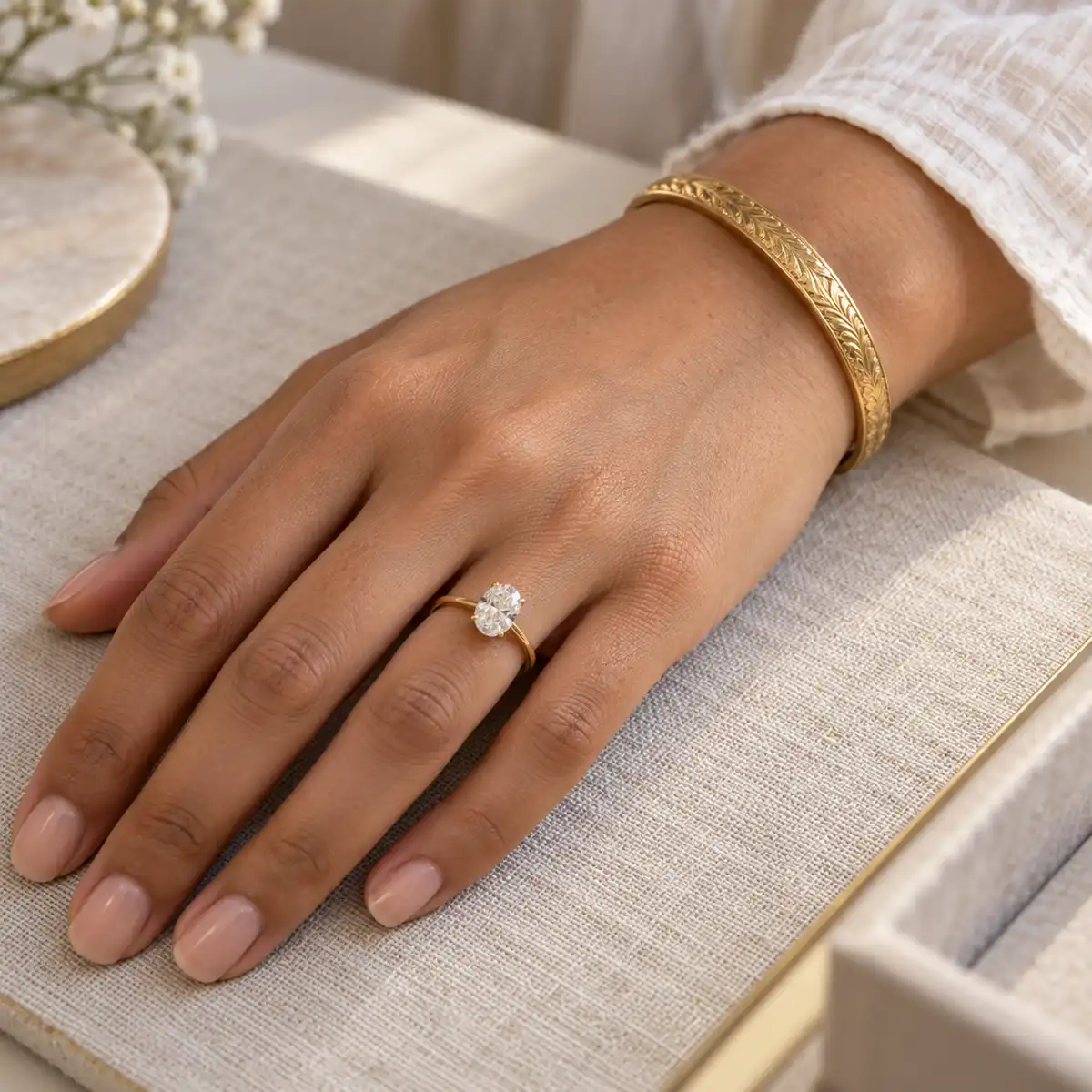
The single most distinctive feature of South Asian engagement ring tradition is the preference for 22ct yellow gold, which is significantly higher in gold content than the 18ct or 9ct gold dominant in mainstream UK retail. 22ct gold contains 91.6% pure gold against 18ct's 75% and 9ct's 37.5%, producing a deeper, warmer, more saturated yellow that the South Asian aesthetic specifically values.
The challenge for UK South Asian buyers is that 22ct gold is structurally softer than lower-karat alloys, which makes it less suitable for daily-wear engagement rings with claw-set stones. The high gold content means the metal scratches and abrades more readily, and claws holding a centre stone in 22ct can require retipping more frequently than in 18ct or platinum.
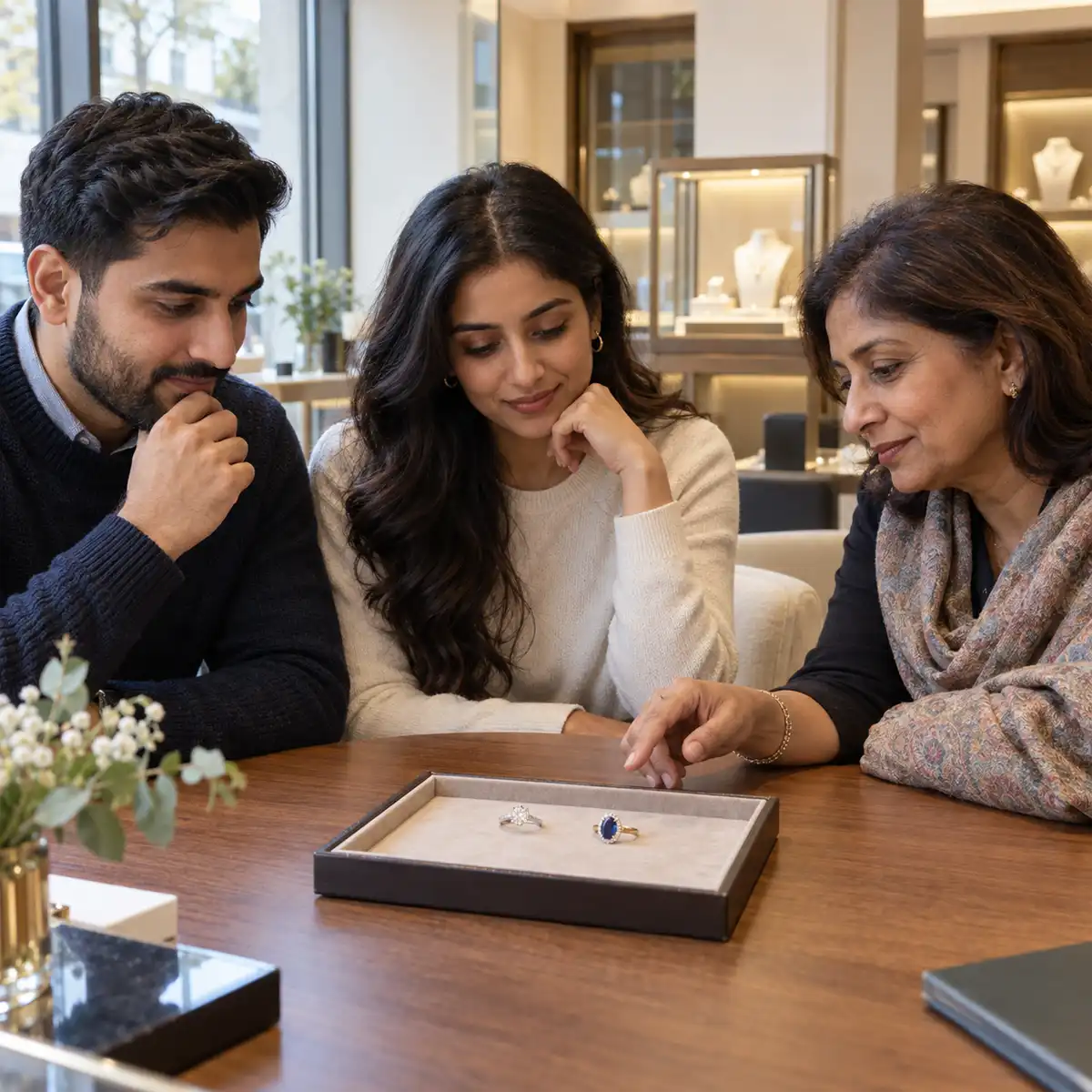
The UK working solutions are well-established. South Asian-specialised UK jewellers, concentrated particularly in Wembley and Southall in London, in Birmingham's Soho Road and Coventry Road quarters, and in the Manchester Cheetham Hill area, offer engagement rings in 22ct gold designed specifically for the durability requirements of daily wear. These ateliers use thicker shanks, reinforced settings, and design conventions that compensate for the softer metal.
Alternative UK sourcing routes include Hatton Garden specialists who can commission 22ct gold engagement rings to South Asian design specifications, though the mainstream Hatton Garden default is 18ct or platinum. The buyer requesting 22ct should confirm at the design stage that the atelier is comfortable working in the higher-karat alloy and has documented experience with its working properties.
A snippet-ready summary for UK South Asian buyers: South Asian engagement ring traditions UK typically favour 22ct yellow gold over the 18ct standard of mainstream UK retail. UK sourcing concentrates in Wembley, Southall, Birmingham, and Manchester at South Asian-specialised ateliers, with Hatton Garden specialists also available for bespoke 22ct commissions. The trade-off is durability: 22ct requires reinforced settings and more frequent maintenance compared with 18ct or platinum.
The mangalsutra question alongside the engagement ring
A consideration that arises frequently in UK South Asian engagements is whether the engagement ring and the mangalsutra are designed together or as separate pieces with separate timelines. Traditionally, the mangalsutra is presented at the wedding ceremony itself rather than the engagement, and the two pieces follow separate aesthetic logics: the engagement ring sits in the Western diamond solitaire tradition, while the mangalsutra follows a centuries-old format with regional variations in the pendant style and chain construction.
UK South Asian couples increasingly commission both pieces from the same atelier as a coordinated set, which allows the metal tone, design language, and overall bridal aesthetic to read coherently across the wedding sequence. This is particularly common where the bride wants the engagement ring to be visible alongside the mangalsutra in subsequent wedding photography and family events.
The UK ateliers most experienced with this coordinated approach are concentrated in the South Asian-specialised areas mentioned above, with several Hatton Garden specialists also offering coordinated bridal commissions. The lead time for a coordinated set is typically 8 to 14 weeks, and pricing varies significantly by metal weight and stone specifications.
Fun fact: The mangalsutra's two-strand black-bead-and-gold construction, common in many North and West Indian traditions, dates back to at least the 6th century in documented forms, making the mangalsutra one of the longest continuously-used bridal jewellery items in any global culture.
Family gold and the heirloom integration question
A practical reality of UK South Asian engagements is the role of family gold passed down across generations. Many UK South Asian families hold substantial heirloom gold from previous generations of weddings, and the question of whether the engagement ring incorporates this gold or sits alongside it as a new piece is a common discussion at the design stage.
UK ateliers working in the South Asian tradition routinely accept family gold for melt-and-recast into new pieces, with the bride's heirloom gold from her grandmother's bridal set serving as the source metal for her own engagement ring. This practice carries deep symbolic weight and produces a piece that is materially connected to family lineage in a way no purchased gold can replicate.
The technical considerations require attention. The atelier must verify the karat of the heirloom gold (which may be 22ct, 21ct, or 18ct depending on origin), assess any existing stones for reuse or replacement, and confirm the practical feasibility of the design in the specific metal supplied. This consultation is best handled at the design stage rather than after the design is finalised, because the working properties of the supplied metal can constrain certain settings or design elements.
What to ask the UK jeweller before commissioning
Five questions reveal whether a UK jeweller is operating to South Asian tradition standards. First, what is your experience with 22ct gold engagement rings designed for daily wear, and can you show examples? Second, do you offer coordinated mangalsutra and engagement ring commissions, and what is the typical timeline? Third, how do you handle family gold for melt-and-recast, and what is your verification process? Fourth, what reinforced setting techniques do you use to compensate for 22ct's softer working properties? Fifth, what is the maintenance schedule you recommend for 22ct daily-wear engagement rings?
A jeweller answering all five questions clearly, with examples and documentation, is operating to the standard the tradition deserves. A jeweller deflecting on 22ct or treating South Asian commissions as an extension of mainstream UK retail is providing a different service than the tradition requires.
Closing thoughts for the buyer at this stage
The single most useful question to ask yourself when planning a South Asian engagement ring within UK tradition is which specific regional tradition is anchoring the wedding, and what role the engagement ring plays within that tradition's broader jewellery system. The answer determines whether the ring is a primary symbolic piece or one element within a wider set, whether 22ct or 18ct gold is the working choice, and whether the ring should be commissioned alone or alongside the mangalsutra and bridal set. The decision is significantly easier once the regional and family specifics are named clearly at the start.
Once the tradition is anchored, the practical commissioning process begins, and the UK bespoke route offers the design flexibility that mainstream retail rarely provides for high-karat or heritage-influenced pieces.