
Two quotes. Same brief, same budget, same saved screenshots. One is 40% higher than the other. Both jewellers seemed competent, both produced certificates, and neither did anything you could point at.
This is where most buyers make their worst decision, because only 2 moves appear to be available and both are bad. Take the cheaper one and hope. Take the dearer one and assume the gap bought something real.
Here is what you actually need to know before you decide.
Comparing engagement ring quotes is not a price exercise. It is a specification exercise. Two quotes are comparable only when the things behind them are comparable, and in practice they almost never are. The distance between 2 numbers is usually the distance between 2 different rings described in the same vocabulary.
Note also what a quote answers, which is one question only. What this ring costs today.
At the consultation desks at 9 Hatton Garden, EC1N, quotes get laid side by side often enough that the pattern is predictable. The cheaper ring is rarely worse value. It is usually a different specification. Align the specification and one of the 2 numbers moves.
What to check first when comparing engagement ring quotes
Check the stone before anything else. Match carat weight, colour grade, clarity grade, cut grade, and the issuing laboratory across both quotes. If any of those 5 differ, you are not comparing prices, you are comparing rings. Align the stone specification first, then compare what remains. In most side-by-side quotes, the stone accounts for the large majority of the total.
That last point is the one buyers underestimate. Arguments about setting styles and workshop reputations occupy most of the conversation, while the item driving the difference sits in a single line near the top.
Why two quotes are almost never for the same ring
Specification drift is normal and mostly unintentional.
You describe what you want in words. Round, about a carat, white, platinum, nothing too fussy. Two jewellers hear that and each builds toward it using their own stock, their own suppliers, and their own reading of your budget. One lands on a 0.90 carat G VS2. The other lands on a 1.01 carat H SI1. Both are honest answers to the brief you gave. Neither is the same ring.
The words that cause the most drift are the vague ones. About a carat covers a 20% range of weight and a wide span of price. White covers D to J depending on who is listening. Nothing too fussy covers a solitaire and a pavé shoulder.
The fix is unglamorous. Give both jewellers the same written specification rather than the same description, and ask each to quote against it. Ask for a second quote against their own recommendation if they think your specification is wrong. Then you have 2 comparable numbers plus 2 expert opinions, instead of 2 incomparable numbers and no information.
How diamonds are actually priced and why the certificate is the only comparable
Diamond pricing has an underlying structure, and knowing it removes most of the mystery from a quote.
The trade prices polished stones against a benchmark list of asking prices, organised by carat weight band, colour and clarity, expressed per carat. Dealers do not pay the list price. They negotiate a discount from it, which is why the standard trade question is how much back, meaning how far below list. Most stones transact meaningfully below the benchmark. Your jeweller's cost for a stone is that discounted figure plus their margin, and the discount they achieve depends on their relationships, their volume, and how hard they looked.
Two consequences follow directly.
First, the certificate is the only thing that makes 2 stones comparable, because the price structure is built from certificate fields. A stone without a report from GIA or IGI cannot be located on the grid at all, and a quote for an uncertificated stone is a quote for an unknown.
Second, price moves in steps at carat thresholds rather than smoothly. The benchmark is organised into weight bands, so a stone at 1.00 carat sits in a different band from one at 0.98, and it is priced accordingly despite the 2 being visually indistinguishable on a hand. A buyer willing to sit just under a threshold buys the same apparent size for a structurally lower price. This is one of the few genuine efficiencies available in the whole transaction.
Fun fact: The diamond trade's benchmark price list has been published every Thursday since 1978, and it quotes asking prices rather than transaction prices, which is why the standard question between dealers is not what does it cost but how much back.
Which parts of a quote are labour rather than material
Once the stone is aligned, the remainder splits into metal, labour and documentation, and only 1 of those 3 is straightforward.
Metal is close to a commodity. 950 platinum costs more per gram than 18ct gold and is denser, so a platinum ring uses more metal by weight for the same dimensions. That difference is arithmetic, and it should be roughly consistent between quotes.
Labour is not arithmetic. CAD design and revisions, wax or resin modelling, lost-wax casting, stone setting, and hand-finishing are all hours, and hours vary with skill and with how much of the work happens under the same roof. A pavé band takes materially longer to set than a 4-claw solitaire, and a poorly set pavé band is the most common failure in the entire category. This is the line where 2 quotes legitimately diverge without either being wrong.
Documentation is small but real. Hallmarking at the London Assay Office, insurance valuation paperwork, and the presentation of the certificate itself all sit somewhere in the number.
Ask which of these are included and which appear later. A quote that excludes hallmarking or CAD revisions is not cheaper. It is incomplete.
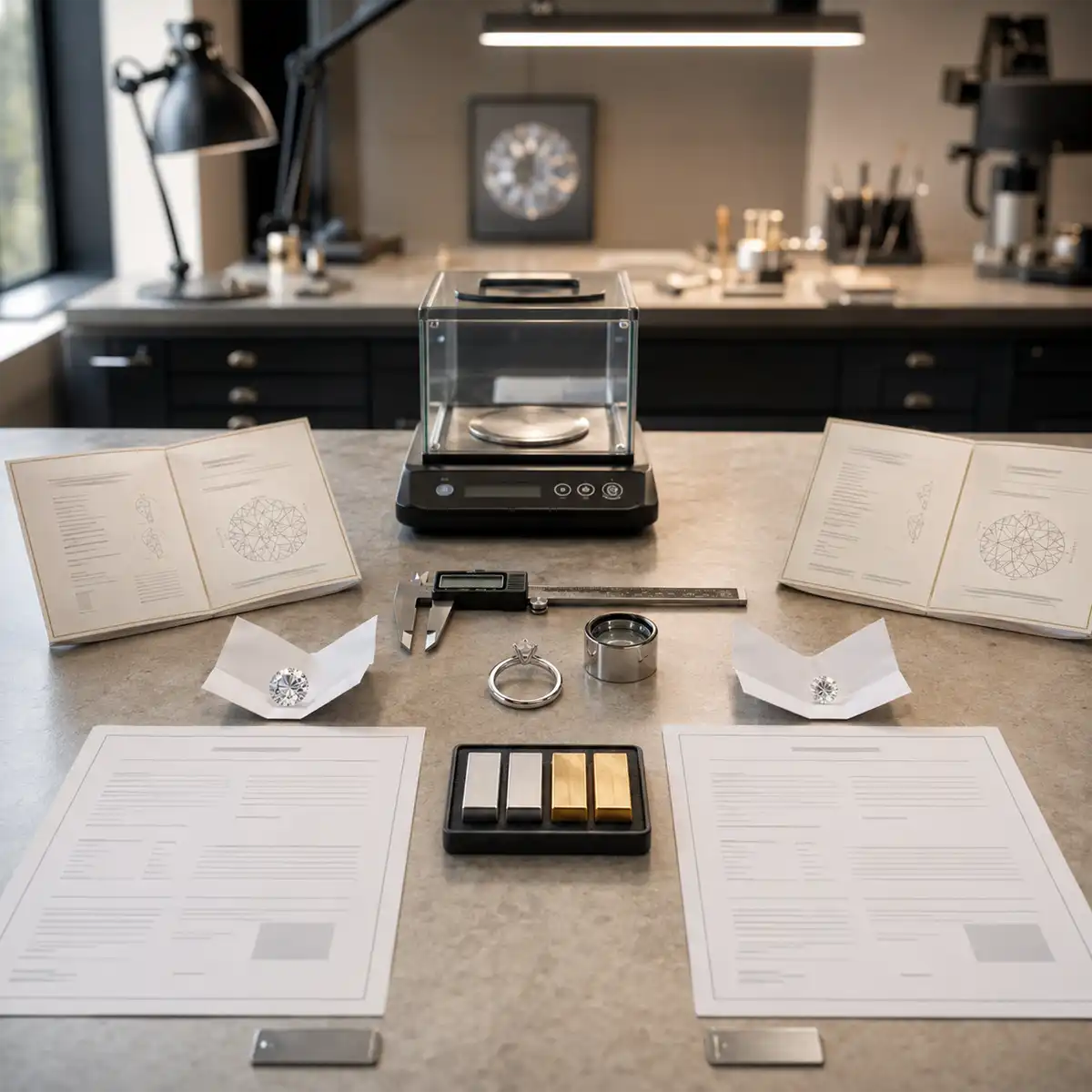

The lab-grown line that makes two quotes incomparable
One field on a certificate can account for the entire gap between 2 quotes.
A lab-grown diamond and a natural diamond of identical specification are physically the same material, graded by the same laboratories, against the same criteria. They are not the same price, and the gap has widened considerably as lab-grown production has scaled. A quote built on a lab-grown stone and a quote built on a natural stone are not competing offers. They are answers to different questions.
Reputable reports state laboratory origin explicitly. Check for it. If one quote is dramatically lower and you cannot immediately see why, this is the first place to look, and the second is the carat threshold.
Neither choice is wrong. But choose it deliberately rather than discovering it in a discount.
What a quote must itemise before you can judge it
Ask for the quote in writing, itemised, with 6 things on it.
The full stone specification including laboratory and report number. The metal and its fineness. The setting style and the count of any additional stones. Whether hallmarking is included. The lead time from approved design. What happens if you want a revision after CAD.
Any jeweller who will not produce that has told you something useful at no cost. Pricing at Smith & Green is provided on consultation because it is specific to the stone and the labour involved, and both are known only after the conversation. But the structure of the quote should never be a mystery, and a written itemisation is the normal output of a serious consultation rather than a favour.
Then compare like with like. One number at a time.
Conclusion
Get both quotes in writing against one written specification, then book time to have them read by someone with the stones in front of them. Smith & Green take appointments Tuesday to Saturday, 09.30 to 18.00, at 9 Hatton Garden, 4 minutes from Chancery Lane station and a short walk from the Farringdon Elizabeth line exit.
Ask 3 questions of any quote. Ask for the laboratory report number so the stone can be located rather than described. Ask whether hallmarking, CAD revisions and valuation paperwork are inside the number. Ask what the same money buys 0.05 carats lower, because the answer is frequently a better stone.
Allow 6 to 10 weeks from approved design if the ring is bespoke. Comparing engagement ring quotes properly takes an afternoon, and it is the highest-return afternoon in the entire process.