
Ask anyone who proposed before about 2015 how they chose the ring, and the answer usually involves a Saturday, a high street, and a shop assistant. Ask someone who proposed last year and the answer increasingly starts at a kitchen table, on a laptop, at half past ten at night.
The shift is not simply that people research online first. It is that the tool they research with has changed shape. The filterable stone list that dominated a decade ago has been replaced by the engagement ring builder, a step-by-step configurator that lets a buyer choose a shape, select a certificated diamond, pair it with a setting and see one finished price.
That change has done more to demystify ring buying in Britain than any amount of consumer advice. It has also introduced a few traps worth knowing about, most of them relating to how easy the format makes it to spend more than you intended. Used deliberately, a configurator gives an ordinary buyer the sort of comparative view that once required a trade contact.
What an Engagement Ring Builder Actually Is
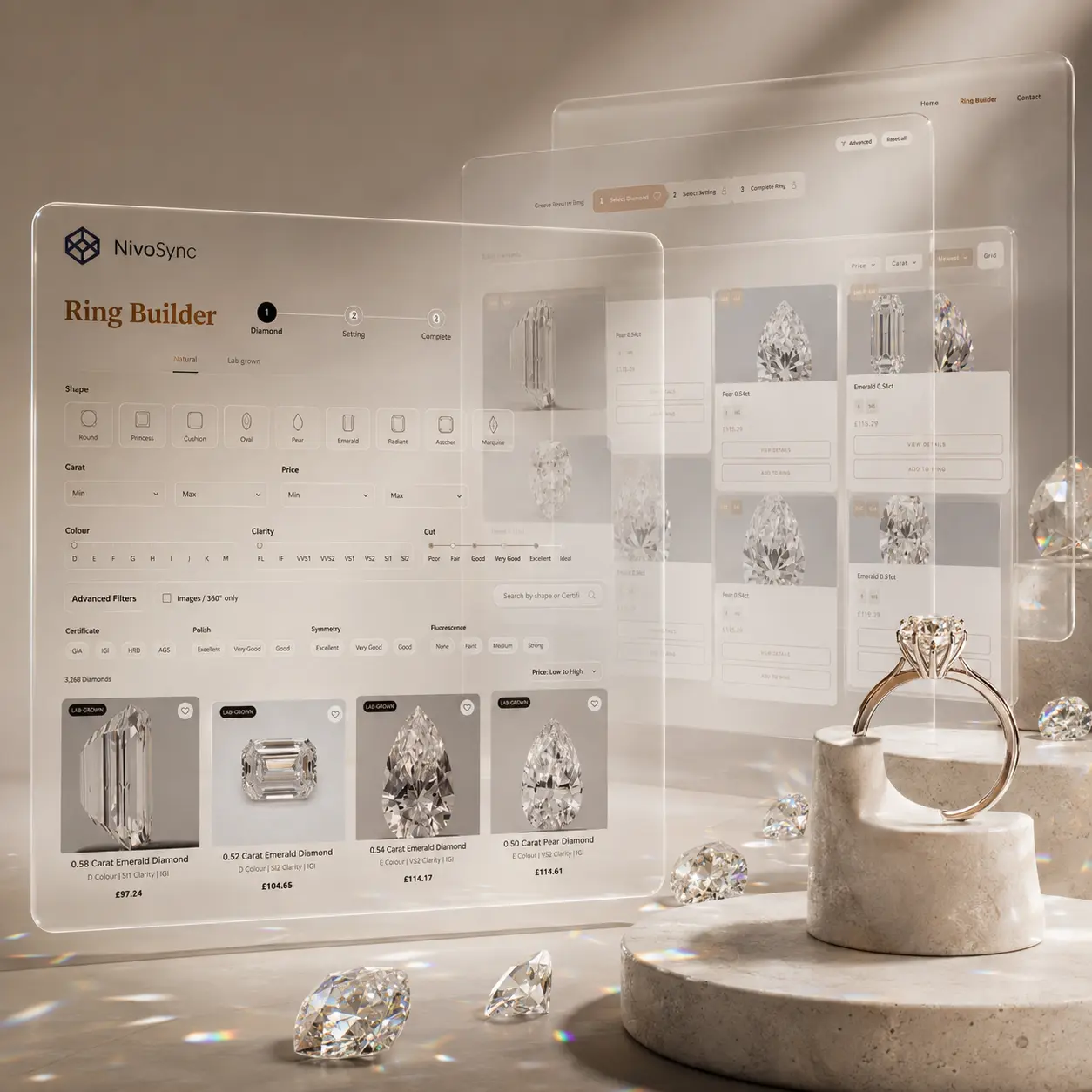
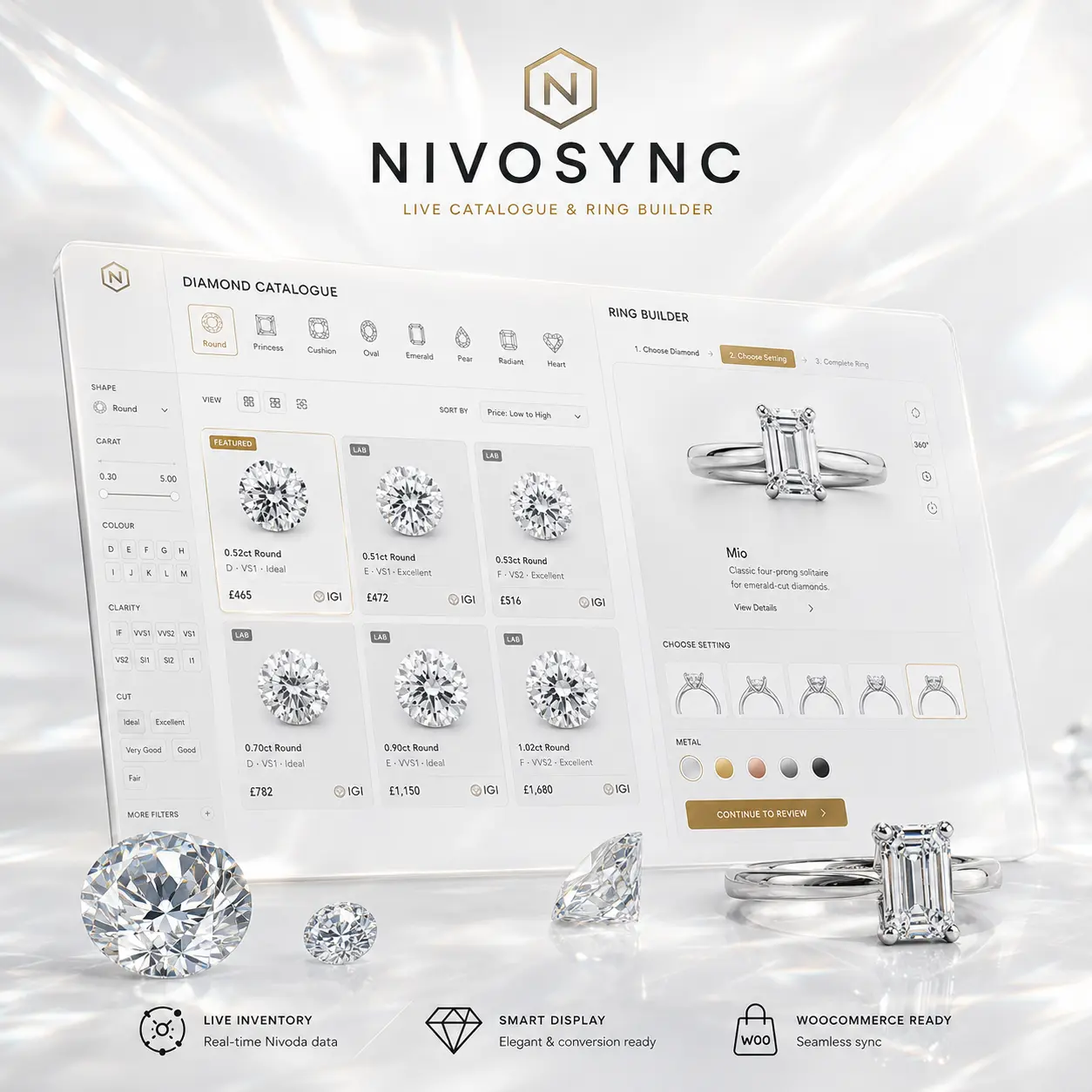
An engagement ring builder is an online configurator that separates the two halves of a ring, the centre stone and the setting, and lets you choose each independently before combining them into a single priced item. Most follow the same four steps. Pick a shape, pick a diamond, pick a setting, review the composed ring.
The separation is the whole point. A traditional retail ring is sold as a finished object at a fixed price, which conceals how the money is divided. A builder makes the split explicit. You can see that moving from a 1.00ct to a 1.20ct stone costs more than upgrading the setting from 18ct white gold to platinum, and you can make that trade with your eyes open.
For most buyers this is the first time the arithmetic of a ring has ever been visible. The centre stone typically accounts for somewhere between 60% and 75% of the total on a certificated diamond ring, and seeing that proportion on screen changes how people allocate a budget.
Why Configurators Replaced the Diamond List
The earlier generation of jewellery websites presented a searchable list of loose stones and left the customer to imagine the rest. It was a genuine advance on nothing, and it was also a poor buying experience for anyone who had not shopped for diamonds before.
The difficulty was translation. A listing reading 1.10ct, oval, G, VS2, excellent cut, GIA certificated is precise, complete and almost meaningless to a first-time buyer. It does not tell you whether the stone will look large on a size L finger, whether that colour grade will read as white in a yellow gold setting, or what the ring will cost once it exists.
Builders answer all three by construction. Shape first, because shape is the decision buyers hold an opinion on before they start and it removes the great majority of the inventory painlessly. Stone second, from a field narrowed to something a person can actually assess. Setting third, which is where the ring stops being a specification and starts being an object. Then a total.
How to Use a Ring Builder Without Overspending
The single most useful discipline is to set two budgets rather than one, a figure for the stone and a figure for the setting, and to configure at least 3 rings before falling in love with any of them.
Builders are designed to feel additive. Each step presents an upgrade, and each upgrade is individually modest. The cumulative effect is that buyers commonly finish 20% to 30% above the number they started with, not through any deception but because the interface never asks them to reconsider an earlier choice.
The counter-move is to build deliberately. Configure your target ring, then build the same ring one clarity grade lower, then build it one colour grade lower, then compare all three totals side by side.
The differences are usually instructive. A stone at VS2 rather than VS1 is very often indistinguishable to the unaided eye once mounted, while the saving is real. The same is frequently true moving from G to H colour, particularly in a yellow or rose gold setting where a faint warmth reads as intentional rather than as a compromise. Our fuller treatment of how to choose an engagement ring setting covers where the remaining budget is best spent.
Fun fact: The oval brilliant cut as we know it was developed by Lazare Kaplan in the late 1950s, and it typically appears around 10% larger than a round brilliant of identical carat weight because more of the stone's mass sits at the surface.
Where the Diamonds in an Online Builder Come From
Most independent British jewellers running an online builder do not own the stones on display. They are drawing on a wholesale marketplace that aggregates inventory from independent suppliers internationally, and the stone is ordered from that supplier once you commit to buy.
This is standard trade practice and there is nothing irregular about it. It is also why a small jeweller in a market town can present a selection that would have required several million pounds of stock a decade ago. The stones are real, individually certificated and physically held by the supplier. The retailer is your counterparty and remains fully responsible for the transaction.
What the model does mean is that availability is live and shared. Stones above roughly half a carat are effectively unique, so the same physical diamond can appear on several retailers' websites at once.
Well-built systems place an automatic hold on your specific stone at checkout and release it if the order is cancelled, which prevents the same stone being sold twice. Software such as the ring builder tools independent jewellers now install on their own websites handles that hold as standard, though not every implementation does. If a retailer cannot answer what happens to your stone between payment and dispatch, treat that as a warning.
What a Builder Cannot Tell You
A configurator communicates specification well and appearance poorly, and the gap between those two is where disappointment lives.
Certificates describe stones, they do not photograph them. Two diamonds graded identically for the 4Cs can differ visibly in brilliance depending on crown angle, pavilion depth, girdle thickness and how the stone behaves under different lighting. Strong fluorescence, which some listings treat as a footnote, can make a stone appear slightly hazy in direct sunlight, and it is also why a fluorescent stone often carries a lower price for the same grades.
Scale is the other blind spot. Carat weight is a measure of mass rather than of visible size, and two 1.00ct stones of different cuts and proportions can look noticeably different across the finger. Millimetre measurements, which good listings include, are a better proxy for how large a stone will read than carat weight alone.
The remedy is not to distrust the tool. It is to treat the configuration as a shortlist and to view your final 2 or 3 candidates in person before paying in full, ideally side by side under the same light.
Builders are also generally better at presenting laboratory-grown stones than at explaining what choosing one means over time, since the interface treats the toggle as one filter among twelve. The pricing, grading and resale differences deserve their own consideration, which we set out in our explainer on lab-grown diamonds, price, grading and resale.
Questions to Ask the Retailer Before You Pay
Ask 6 things, and ask them in writing. Which laboratory graded the stone and what is the certificate number, so you can verify it independently on the laboratory's own website. Is the price shown inclusive of VAT and of the setting. Can you view the stone before final payment, and who bears the cost if you decline it.
Then ask about the paperwork and the protections. Will the finished ring carry a UK Assay Office hallmark, which is a legal requirement for precious metal articles above the statutory weight thresholds. Is an insurance valuation included, and at what figure. And critically, is the order classified as bespoke, because rings made to your specification generally fall outside the automatic 14-day cooling-off period that applies to ordinary online purchases. Your rights under the Consumer Rights Act 2015 for faulty or misdescribed goods apply either way, but return rights for a change of heart do not.
Lead times deserve a direct question too. A stone sourced from an international supplier and then set in a UK workshop realistically takes longer than a ring sitting in a display case, and quoted turnarounds of 2 to 4 weeks are common for a stock setting with a sourced stone. Bespoke commissions run considerably longer. If you are working to a specific date, build in slack, particularly between October and February when workshop capacity tightens.
Using the Tool Well
The builders now standard on British jewellery websites are a real improvement on what preceded them, and buyers who use them methodically end up better informed than almost any generation before. The tool rewards a particular kind of user, namely one who configures several versions, understands which grade changes are visible and which are not, verifies the certificate independently, and then goes to see the shortlist in person.
It punishes the opposite behaviour, which is to configure once, upgrade at every step because each increment felt small, and pay without seeing the stone. That is not a flaw in the software. It is what happens whenever an interface makes spending frictionless.
Start with a shape you are confident about, set a firm ceiling before you open the page, and build the same ring at 3 different grade combinations before you decide. Used that way, an engagement ring builder gives an ordinary buyer the kind of comparative view that used to require a trade contact and several appointments, and it costs nothing but an evening.