
The most consequential question a UK buyer can ask before committing to an engagement ring is one most retail counters answer with a stylistic shrug rather than a structural answer. The choice between platinum and 18ct white gold looks identical at the showroom, and to the untrained eye the two metals are visually indistinguishable when both are freshly polished. The lifetime cost, the maintenance burden, and the way the ring will look in 2046 are not identical at all. The buyer paying £4,000 for a setting deserves the structural analysis, and platinum vs white gold engagement rings UK is the comparison most likely to affect long-term satisfaction with the purchase.
What each metal actually is
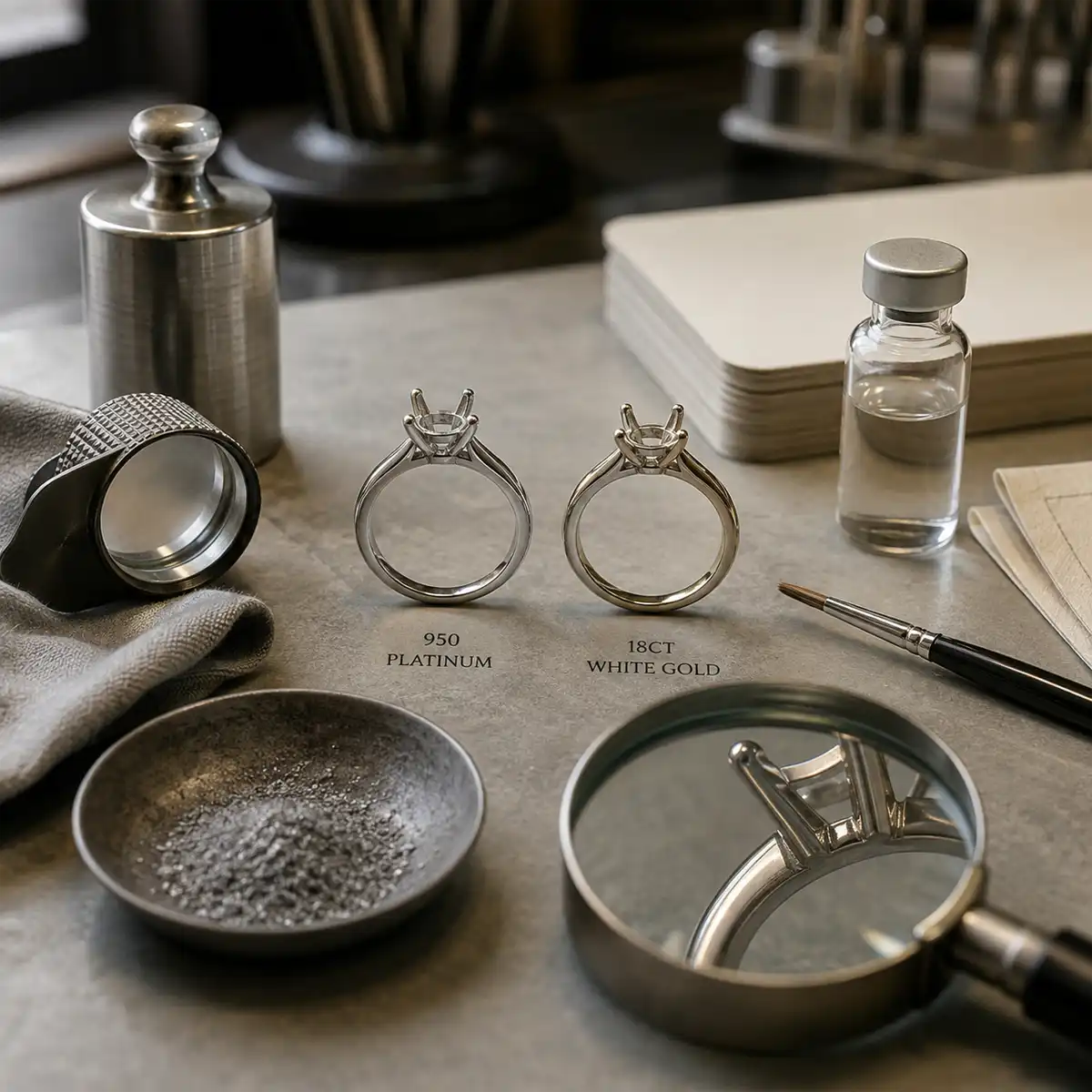
Platinum used in UK engagement rings is hallmarked at 950, meaning the alloy contains 95% pure platinum mixed with 5% of another platinum-group metal, typically ruthenium or iridium. The result is a dense, naturally white, hypoallergenic metal that requires no surface treatment to maintain its colour. The platinum hallmark is one of the four compulsory marks under the Hallmarking Act 1973 for any platinum jewellery sold in the UK above the weight threshold.
18ct white gold is a fundamentally different product. The alloy is 75% pure gold, which is yellow, mixed with 25% of paler metals including palladium, silver, copper, or nickel to neutralise the yellow tone. The resulting alloy is technically off-white with a faint yellow or grey cast, which is then masked by a layer of rhodium plating applied at the manufacturing stage. The rhodium plating is what produces the bright white appearance the buyer sees in the showroom, and that plating is a consumable surface treatment that wears off through daily use.
This distinction is the foundation of every meaningful difference between the two metals over the lifetime of the ring.
Density and the daily-wear consequence
Platinum's density is one of the metal's most underappreciated working properties. Pure platinum weighs 21.45 grams per cubic centimetre against 18ct white gold at approximately 14.7 grams per cubic centimetre. A platinum ring weighs noticeably more on the hand than the equivalent white gold ring, and this density translates into structural advantages that matter across decades of wear.
When platinum is scratched, the metal displaces rather than wearing away. A scratch on a platinum ring pushes metal to the sides of the scratch line, leaving the volume of metal in the ring effectively unchanged. The same scratch on 18ct white gold removes a small quantity of metal, and across years of cumulative scratching the ring becomes measurably thinner. This is why platinum claws can hold a stone securely for 50 years where white gold claws frequently require retipping or replacement after 15 to 20 years of daily wear.
For the buyer thinking in heirloom terms, the density difference is the single strongest argument for platinum at the moment of purchase. For the buyer thinking in 5-year terms, the difference matters less, but the lifetime calculation still favours platinum on durability metrics that retailer comparison content rarely makes explicit.
The rhodium plating cycle no retailer flags upfront
The maintenance question is where 18ct white gold's hidden cost emerges. Rhodium plating wears off through daily contact with skin, soap, water, and abrasive surfaces, and on most wearers the plating begins to show wear within 12 to 24 months of continuous wear. The underlying alloy reveals a yellowish or greyish cast where the rhodium has worn through, particularly on the underside of the band and around the inside of the claws.
Restoring the appearance requires re-plating, which a UK jeweller typically performs for £40 to £80 per service. Most active wearers require re-plating every 18 to 24 months across the lifetime of the ring. Across a 30-year wear horizon, the cumulative re-plating cost runs to £600 to £1,200, plus the inconvenience of leaving the ring with a jeweller for several days each cycle.
Platinum requires no equivalent maintenance. The metal develops a soft patina over several years of wear that some wearers prefer and others have polished out at long intervals. A polish service costs £30 to £60 and most platinum rings need this only every 5 to 10 years, with no underlying alloy revelation problem because there is no plating to wear through.
A snippet-ready summary for buyers comparing lifetime cost: platinum costs more upfront than 18ct white gold by roughly 40% to 70% at equivalent ring designs, but eliminates the £600 to £1,200 lifetime rhodium re-plating cost associated with white gold and offers superior long-term durability. White gold remains the lower-total-cost option only if the wearer is comfortable with the maintenance cycle and the eventual yellowish cast as plating wears through.
UK price geometry at equivalent specifications
The upfront price differential between the two metals depends on the design weight of the ring. A simple solitaire setting in 950 platinum at approximately 5 grams of finished weight typically prices at £900 to £1,400 at UK ateliers in 2026, while the equivalent in 18ct white gold prices at £550 to £900. The gap widens with heavier designs: a substantial halo setting in platinum at 8 to 10 grams of finished weight prices at £1,800 to £2,800, while the equivalent in 18ct white gold sits at £1,000 to £1,700.
These figures cover setting cost only and exclude the centre stone. The platinum premium over 18ct white gold has narrowed slightly through 2024 and 2025 as platinum spot price has moderated against the gold price, but the structural relationship persists: platinum carries an upfront premium that the buyer recovers, in maintenance terms, somewhere between year 8 and year 15 of ownership at typical re-plating intervals.
Allergic reaction and the nickel question
A material consideration for some UK buyers is the question of nickel content. White gold alloys produced before approximately 2010 frequently used nickel as the whitening alloy component, and a small percentage of wearers experience contact dermatitis from sustained skin contact with nickel-containing jewellery. EU regulations effectively eliminated high-nickel white gold from the UK market years ago, and most contemporary UK 18ct white gold uses palladium-based whitening, but the issue persists for inherited or vintage white gold pieces.
Platinum is hypoallergenic in its 950-alloy form and produces no reaction in any documented case. For wearers with known metal sensitivities, this single property has historically been the deciding factor.
Resizing and structural modification
A practical consideration that affects long-term ownership is how each metal responds to resizing. Platinum is significantly harder to resize than 18ct white gold, requires higher working temperatures, and demands a more skilled bench jeweller. UK ateliers typically charge £80 to £150 for a standard platinum resize against £50 to £90 for 18ct white gold. The work takes longer, and the platinum solder joint is more visible than the white gold equivalent in close inspection.
For rings with intricate pavé work or full-eternity bands, both metals present resizing challenges, but the platinum challenge is greater. A buyer commissioning a complex bespoke design should ask about resizing tolerances at the design stage rather than discovering the limits years later.
Fun fact: Platinum did not enter widespread use in jewellery until the late 1800s because the metal's melting point of 1,768 degrees Celsius exceeded the working capacity of most jewellers' equipment until oxyhydrogen and oxyacetylene torches became commercially available in the early 20th century.

Hallmarking and what the marks actually guarantee
Both metals are subject to compulsory hallmarking under the Hallmarking Act 1973 for any item sold in the UK above the relevant weight threshold. A UK platinum engagement ring carries four marks: the sponsor's mark identifying the maker, the platinum standard mark of 950 within a pentagon, the assay office mark identifying which UK assay office tested the metal, and the date letter indicating the year of marking. An 18ct white gold ring carries the same structure with the gold fineness mark of 750 (representing 75% gold) within an oval.
The hallmarks are the buyer's legal guarantee of metal content. A ring sold without correct hallmarking, where weight requires it, is in breach of UK consumer law. Buyers should verify all four marks under magnification before committing to a purchase, particularly on imported pieces where the assay office mark confirms UK testing rather than a foreign equivalent.
Which metal suits which buyer
Platinum suits the buyer who prioritises long-term durability, intends the ring as a lifetime piece, has known metal sensitivities, accepts the upfront premium, and prefers minimal maintenance over the lifetime of the ring. White gold suits the buyer who prioritises lower upfront cost, is comfortable with the maintenance cycle and re-plating intervals, prefers the slightly brighter initial appearance that fresh rhodium plating provides, and treats the ring as a 10 to 15-year piece rather than a 50-year heirloom.
Both metals are entirely legitimate choices for a UK engagement ring, and neither is structurally wrong. The choice should be made knowing the lifetime maintenance cost differential, not in ignorance of it.
Closing thoughts for the buyer at this stage
If you are weighing platinum vs white gold engagement rings UK at the showroom, ask the jeweller to show you a platinum ring that has been worn for 10 years alongside a white gold ring that has been worn for 10 years and not re-plated. Most reputable UK ateliers can produce examples from their workshop archive on request. Seeing the long-term reality of each metal is worth more than any product brochure, and the comparison reveals what the showroom-fresh ring cannot show. Once you have seen the 10-year comparison, the decision becomes a straightforward question of priorities rather than aesthetics.
Once the metal is settled, the certification framework that protects your purchase becomes the next consideration, particularly if you are working in the £4,000-plus bracket where independent laboratory grading is non-negotiable.