
The pre-owned engagement ring market in the UK has expanded materially through 2024 and 2025, driven by three forces: rising new-ring prices at the high end, growing acceptance of second-hand luxury across other categories, and a generation of buyers comfortable with online provenance verification. A pre-owned ring at 30% to 50% below the equivalent new-ring price is a genuine value proposition, but the buyer entering this market faces authentication, valuation, and consumer-protection questions that simply do not apply to a new ring purchase from a regulated retailer. Pre-owned engagement rings UK is therefore a market where editorial independence has direct value, because every party in the transaction has a commercial interest in obscuring at least one part of the picture.
This guide is written for the UK buyer at the comparison stage who wants to understand what the pre-owned market actually offers, where the risks sit, and what protection structures matter before committing.
Why the UK pre-owned market has grown
The structural reasons behind the pre-owned market's growth in 2025 and 2026 are worth naming, because they shape what is and is not available to the buyer.
New diamond engagement ring prices at the upper-mid tier (£5,000 and above) have moved with metal spot prices and certification premium pricing across the past three years. A buyer working in the £4,000 to £8,000 range finds that the new-ring market increasingly compresses their stone-size options, while the pre-owned market at the same budget often delivers stones one full carat-grade above what the new market provides.
The second force is the broader cultural shift toward second-hand luxury. The UK pre-owned market for designer handbags, watches, and fine jewellery has moved decisively into mainstream consumer territory through 2024 and 2025, with platforms such as 1stDibs, Hardly Ever Worn It, and specialist Hatton Garden second-hand jewellers reporting significant year-on-year volume growth. Pre-owned engagement rings have benefited from this normalisation.
The third force is provenance verification technology. Online platforms now routinely provide laser inscription verification, certificate cross-checking, and high-resolution imagery that allow remote inspection at a level not available even five years ago. The technical barrier to confident pre-owned purchasing has fallen meaningfully.
What "pre-owned" actually covers in UK practice
The term "pre-owned" covers four distinct categories in the UK market, and the buyer's first task is to understand which category they are looking at.
True second-hand engagement rings have been worn by a previous owner, typically returned for resale through a specialist dealer, auction house, or pawnbroker. These stones may have been worn for years or decades and may show wear on the metal, claws, or pavé work that requires assessment.
Estate jewellery refers to pieces sold from an estate (often after a death or divorce), which may include rings worn for decades or pieces held in a collection but rarely worn. Estate pieces sometimes carry historical interest beyond the stone itself.
Antique engagement rings, conventionally defined as pieces over 100 years old, sit in a specialist sub-market with distinct valuation and authentication considerations. UK antique specialists in Hatton Garden and at established auction houses such as Bonhams, Christie's, and Sotheby's serve this market with dedicated expertise.
Returned new rings sold as pre-owned represent a smaller category. These are rings purchased and returned within a retailer's policy window, then resold at a discount. The condition is typically near-new, but the rings are no longer technically new for resale purposes.
A snippet-ready summary for buyers entering the market: pre-owned engagement rings UK divide into four distinct categories. True second-hand pieces have been worn and may show wear; estate jewellery comes from specific estates with documented provenance; antique rings over 100 years old sit in a specialist sub-market; returned new rings offer near-new condition at modest discount. Each category carries different authentication, valuation, and pricing considerations.
The price geometry against new-ring equivalents
The pricing relationship between pre-owned and new is the headline value question. Across the UK market in 2026, a true second-hand engagement ring of comparable specification typically prices at 30% to 50% below the equivalent new-ring retail price, though the discount varies significantly by category, condition, and selling channel.
A 1.00-carat round brilliant natural diamond at G colour, VS2 clarity, with current GIA certification, in a platinum solitaire setting, prices new at UK retailers between £6,500 and £9,000 in 2026. The same specification on the pre-owned market typically prices between £3,800 and £5,500, depending on whether the seller is a specialist dealer, an auction house, or a private platform.
The discount widens significantly at higher price points. A 2.00-carat natural diamond at strong specifications prices new at UK retailers between £20,000 and £30,000; the pre-owned equivalent often sits between £10,000 and £18,000, reflecting the depreciation curve diamonds follow regardless of original quality.
The discount narrows or reverses for genuinely rare stones. An unheated Burma sapphire of exceptional colour, an antique Asscher cut from a documented Art Deco workshop, or a signed piece from an established maker (Cartier, Van Cleef & Arpels, Boucheron) can hold or appreciate value across decades. The pre-owned market at this end functions more like the watch market, where specific references command genuine investment-grade pricing.
These figures are indicative ranges drawn from UK pre-owned platform pricing visible across the market in 2025 and early 2026; specific pricing varies by stone, certification, and seller.
The authentication question that matters most
The single most consequential difference between buying new and buying pre-owned is the authentication burden. A new ring from a regulated UK retailer arrives with current certification, a documented chain of custody from the certifying laboratory through the retailer to the buyer, and the retailer's commercial commitment to the stone's described specification. A pre-owned ring carries none of these guarantees by default, and the buyer must build the equivalent assurance through independent verification.
Three verifications are non-negotiable for any pre-owned engagement ring above £2,000. First, the certificate must be current, verified through the issuing laboratory's online verification tool, and the report number must match the laser inscription on the stone's girdle. Second, an independent UK valuer with no commercial relationship to the seller must inspect the stone and confirm the specifications match the certificate. Third, the metal must be assessed for hallmark integrity and any structural compromise from prior wear or repair.
The certificate verification is the most critical step and the one most buyers skip. A certificate from 2008 may be genuine but stale; the stone may have been recut or damaged in the intervening years, leaving the current stone different from what the certificate describes. Recertification through GIA or HRD (or IGI for lab-grown pre-owned, which is a small but growing sub-market) costs £150 to £400 and produces a current document the buyer can rely on.
The independent valuation costs £80 to £180 at a UK NAJ-accredited valuer or an Institute of Registered Valuers member. This is the buyer's primary protection against misrepresentation and the document the eventual insurer will require regardless. A seller who refuses to allow independent inspection before purchase is a seller worth walking away from.
The UK selling channels and their working differences
Five main channels supply the UK pre-owned engagement ring market, and each operates under different rules.
Specialist Hatton Garden second-hand dealers represent the established trade route. These dealers acquire pieces through estate purchases, private sales, and trade-in routes, refurbish them where appropriate, and sell with documented provenance. The advantage is professional expertise; the trade-off is that prices reflect the dealer's overhead and margin.
Auction houses, primarily Bonhams, Christie's, Sotheby's, and the regional UK auction circuit, sell jewellery at scheduled sales with published estimates and full pre-sale viewing periods. Prices realised vary dramatically by the day; a piece estimated at £4,000 to £6,000 may sell for either figure or beyond. Buyer's premium typically adds 25% to 28% to the hammer price, which materially affects the working calculation.
Online platforms, including 1stDibs UK, Hardly Ever Worn It, Vestiaire Collective, and the second-hand sections of established retailers, offer remote browsing with varying levels of authentication infrastructure. 1stDibs operates a vetting system for member dealers; the other platforms vary. Online purchases are typically subject to the Consumer Contracts Regulations 2013 14-day cooling-off period when purchased from a UK trader, though private sales between consumers are not protected.
UK pawnbrokers including H&T, The Money Shop's pre-owned divisions, and specialist jewellery pawnbrokers in major UK cities represent a distinct channel. Stones acquired through unredeemed pawn loans are sold with limited provenance documentation but typically at lower price points than specialist dealers.
Private sales between individuals, increasingly conducted through Facebook Marketplace, Gumtree, and similar platforms, represent the highest-risk channel. No consumer protection applies; no commercial guarantee exists; authentication is entirely the buyer's responsibility. Significant savings are possible but the risk profile is fundamentally different from any regulated channel.
The Consumer Rights Act protection differential
The most important legal consideration is the difference in consumer protection between regulated and private sales, and this is where the UK pre-owned market diverges sharply from the new-ring market.
A pre-owned engagement ring purchased from a UK trader (any business operating in the trade, including dealers, auction houses, and online platforms) is covered by the Consumer Rights Act 2015. The ring must be of satisfactory quality, fit for purpose, and as described. If the ring's condition or specification differs from what the seller represented, the buyer has the right to repair, replacement, or refund within 6 years of purchase under English law.
A pre-owned ring purchased through a private sale between consumers carries no Consumer Rights Act protection. The transaction operates under the older "caveat emptor" principle, where the buyer takes the goods as found. Misrepresentation by the seller may give rise to a separate civil action, but the practical recourse is significantly weaker than the trader-purchase route.
This single distinction should govern channel choice for any pre-owned ring above approximately £1,000. The Consumer Rights Act protection is worth the price differential a regulated channel typically commands over a private sale, particularly for buyers without independent expertise to authenticate the stone before purchase.
Fun fact: The Bond Street auction house Phillips, founded in 1796, conducted some of the earliest documented public auctions of pre-owned engagement rings in the UK, with surviving sale catalogues from the early 1800s showing diamond rings selling at pre-owned prices roughly 35% to 45% below contemporary new-ring retail values, a discount geometry that has remained remarkably stable for over two centuries.
What to inspect before committing
A pre-owned engagement ring requires inspection beyond the certificate-and-stone verification that applies to new rings. Six structural areas matter for any pre-owned piece.
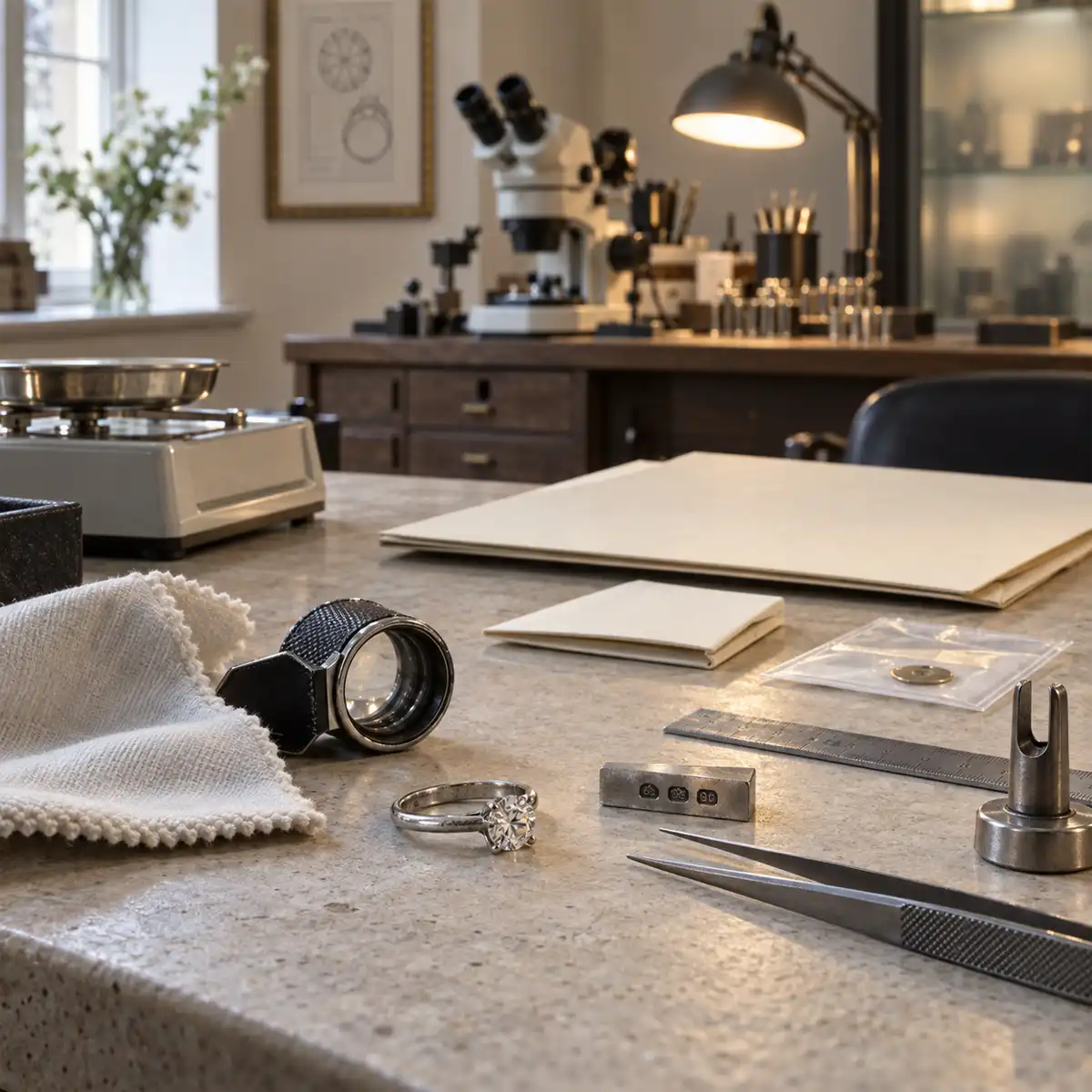
The claws holding the centre stone should be inspected under 10x magnification for wear, thinning, or damage. Worn claws on pre-owned rings are common and often require retipping (£60 to £150 per ring) before the stone is securely held. A reputable seller will have addressed this before sale; a private seller frequently has not.
The pavé work, where present, should be checked for stone loss, loose stones, and worn grain settings. Replacing lost pavé stones costs £80 to £180 each, and a ring with multiple compromised pavé positions may require £400 to £800 of restoration work to return to safe daily wear.
The band itself should be examined for thinning, particularly at the bottom of the shank where decades of wear cause measurable metal loss. A band that has thinned below structural tolerance requires reshanking (£200 to £450) which retains the original setting but replaces the lower band.
The hallmarks should be present, legible, and consistent with the metal claimed. A faded or partially worn hallmark is not necessarily a problem on a vintage piece but should be noted; a missing hallmark on a piece claimed to be 18ct gold or platinum is a significant concern.
The centre stone itself requires recertification or current independent inspection, particularly if the supplied certificate is more than 5 years old. A stone may have been recut, damaged, or in rare cases substituted between certification and current sale.
The setting alignment should be inspected with the stone in place. A previously dropped or knocked ring may have settings out of alignment, claws bent, or galleries deformed in ways that affect both appearance and structural security.
What aftercare costs add to the headline price
A practical reality of pre-owned ring purchase that the headline price obscures is the aftercare cost typically required to bring the ring to current daily-wear standards. A pre-owned ring at £4,000 may require £200 to £600 in restoration work (reclaw, polish, partial reshanking, pavé replacement) before it is ready for the next 30 years of wear.
UK ateliers experienced in pre-owned restoration provide pre-purchase inspections for £60 to £120, producing a documented assessment of the work required. This inspection is the single most useful pre-commitment step a buyer can take, because it converts the headline pre-owned price into a true total acquisition cost the buyer can compare against the new-ring equivalent.
A pre-owned ring at £4,000 with £400 of restoration work totals £4,400 against a new-ring equivalent at £6,500, which is still a meaningful £2,100 saving. A pre-owned ring at £4,000 with £900 of restoration work totals £4,900 against the same £6,500 new-ring equivalent, which is a more modest saving the buyer should weigh against the certainty of a new purchase.
What to ask the seller before paying any deposit
Six questions reveal whether a UK pre-owned seller is operating to professional standards. First, what is the documented provenance of this ring, and what records support it? Second, is the certificate current, and will you allow independent verification before sale? Third, what restoration work has been performed on this ring, and by whom? Fourth, will you allow independent inspection by a UK NAJ-accredited valuer of my choosing before commitment? Fifth, what is your returns policy and how does it relate to my Consumer Rights Act protection? Sixth, what aftercare and warranty arrangements apply to this purchase?
A seller answering all six questions clearly and in writing is operating to the standard a £4,000 transaction deserves. A seller deflecting on independent inspection or recertification is a seller worth questioning further. The questions cost nothing, and the answers are the most reliable indicator of how the seller will treat any post-sale issues that arise.
Closing thoughts for the buyer at this stage
If you are weighing pre-owned engagement rings UK against the new-ring equivalent, the most useful action is to identify two or three specific stones at comparable specifications across both markets, obtain pre-purchase inspections on the pre-owned candidates from a UK NAJ-accredited valuer, and produce a true total-cost comparison including restoration work. This converts the pre-owned discount from a headline figure into a working number you can decide on. For most UK buyers in the £3,000 to £8,000 range, the pre-owned route delivers genuine value once the verification and restoration costs are factored in; above £10,000, the case for pre-owned strengthens further as the absolute discount widens.
Once the ring is acquired, the same insurance and revaluation discipline that protects a new ring applies equally to a pre-owned one, and an independent valuation document at the point of purchase is the foundation of that protection.