
The oval cut is the diamond shape that has reshaped the UK engagement ring market more than any other in the last decade. Walk into any Hatton Garden bespoke atelier on a Saturday morning and the request volume tells the story: oval has overtaken the round brilliant as the most-asked-for shape in the £3,000 to £15,000 mid-luxury bracket, and oval engagement rings now dominate UK Pinterest saves and bridal Instagram boards through 2025 and into 2026. The reason is rarely just sparkle. Oval delivers something the round brilliant cannot, and it does so in ways most retailer category pages skim over.
This guide treats oval as both a stone-shape decision and a setting decision, because in practice the two are inseparable. A 1.50-carat oval in a thin pavé band reads completely differently from the same stone in a wide polished shank, and any UK buyer making a £4,000 commitment deserves the analysis a retailer category page will not deliver.
What an oval cut actually does on the hand
The oval cut is a modified brilliant, meaning it carries the same 56 to 58 facets as a round brilliant arranged across an elongated silhouette. The optical consequence is significant. Because facets are stretched along a longer axis, an oval at 1.00 carat appears roughly 10% larger in face-up area than a round brilliant of the same weight, and the elongation flatters the wearer's finger by lengthening it visually. For UK buyers with shorter fingers or wider knuckles, this is the single most-cited reason for choosing oval over round.
The shape sits comfortably across hand types in a way few other elongated cuts do. Pear shape demands attention through orientation. Marquise polarises. Oval reads as classical without being conservative, which explains why it has become the default bespoke commission request at studios from Holts in Hatton Garden to bespoke ateliers across the country. UK 2025 trend data from leading bridal publications consistently places oval at the top of the most-requested cut category, with elongated antique-cut variants gaining particular traction in the second half of the year.
The bowtie effects every oval owner needs to understand
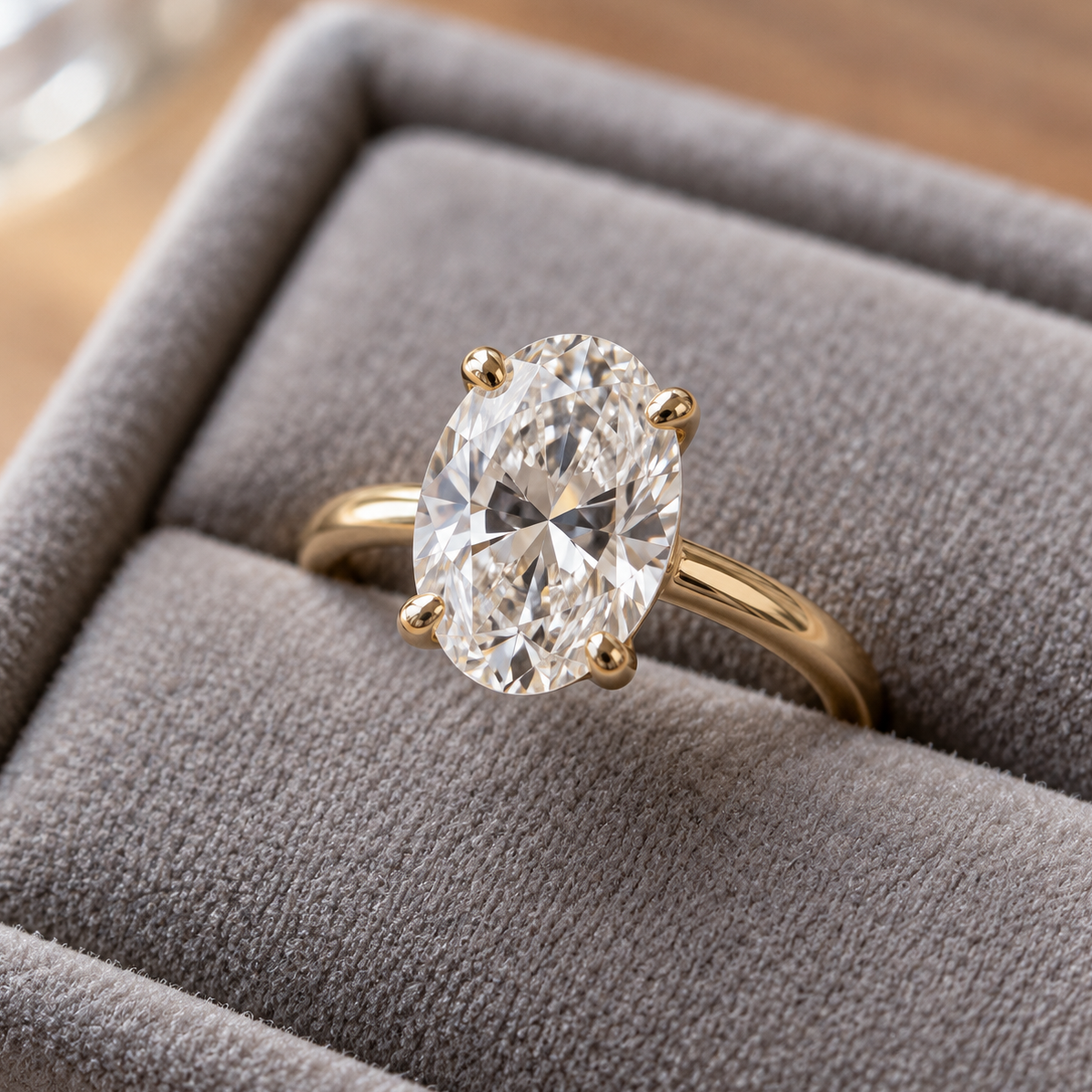
Every oval diamond contains a faint shadow that runs across its centre when viewed face-up under angled light. This is the bowtie effect, and no oval cut is entirely free of it. The bowtie occurs because the elongated facet pattern creates a region where light entering the top of the stone is not returned cleanly to the eye. In a poorly cut oval, the bowtie reads as a dark hourglass blocking the centre of the stone. In a well-cut oval, the bowtie is visible only under specific light angles and disappears as the wearer moves.
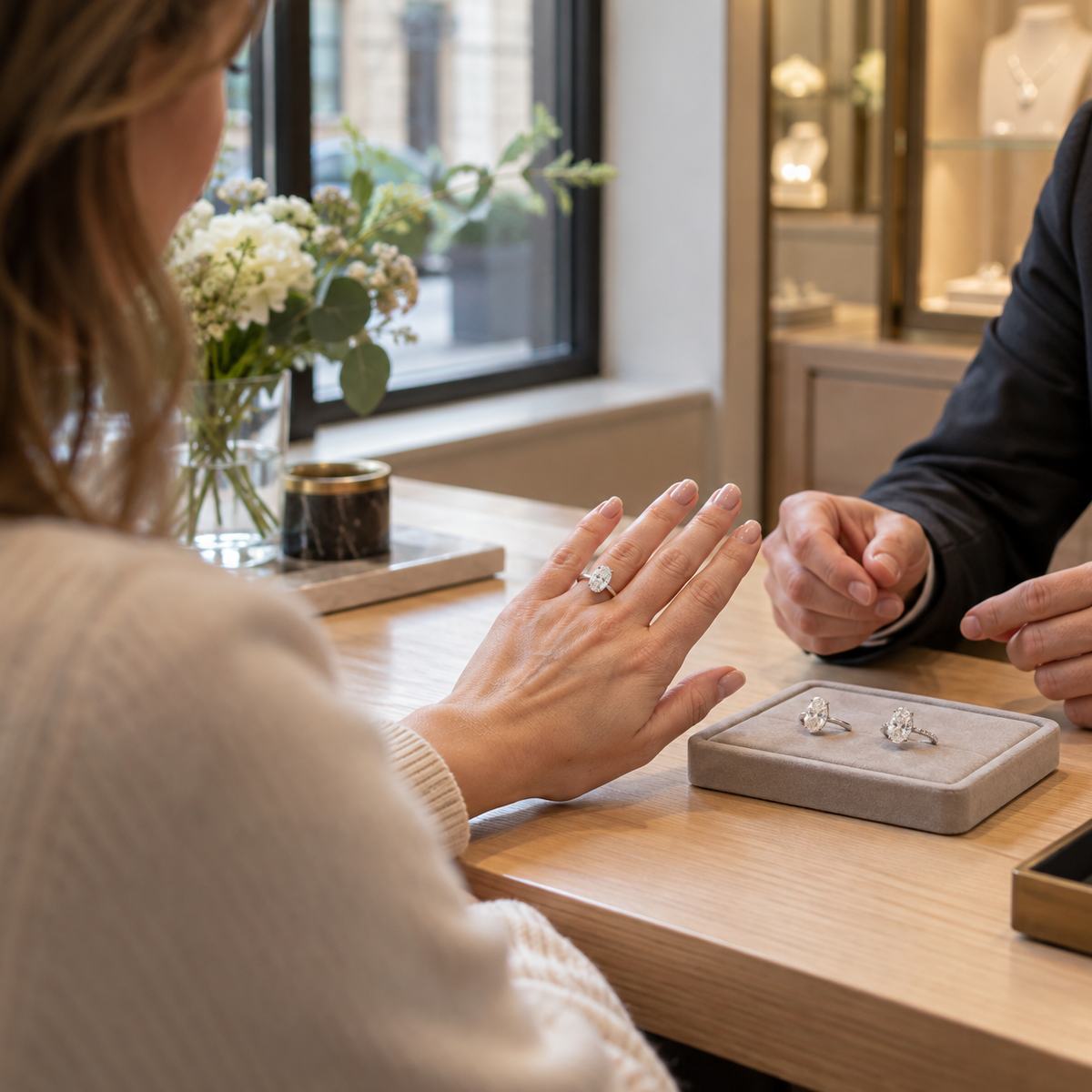
UK buyers walking into Hatton Garden showrooms in 2026 should ask one question above all others when shown an oval: rotate the stone slowly under a daylight-balanced lamp and watch the bowtie behaviour. A bowtie that lingers across multiple viewing angles is a cutting compromise. A bowtie that flickers and disappears with movement indicates a stone the cutter prioritised correctly. This single observation matters more than colour grade, more than clarity grade, and arguably more than carat weight in determining how the finished ring will read on the hand.
Why length-to-width ratio is the working preference
The defining proportion of an oval is its length-to-width ratio. UK retailer ovals typically run between 1.30 and 1.50, and the choice within that range is genuinely a matter of preference rather than a question of right and wrong. A 1.30 ratio reads as a soft, almost rounded oval that approaches the visual character of a cushion cut. A 1.50 ratio reads as a sharply elongated stone that flatters longer fingers and creates a more dramatic line.
The current UK preference sits between 1.35 and 1.45, with 1.40 emerging as the most-requested ratio at independent ateliers through 2025. Anything below 1.25 starts to lose oval's signature elongation. Anything above 1.55 begins to read as a soft marquise, which appeals to some buyers but reduces the everyday wearability the standard oval offers.
A snippet-ready summary for those weighing the choice: the ideal length-to-width ratio for an oval engagement ring depends on hand shape and personal preference, but most UK buyers settle between 1.35 and 1.45. Shorter fingers benefit from the elongation of a 1.45 ratio; longer fingers can carry a softer 1.30 without losing presence. Always view the stone face-up before committing, because the ratio reads differently in person than it does in a product photograph.
How setting choice transforms the same stone
The single greatest variable in how an oval engagement ring reads is the setting it sits in, and this is where buyer education breaks down at most retail counters. Three common setting decisions transform the visual identity of an oval to such a degree that the same 1.50-carat centre stone can read as three entirely different rings.
A thin pavé band creates the sleek, modern oval that has dominated UK celebrity engagement ring coverage since 2020. The slim shank of pavé-set diamonds elongates the visual line of the centre stone and shifts the overall reading toward contemporary minimalism. This setting accounts for the majority of bespoke commissions in the £4,000 to £8,000 UK price band.
A plain polished shank delivers a quieter, more architectural reading. The contrast between the smooth metal and the brilliance of the centre stone makes the diamond the unambiguous focal point, and the ring ages with less stylistic baggage than any pavé variant. For buyers who want timelessness over trend, this is the structural choice.
A hidden halo or full halo around an oval introduces a different proposition entirely. A full halo of pavé-set melée diamonds creates a 15% to 20% increase in perceived size, which can transform a 1.00-carat oval into a stone that reads as 1.30 carats on the hand. The trade-off, as with any pavé-heavy design, is increased maintenance over a 10-year wear horizon.
What UK price points actually deliver
Pricing varies by retailer, certification, and stone specification, but the UK 2026 market has settled into reasonably predictable bands at the most-requested oval specifications.
A natural 1.00-carat oval at G colour, VS2 clarity, with a strong cut grade, set in 18ct white gold or platinum, typically falls between £4,500 and £6,500 at Hatton Garden independent jewellers and rises to £8,000 to £12,000 at premium high-street brands. The same specification in lab-grown form sits between £1,800 and £3,200 at established UK retailers.
A 2.00-carat oval at the same colour and clarity grade has a different price geometry. Natural stones at this weight enter the £18,000 to £28,000 range at UK independents, while lab-grown equivalents sit between £5,500 and £8,500. The price differential between natural and lab-grown widens significantly above 1.50 carats.
These figures are indicative ranges drawn from UK retailer pricing visible across the market in 2025 and early 2026, not invented numbers; specific pricing depends on individual stone specifications, certification body, and the retailer's commercial model.
What to ask before paying a deposit
UK buyers approaching their oval engagement ring decision in 2026 should hold a short checklist before committing. The bowtie behaviour is the first item. The length-to-width ratio is the second. The third is certification: a natural oval above 0.50 carats should carry GIA certification at minimum, while a lab-grown oval should typically carry IGI certification with full proportion data.
The fourth question is structural. How is the oval being held in the setting? A four-claw setting on the cardinal points exposes more of the stone but offers slightly less protection at the elongated tips, where ovals are most vulnerable to chipping. A six-claw setting with two additional claws bracing the tips is the structural standard at UK ateliers. For active wearers, a half-bezel or full-bezel setting protects the tips entirely at the cost of light exposure.
The fifth question, and the one most often skipped, is whether the chosen setting allows for resizing. A pavé band with stones running the full circumference of the shank is significantly harder to resize than a setting where the pavé runs only the upper portion. UK ateliers will typically state this upfront if asked directly.
Fun fact: The Tiffany & Co. oval engagement ring popularised by Blake Lively in 2012 is widely credited with triggering the modern oval revival in Western markets, though the cut itself was developed in its current form by diamond cutter Lazare Kaplan in 1957.
How oval ages alongside other shapes
A consideration that inspiration-stage articles rarely address is how a stone shape ages over a 20-year wear horizon. Oval has the advantage of being neither maximally fashionable nor minimally so, which means it carries less period-specific identity than shapes such as the pear or the marquise, which both peaked in the 1970s and 1980s and now read as period-tagged. Oval reads as classical in the way the round brilliant does, but with an elongated character that makes it more visually distinctive without becoming dated.
For UK buyers planning a 30-year heirloom rather than a 5-year statement piece, this is one of oval's strongest practical arguments. The ring will look as appropriate in 2046 as it does in 2026, which cannot be said with confidence of every shape currently trending.
Closing thoughts for the buyer at this stage
If you are at the inspiration stage of choosing an oval engagement ring, the single most useful question to ask yourself is this: do you want a stone that reads as classically elongated, or a stone that reads as maximally elongated? The answer determines your length-to-width ratio, which in turn determines your setting options and your eventual price band. Visit two Hatton Garden ateliers in person if possible, view at least three ovals at different ratios under daylight-balanced light, and ask each jeweller to demonstrate the bowtie behaviour as the stone moves. The decision becomes much clearer once you have seen ratio variation in person rather than in product photography.
Once the shape question is settled, the next decision is the metal in which the oval will sit. The choice between platinum and white gold materially affects long-term cost of ownership over the lifetime of the ring, and that decision deserves its own analysis.