
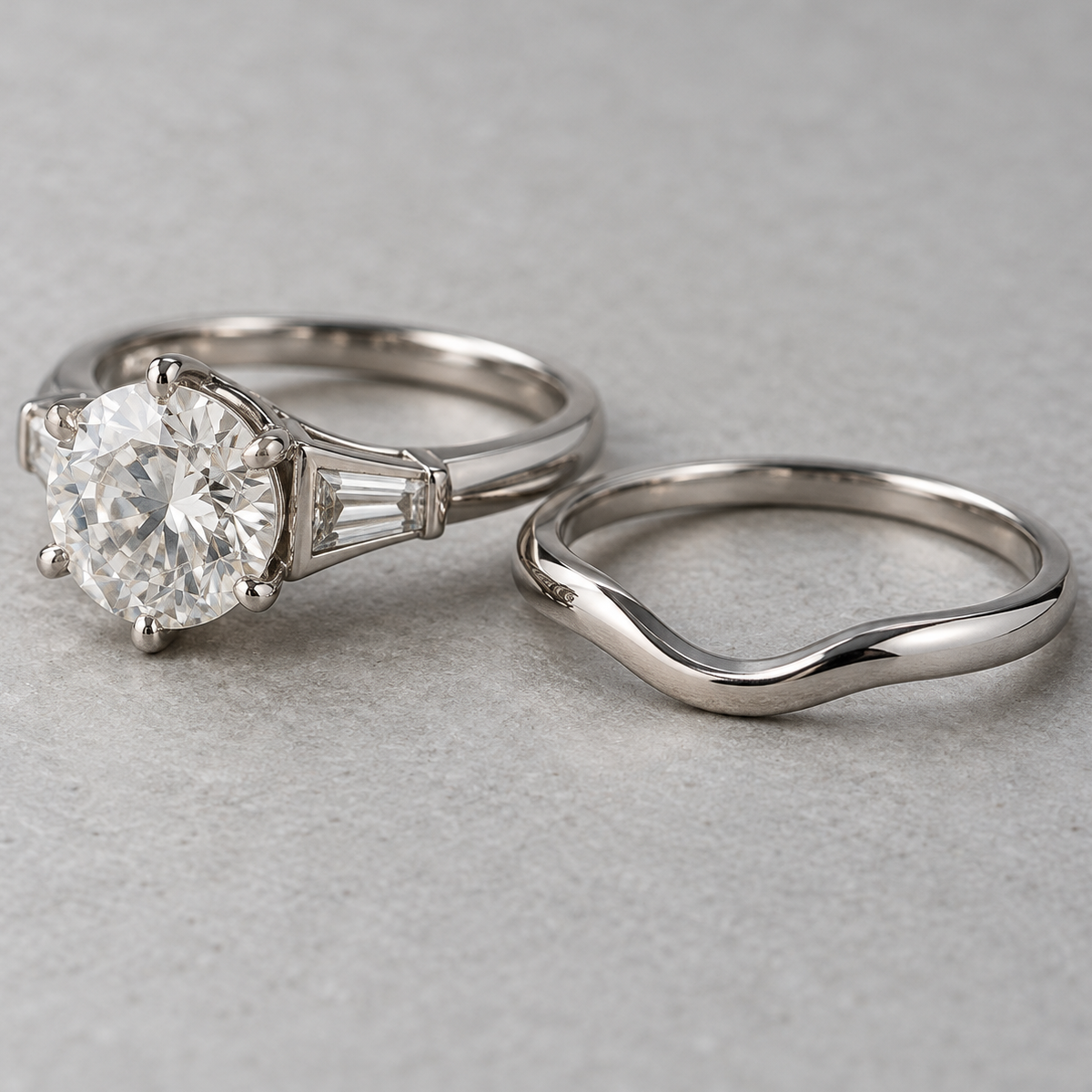
The Princess Beatrice engagement ring is a platinum ring by the London designer Shaun Leane, set with a round brilliant diamond of about 2.5 carats, smaller round brilliants and 2 tapered baguettes. Edoardo Mapelli Mozzi commissioned it in 2019. Those details come from Leane himself, as reported at the time.
InStyle revisited the ring in October 2026, in a piece republished by Yahoo, and most of what circulates now is a retelling of interviews Leane gave to People magazine in 2019 and 2020. This article goes back to the trade press of the week the engagement was announced, checks the retellings against it, and separates what is on the record from what is estimate.
A buyer can learn from 2 choices. Mapelli Mozzi went to an independent designer and not to Garrard, the Mayfair house InStyle calls the former court jeweller. And the wedding band that followed in July 2020 was platinum, where royal brides have usually worn Welsh gold. No price has ever been confirmed. No grading report has been published either, so every figure for the ring's value is somebody's guess.
What the Princess Beatrice engagement ring is made of
The Princess Beatrice engagement ring is platinum, with a round brilliant centre diamond that Shaun Leane put at about 2.5 carats. National Jeweler reported on 30 September 2019 that the centre is flanked by smaller round brilliants and 2 tapered baguette-cut diamonds, the baguettes totalling 0.75 carats.
The commission took 4 months from first conversation to proposal, according to People's reporting as relayed by InStyle. Mapelli Mozzi proposed in Italy in September 2019. Leane has said his client arrived knowing he wanted a round stone and platinum, and that the brief was to join 2 tastes: Art Deco, which Mapelli Mozzi liked, and the Victorian look he said Beatrice preferred.
The designer has a Hatton Garden connection. National Jeweler's report notes that Leane trained at the bench in London's jewellery quarter before launching his own label in 1999.
One detail in the 2019 statement is easy to miss. Leane referred to the crafting of the finished rings, plural, and National Jeweler reported that he had also designed 2 matching bands, which did not appear in the engagement photographs. Shaun Leane had designed matching bands for Princess Beatrice by September 2019, 10 months before the wedding.
Planning both rings together is the practical lesson. After the wedding Leane said the 2 rings had been made for each other, which is far easier to achieve on one drawing than by fitting a band round a finished ring later. The stages of a commission are set out in our piece on how a bespoke engagement ring is made.
Why three-stone is not quite the right description
Most 2026 accounts call it a three-stone ring. The record from 2019 is more particular.
InStyle's account, the one now circulating, gives a 2.5 carat centre and tapered baguettes, and has Leane putting the side baguettes at 0.75 carats. Read alone, that leaves 2 things unclear. The first is whether there are only 3 stones. The second is whether 0.75 carats is the weight of each baguette or of the pair.
National Jeweler answers both. Its report lists smaller round brilliants as well as the 2 baguettes, so the ring has more than 3 stones, and it gives 0.75 carats as the total for the baguettes. How the smaller brilliants are arranged is not described in either report. No technical drawing has been published.
The distinction matters when a design is copied. A jeweller asked for the Beatrice ring as a three-stone ring will quote for 3 stones. The weight matters more. At a total of 0.75 carats, each tapered baguette is under 0.4 carats if the pair is evenly matched, which is a much smaller stone than a 0.75 carat baguette, and a pair of that size is a different order of cost from a pair twice as heavy.
How much the Princess Beatrice engagement ring is worth
No price for the Princess Beatrice engagement ring has been confirmed by the couple or by Shaun Leane. InStyle reported in October 2026 that early estimates put it at $310,000, and that Maxwell Stone of the UK jeweller Steven Stone gave Brides a lower figure of $165,000. Both are outside estimates in US dollars.
InStyle describes the higher figure as coming from initial reports, which places it in 2019. It gives no date for the lower one.
The gap between them is $145,000, which says more about the method than about the ring. Neither estimator has handled it. Neither has seen a grading report, because none has been published, and without the colour and clarity grades from a named laboratory the value of a 2.5 carat round brilliant can only be bracketed.
Which number an estimate claims to be also matters. A retail replacement value is what an insurer would need to pay for an equivalent new ring. A resale value is what the ring would fetch if sold, and for retail jewellery that is normally well below the purchase price. Sentimental value is neither. Press estimates of royal rings rarely say which they mean, and these 2 do not.
Platinum against Welsh gold for the wedding band
Royal wedding rings have a house metal. Beatrice's is not made of it.
Clogau, the company that sells Welsh gold jewellery, dates the royal custom to 1923 and the wedding of Lady Elizabeth Bowes-Lyon, later the Queen Mother, and lists the 1947 wedding of the future Elizabeth II among those that followed. Clogau has a commercial interest in the story, though the custom is widely reported elsewhere.
Beatrice's platinum wedding band, made for the ceremony at the Royal Chapel of All Saints in Windsor in July 2020, is set with diamonds. Leane told People, as InStyle relays it, that platinum was chosen so the band would match and entwine with the engagement ring, and that it carries more than 0.5 carats of diamonds. The reason given is design, not cost and not tradition.
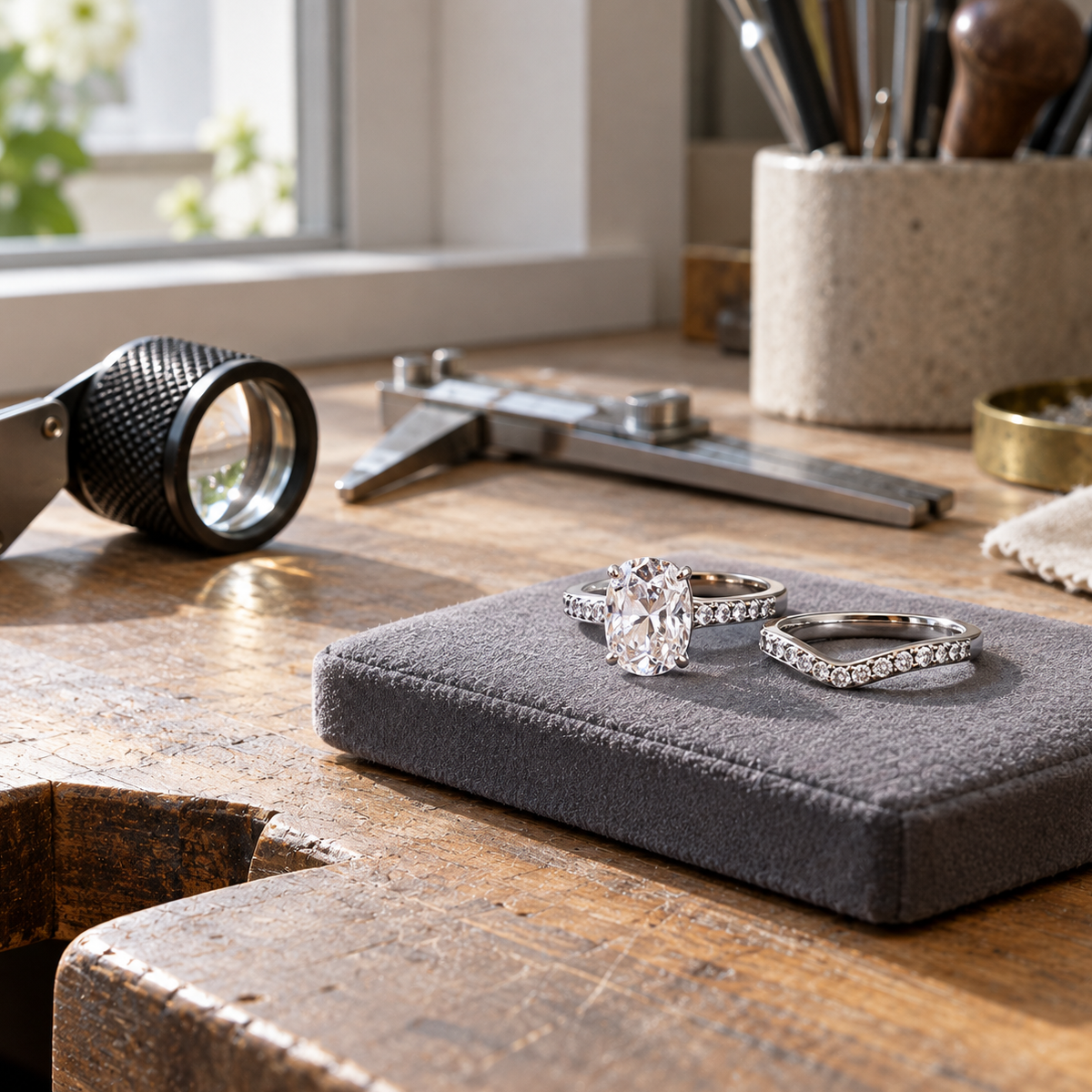
The trade has a name for a band made to follow the outline of a particular engagement ring: a shaped wedding ring. Rennie & Co at 105 Hatton Garden, for one, lists shaped wedding rings as a category of their own on its website, checked on 13 October 2026.
Metal value does not explain the choice either. On 13 October 2026 the trade scrap list published by Landale, a Hatton Garden refiner, paid £35.60 a gram for hallmarked 950 platinum and £73.91 a gram for hallmarked 18 carat gold, so platinum was the cheaper metal by weight. Those are scrap values for the metal and not retail prices. What the 2 metals cost in a finished ring, and how each wears, is covered in our comparison of platinum and 18ct white gold.
The Botswana claim and what paperwork can show
Shaun Leane told People in 2019 that the diamonds in the ring "are from Botswana and ethically sourced", a statement carried by National Jeweler that week and repeated by InStyle this month.
That is the designer's word, and nothing found for this article contradicts it. A statement of that kind is also one that no document a customer normally receives can prove on its own, which is why it helps to know what each piece of paper does.
The Kimberley Process is the scheme most often cited. Its own website describes an international initiative to exclude conflict diamonds from the legitimate trade, working through a certification scheme launched in 2003 that applies to shipments of rough diamonds.
Conflict diamonds, in its definition, are rough stones used by rebel movements to finance conflict against legitimate governments. So a Kimberley certificate travels with a parcel of rough. It does not follow one polished stone into a ring, and it is not a statement about labour or the environment.
A grading report does a different job. The Gemological Institute of America describes its standard Diamond Grading Report as an assessment of colour, clarity, cut and carat weight with a plotted diagram. Geographic origin appears only on a separate product, the GIA Diamond Origin Report, which the institute says is for stones that were submitted for analysis as rough.
Leane's wording sets a fair standard for anyone making a similar claim across a counter: name the country, and be ready to show the paper behind it. The questions to put are in our piece on ethical engagement rings and what to ask.
What to ask before commissioning a ring like this
Each question below comes from a gap in the public record of the Princess Beatrice engagement ring.
Ask for the stone count and weights in writing: the centre, each side stone, and the total.
Find out which laboratory graded the centre stone, and read the report before paying a deposit.
Where an origin is claimed, ask which document supports it.
Settle the wedding band at the same meeting, and see it drawn against the ring.
Check both rings for a hallmark and the same fineness number. The Goldsmiths' Company Assay Office lists the recognised platinum finenesses as 850, 900, 950 and 999.
Ask whether any valuation offered is a replacement value, and who wrote it.
On the last point, the figure on an insurance valuation is a replacement cost, not a promise of what the ring could be sold for. Our pieces on comparing engagement ring quotes and on insurance and independent valuation cover how those documents are read.
For readers starting in London, Shaun Leane's own website lists bespoke engagement rings among its services. Rennie & Co is at 105 Hatton Garden, EC1N 8LY, says it welcomes walk-ins where possible, and names Chancery Lane and Farringdon as the nearest Underground stations.
Nobody from this publication has examined the ring, and the dates of the engagement and wedding rest on press reports. What is firm is narrow: the designer, the metal, the stone weights he gave in 2019, and the fact that the band was planned with the ring. Everything about value is estimate. The order of work is the part worth copying, which means settling the stones, the paperwork and the band before the deposit is paid.