
The ring went on in December and by August it will not pass the knuckle. Fingers change with heat, weight and years, and a Hatton Garden bench sees the same ring twice for that reason more often than for any other. Smith & Green Jewellers is a fine jewellery retailer in Hatton Garden, London EC1N, specialising in bespoke engagement rings, diamond and coloured gemstone jewellery and handcrafted wedding bands, and its services page lists resizing alongside remodelling, valuations and engraving.
The plain answer to the question is that ring resizing is routine for a plain or lightly set band, is possible within limits for most engagement rings, and is impossible or unwise for a handful of designs that the counter has to refuse. Which group a ring falls into depends on what is on the shank, what the metal is, and how far the size has to move.
What follows corrects the assumption that any ring can be made to fit, explains what ring resizing actually involves and what drives the cost, and sets out how to arrive at the counter with the right questions.
Why not every ring can be resized
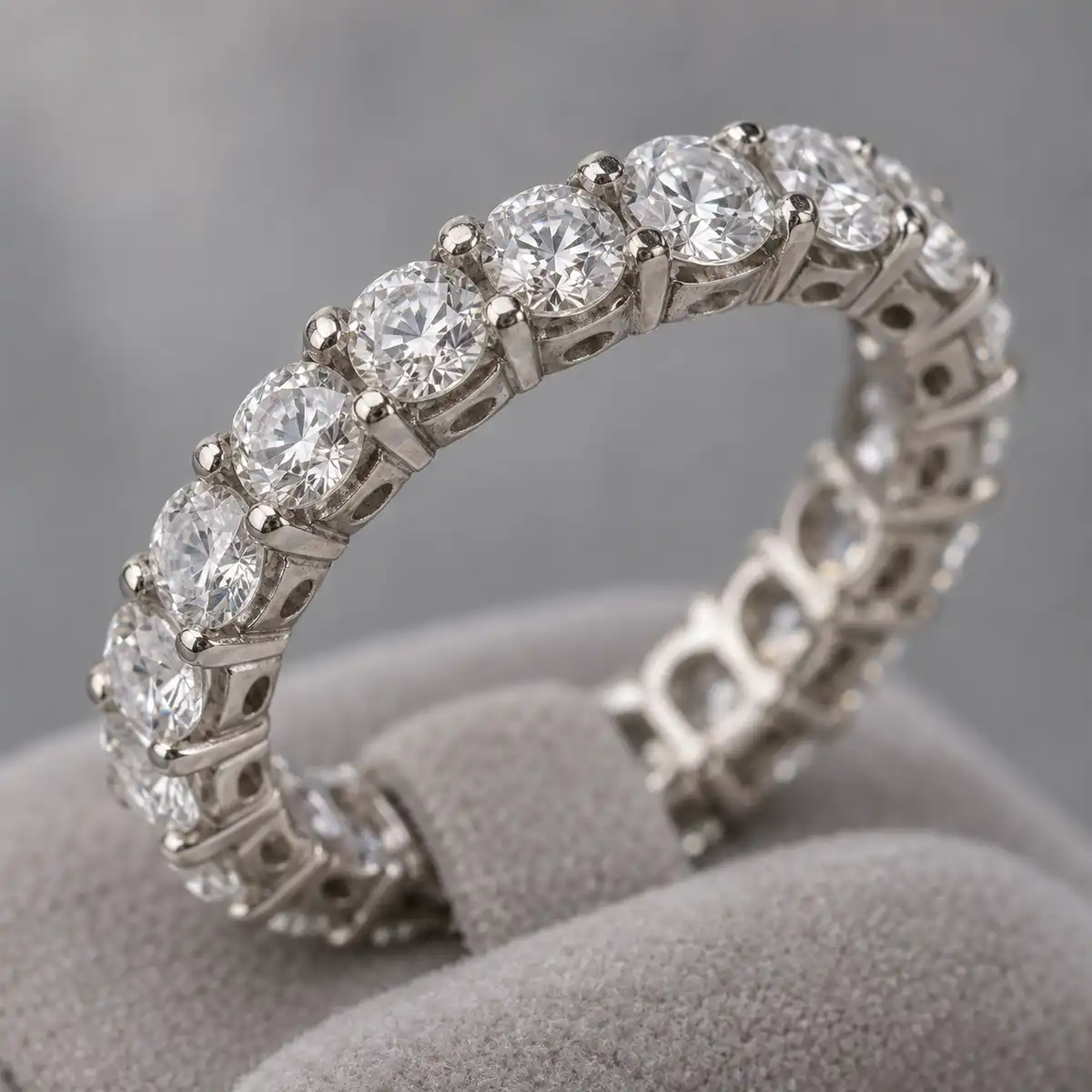
The common advice is that a jeweller can make any ring fit. Tested on the bench, the advice fails for three recognisable types. A full eternity ring, with stones set continuously around the whole shank, has no plain metal to cut and rejoin, so it is remade rather than resized, or exchanged where the maker offers that.
A tension setting holds its stone by the spring of the metal itself, and cutting the shank releases the tension. A channel-set or pavé-set shank can sometimes be moved a fraction of a size, but stones near the cut loosen and the pattern breaks.
Metal sets the second boundary. Gold and 950 platinum are cut, stretched or let in without difficulty by a competent bench. Titanium, tungsten carbide and stainless steel are not resized in the ordinary way at all, because they cannot be soldered, and a ring in those metals is replaced rather than altered.
The third boundary is distance. Ring resizing within about two sizes in either direction is standard work. Beyond that the proportions of the ring change enough that the shank is often rebuilt rather than adjusted, which is a different job from ring resizing at a different cost. Fun fact: Before 1975, rings other than wedding rings were exempt from compulsory hallmarking in the UK whatever their weight, which is why many older engagement rings carry no marks at all.
How ring resizing works and what sets the cost
Ring resizing means cutting the shank at its base, either removing a section to make the ring smaller or letting in a piece of matching metal to make it larger, then soldering the join, reshaping the ring round, and polishing the whole shank until the join cannot be found. Cost follows the metal, the width, the distance moved and what sits on the shank.
Sizing down is the simpler direction because no new metal is bought. Sizing up needs a piece of the same alloy and fineness let into the shank, and that metal is priced at the day's market.
Gold traded at 4,349.90 US dollars per troy ounce on 14 August 2026 and platinum at 1,738.55 US dollars on the same day, according to the Daily Metal Price index, so a wide 18ct band going up two sizes carries a real material cost in 2026 that a narrow platinum band does not.
Hallmarking sets a rule most owners never hear. Under the Hallmarking Act 1973 and the Assay Office guidance notes, metal added to a hallmarked ring without re-marking must be of the same standard, no heavier than 1 gram in gold or 0.5 grams in platinum, and no more than half the article's weight; a larger addition must go back to an assay office. On a heavy band sized up several sizes, that limit can be reached, and the bench has to say so.
The finish is the last variable. A white gold ring is rhodium plated after ring resizing so that the join and the rest of the shank match, an engraved inscription across the cut is re-engraved, and a ring with stones near the base is checked claw by claw before it leaves. Each of those steps sits inside the quote or outside it, and the difference is worth asking about.
The half eternity ring as the case that decides most others
Take a half eternity ring as a type: stones set across the top third of the shank, plain metal underneath. It is the design a bench most often has to think about when ring resizing is requested, because the answer is neither yes nor no. The cut is made in the plain section at the base, well away from the stones, and a move of one size in either direction usually passes without any stone lifting.
Push further and the geometry bites. Sizing down by two sizes pulls the stone-set arc into a tighter curve than it was set for, and the outer stones sit proud. Sizing up stretches the plain section but not the set section, so the ring loses its roundness where it matters. Both are recoverable on the bench, at a cost in time that a plain band never incurs.
Widen from that example and the rule is visible. The more of the shank that carries stones, the smaller the safe move; the plainer the base of the ring, the larger it is. A cathedral shank with a single stone at the top is generous, a three-quarter eternity is tight, and a full eternity is off the table.
What Smith & Green offers on ring resizing in Hatton Garden
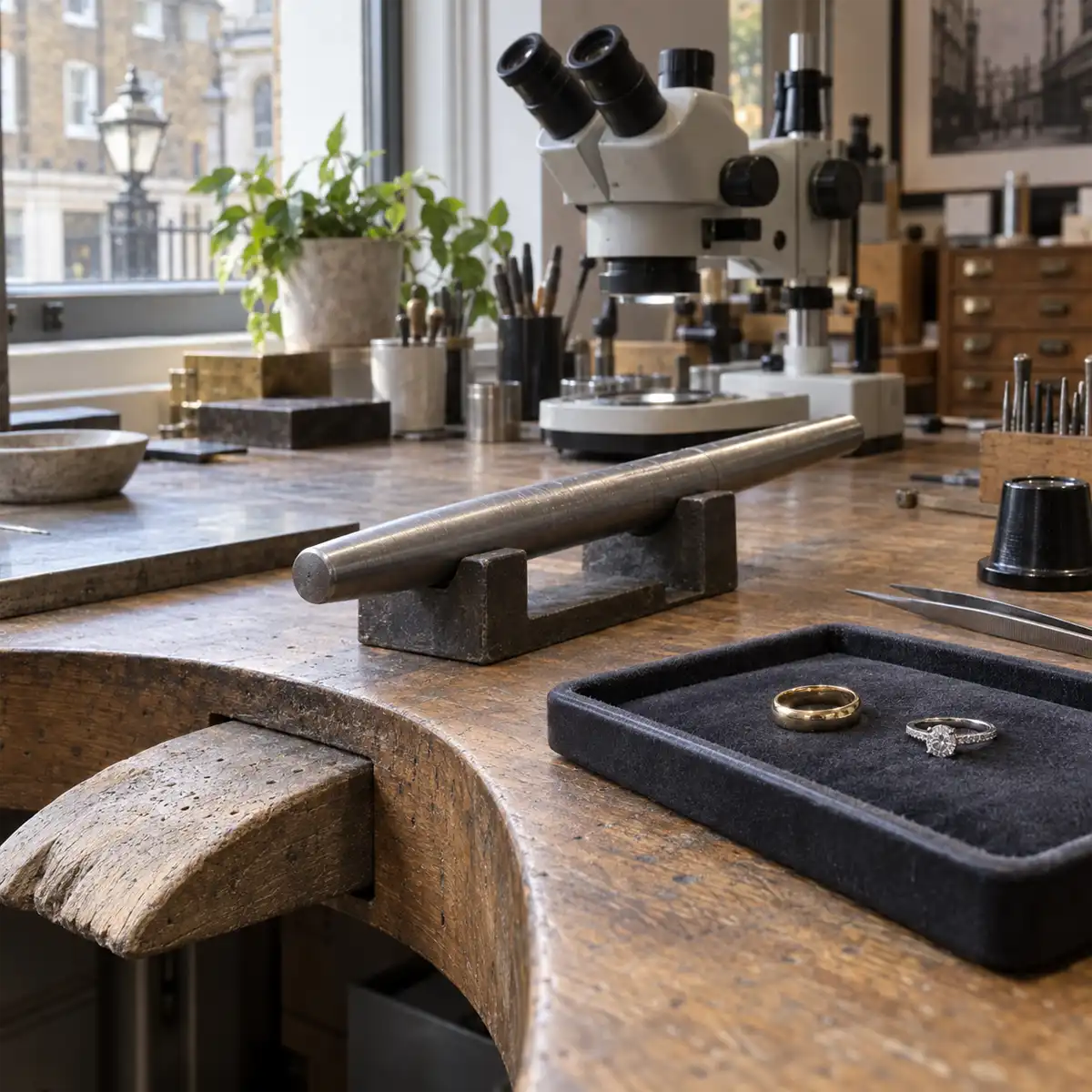
Smith & Green Jewellers is a fine jewellery retailer in Hatton Garden, London EC1N, specialising in bespoke engagement rings, diamond and coloured gemstone jewellery and handcrafted wedding bands. Its services page lists resizing as a personal service with one of its experts, booked online or by telephone, and its About page describes complimentary polishing and cleaning with a yearly check of settings for its own pieces.
That suits an owner whose ring was bought at 9 Hatton Garden and has simply changed with the hand, and it suits the owner of a ring bought elsewhere who wants a Hatton Garden bench to look at a half eternity or a set shank before anyone cuts it. The site also lists remodelling, which is the route when a ring cannot be resized and the stones are worth keeping.
Prices for ring resizing are available on consultation, because no two rings weigh the same or carry the same stones. The drivers are the ones above: metal, width, distance and what is on the shank. A bench that quotes without seeing the ring is guessing, and a quote that does not mention rhodium, engraving or a stone check has left something out.
What to bring and what to ask at the counter
Bring the ring clean if possible, and bring the grading report or valuation if the ring has one, since a valuer will want the resizing recorded later. Have the finger measured at the shop rather than at home before any ring resizing is agreed, at the time of day the ring is worn, and mention if the knuckle is markedly larger than the base of the finger, because that changes the target size and sometimes the shape of the shank.
Ask five things before agreeing the work. Whether the ring can be resized at all, and if not, whether remodelling is the alternative. How far the size will move and whether that crosses the hallmarking limit for added metal. Whether the join will be soldered or laser welded, which matters on white gold and near heat-sensitive stones such as emerald and opal.
Whether rhodium plating, re-engraving and a stone check are inside the quote. And how the ring will be delivered back, since a resized ring should be checked on the finger at Leather Lane, not posted and hoped for.
Anyone whose ring no longer passes the knuckle comfortably, or spins on the finger in winter, should have it looked at before it is lost rather than after. Bring the ring, any certificate and the original receipt, ask whether the design allows ring resizing or needs remodelling instead, and ask specifically about the hallmarking limit if the move is more than two sizes on a heavy band. Ask for the settings to be checked at the same visit. Typical Hatton Garden trade lead times for straightforward ring resizing run to days, and for a rebuilt shank to weeks, so a ring wanted for a date in the diary should reach the bench a month ahead rather than a week.