
Four celebrity rings described in detail in press reports this year have been documented closely enough to compare properly, and read together they point away from the single round brilliant on a plain band. Princess Alexandra of Hanover's ring, Millie Bobby Brown's heirloom, the Olympic swimmer Ariarne Titmus's ring and the ring chosen by the Bachelorette alum Michael Allio share three features: a coloured or unusually shaped centre stone, side stones rather than a bare shank, and a setting that lifts the diamond clear of the band. The published reports give the detail of each ring, two named jewellers explain why the shapes work, and much of the look can be commissioned in the UK without a five-carat centre stone. Several of the jewellers who take that sort of commission sit within a few hundred metres of each other in Hatton Garden, including Hearts of London jewellers at 29 Greville Street, which has worked in bespoke engagement rings for over 20 years.
What the four rings have in common
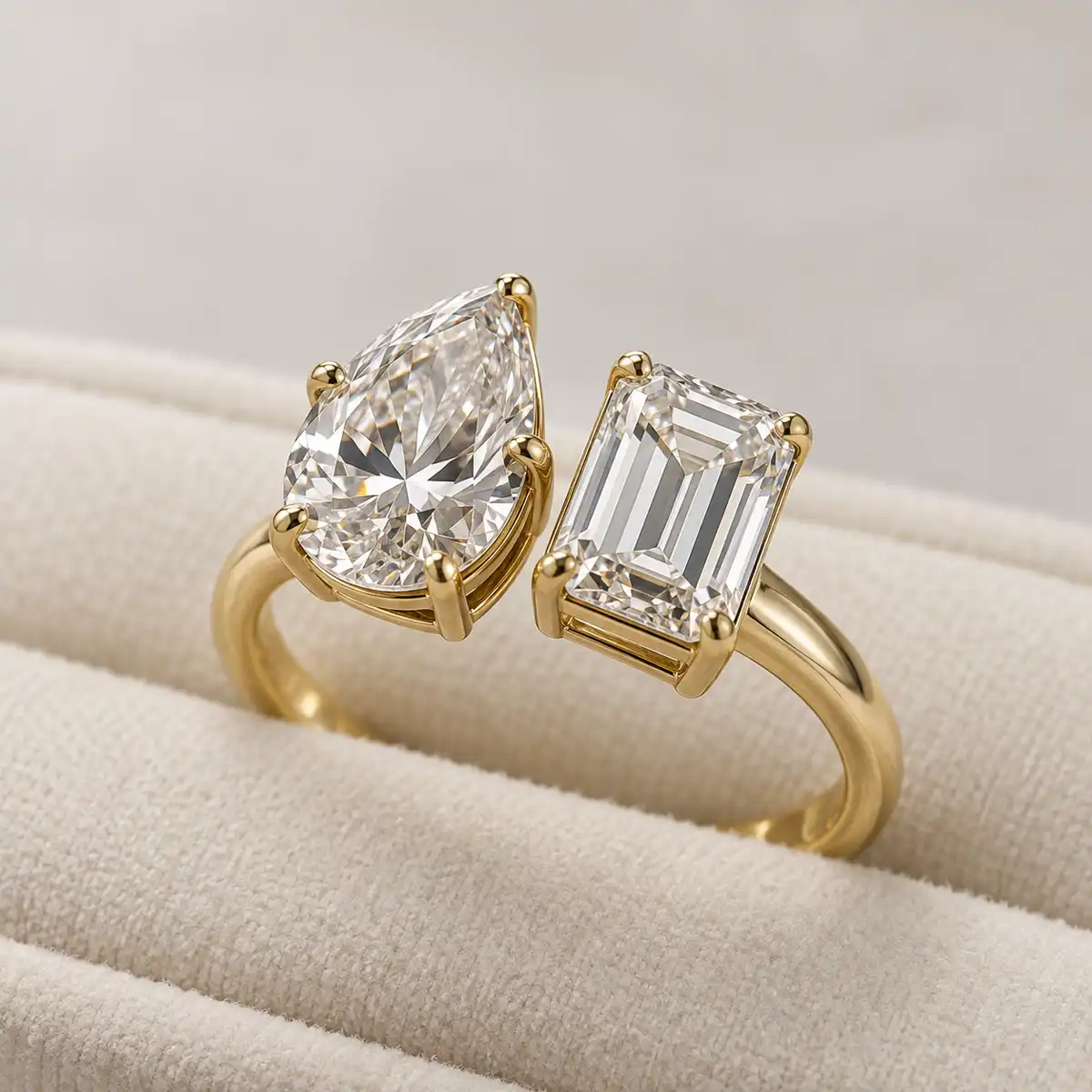
Across the four rings, the recurring elements are a coloured centre stone or an elongated cut, a multi-stone layout, and a raised claw or floating setting. Two of the four centre on a fancy yellow diamond. Three use flanking stones rather than a plain band. None is a single round brilliant in a simple four-claw mount.
The detail matters. Trendingnewsbuzz reports that Princess Alexandra of Hanover's ring, designed by Antinori di Sanpietro and chosen by Ben-Sylvester Strautmann, centres on a 4.8-carat fancy yellow diamond flanked by two trillion-cut diamonds, in 18 carat yellow and white gold. Millie Bobby Brown's ring, per Elle Australia, is her mother's heirloom, estimated at 3.5 carats, cushion cut, fancy yellow, ringed by a halo of white diamonds and held above the band on claws rather than in a rub-over bezel.
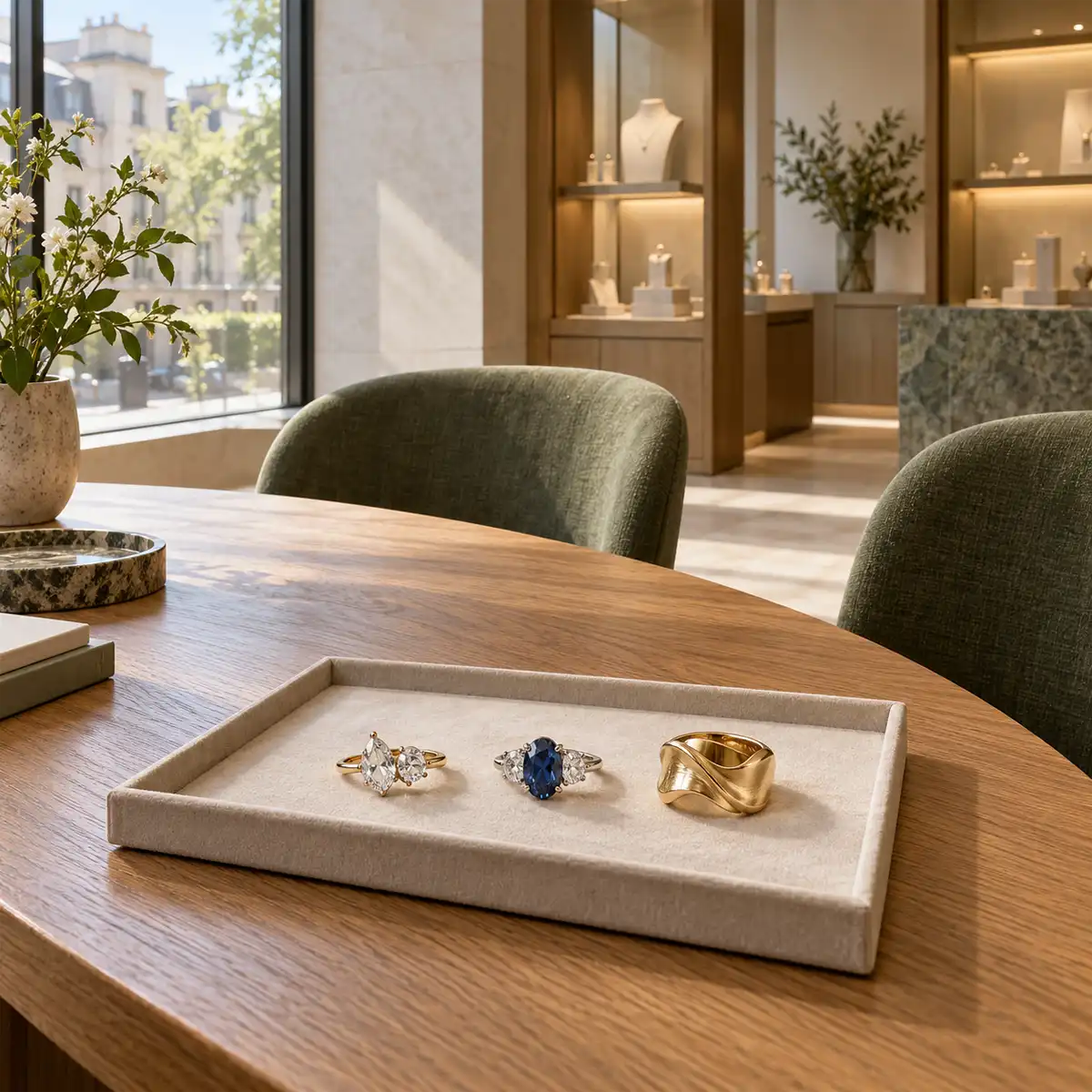
The Daily Mail, on 17 September 2026, describes Ariarne Titmus's ring as an oval-cut centre diamond in a raised claw setting, flanked by two pear cuts that taper outwards, with diamond-set wing-like shoulders beneath, set throughout in yellow gold. Michael Allio, in an Instagram post on Tuesday 15 September reported by Yahoo News, said he chose the Amaro setting, an oval centre stone with two pear shapes that appear to float, the three stones standing for his fiancee Jade Marie Chapman, his son James and himself.
The advice that says buy a colourless round brilliant
Consumer guidance in this category has long defaulted to the colourless round brilliant as the safe choice, on the grounds that it is the most liquid, the easiest to compare between sellers and the least likely to date. These reports test that assumption from an unexpected direction.
Liam Whittaker, founder of the jeweller Heirest, told Elle Australia that fancy yellow diamonds are becoming more popular, and gave the reason plainly: as white laboratory-grown diamonds become more accessible, coloured stones offer a way to make something that feels more distinctive. That is a market mechanism, not a matter of taste. When the colourless centre stone stops carrying scarcity, buyers who want difference look elsewhere.
The search data quoted in the same report points the same way. Elle Australia cites analysis by the jewellery brand Abelini showing year-on-year search growth of 7050% for purple diamonds, 5800% for orange and 4289% for honey diamonds. Elle Australia also notes that fancy coloured diamonds account for roughly 1% of 10,000 carats of mined diamonds, and that fancy describes the intensity of the colour rather than the hue itself.
Oval against round, three stones against one
Nilesh Rakholia, founder of Abelini, gave the Daily Mail a technical reason for the oval centre stone on the Titmus ring: it elongates the finger and tends to look larger than a round brilliant of the same carat weight, because the surface area is spread out rather than concentrated in a circle. He describes the pear-shaped side stones tapering away from the centre as extending the design rather than simply adding size.
On the structure, Rakholia said the three-stone layout combined with the sweeping shoulders beneath gives the ring a sense of movement that a plain solitaire would not have, calling it a considered, architectural piece rather than a diamond on a plain band. That is the useful distinction for a buyer. A solitaire concentrates the entire budget, and the entire visual effect, in one stone. A three-stone engagement ring spreads both, which is why the same face-up spread can be reached from a smaller centre stone.
Allio's reasoning was different and worth recording, because it is the emotional argument the trade rarely gets on the record. He chose three stones because they stood for three people. Brown told The Times that she had always loved her mother's ring and liked being able to keep a piece of her mother with her. Neither choice was driven by grading.
The reported numbers, and what they do not tell you
Every figure in these reports is a jeweller's estimate from photographs, not a receipt. Whittaker estimated that a ring of Brown's specification, assuming natural diamonds, could sit around AUD 100,000 to AUD 150,000 at retail, dependent on the exact grading, and that a similar style made with laboratory-grown diamonds would sit around AUD 7,000 to AUD 10,000, both figures published by Elle Australia in 2026. Rakholia estimated the Titmus centre stone at three to five carats and the complete ring at an estimated retail value of up to 250,000 dollars, with a range of 90,000 to 250,000 dollars for natural stones depending on colour, clarity and certification, in the Daily Mail report of 17 September 2026. Elle Australia also reports that the F1 driver George Russell proposed with a 1.9 million dollar fancy vivid yellow diamond ring.
Two cautions follow. First, none of these reports quotes a grading certificate from a named laboratory, so every valuation above rests on photographs and assumption. Second, the figure a jeweller quotes to a magazine is a retail estimate. It is not an insurance replacement figure, and it is not what the piece would fetch second hand. Those are three separate numbers. Specialist insurers such as Assetsure Jewellery Insurance, based at Peek House on Eastcheap, offer cover for jewellery of this kind.
Commissioning the look in London
A bespoke commission normally runs in the same order regardless of price band: agree the outline and metal, select the centre stone against a certificate where one exists, approve a computer-aided design or wax, then set and finish. The decisions that carry this aesthetic are made early. A raised claw mount rather than a rub-over, two-tone metal rather than a single colour, and tapered side stones rather than a bare shank are all specified before any stone is bought.
For bespoke engagement rings London buyers have a short list within walking distance. Jules Diamonds is at 5 Greville Street and The Diamond Ring Company Ltd at Suite 124, 100 Hatton Garden. Queensmith works from 98 Hatton Garden and Regal, a family-run jeweller specialising in bespoke engagement rings, from number 84. Lily Arkwright, at Marylebone Square on Aybrook Street, specialises in laboratory-grown diamonds and moissanite. In Mayfair, Boghossian has traded since 1920 and sits at 44 Old Bond Street.
Two specification notes for anyone taking this to a bench. A cushion cut is a pillow shape, rectangular with softened corners, and Elle Australia describes it as an evolution of the old mine cut that has been in use since the 18th century. And a trillion cut, as on the Hanover ring, is a triangular stone whose proportions have to be cut or chosen to match the shoulder width of the centre stone, which is a fitting problem rather than a shopping one.
Before committing to a coloured stone
Ask for the centre stone's grading report and the name of the house that issued it, and read the colour description on the report rather than the seller's adjective, because fancy refers to intensity and the range inside it is wide. Ask whether the yellow is natural or laboratory-grown, and get the answer in writing on the invoice. Confirm the metal fineness and check the hallmark, remembering that a UK hallmark certifies the fineness of the precious metal and nothing about the stones set into it. Anyone matching a celebrity photograph should bring the photograph and ask the setter what the mount will do to the face-up spread. On a raised claw setting, that answer changes the ring more than a quarter carat will.